

Spreading The Wealth ⏱️
Lap 284: Sponsored by CORE
Sponsored by CORE
Heat training has taken over endurance sports. Olympian Clayton Young has been doing it for years including before he became an NCAA champion at BYU.
Catch this sponsored bonus episode of the CITIUS MAG Podcast where he shares his experience with it all: why the gains (plasma, blood volume, VO2 max, recovery) show up in cool races too, how he stacks heat sessions without torching his key workouts, and how you can start.
The CORE 2 Body Temperature Sensor has been one of the tools he uses to track it all. The Lap Count readers get 10% off their own with code CITIUS10 when they visit https://corebodytemp.com/products/core2.
Compiled by David Melly, Paul Snyder, & Kyle Merber
Where Is America’s ‘Tweener Championship? 🌎
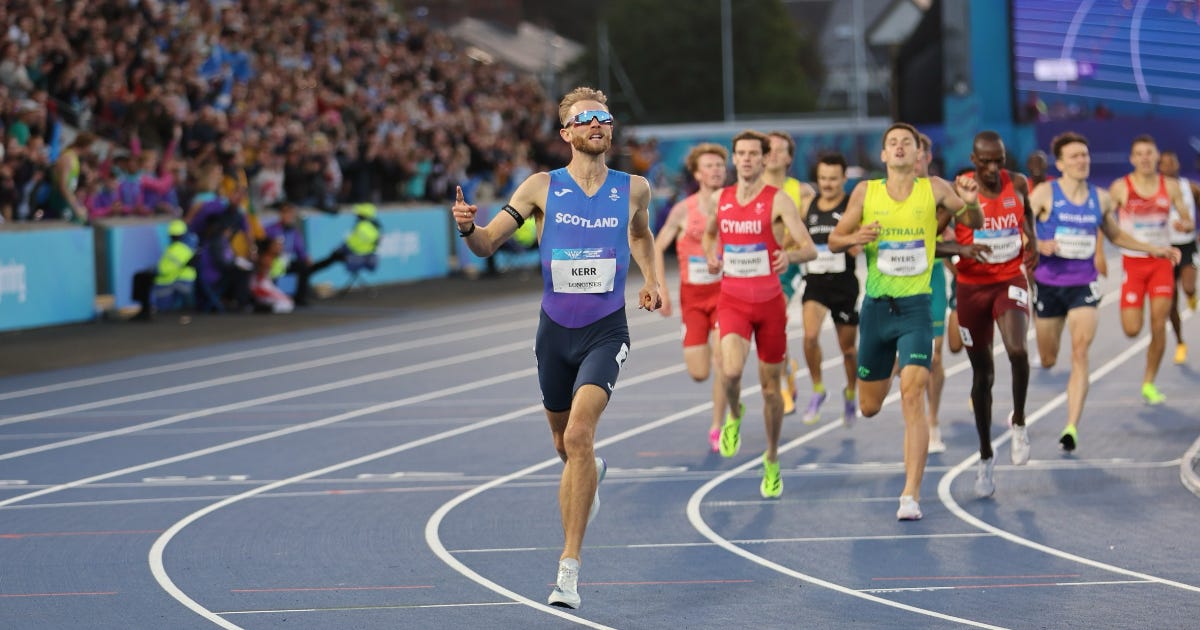
What exactly is the Commonwealth Games?
We know what they are on paper: a nearly 100-year-old quadrennial assembly of 74 national teams to compete for medals in ten sports, offset two years from the Olympics themselves. The championship originally known as the British Empire Games is, despite its weird and persistent shades of colonialism and monarchism, held in high esteem by England and the 73 other jurisdictions with King Charles on their money. Athletes from those countries prize Commonwealth medals just below World and Olympic ones, sometimes to the confusion of those of us watching quizzically from the outside.
Ethical and moral questions aside, the Commonwealth Games matter.
But like… why? Perhaps that’s the better question.
The history, particularly for Brits themselves, is part of it. But in large part, winning gold at Comms matters because the competition is really, really good. The fact that Jamaica and Kenya were once colonized by the English means that both the sprints and distance events require elite performances to land on the podium, particularly when compared with, say, the European Champs.
Here’s how the 66 individual track medals at the 2024 Olympics broke down: 20 Americans, 25 athletes from the Commonwealth of Nations, and 21 from other countries. The field events are a little more equitable (10 U.S., 19 Commonwealth, 25 other). So while no one participating nation is better at track and field than Team USA, collectively, the competition is stronger than at our national championship or any other regional championship.
What that means, essentially, is that for Josh Kerr to win the mile at the Commonwealth Games, he must face the strongest medal competition he’ll see outside of a World or Olympic final. Which, in a year like 2026, means the Commonwealth Games is probably the toughest championship race on his schedule (apologies to World Indoors but it’s true).
If you’re deciding to put all your 2026 eggs in a small number of baskets, it’s understandable that you’d bet on the staying power of Year 96 of Comms over Year 1 of the World Ultimate Championships. Which isn’t to say that many of the same athletes won’t double back and vie for gold at both. But when these folks are sitting comfortably in their living rooms 20 years from now, the stronger conversation piece might be the medal on their mantel also given out to Usain Bolt, Steve Cram, or Merlene Ottey. But the Commonwealth Games aren’t just a legacy endeavor.
This year’s results were, for a lack of a better word, cool. The men’s 100m saw the generally-unsung Emmanuel Eseme set a Games record of 9.83 for Cameroon, just ahead of Australia’s Lachie Kennedy, who became the fastest white boy in history, at 9.85. Ky Robinson pulled off a tactical master class with a front-running 27:48.93 gold in the 10,000m, as his fellow Aussies ran rampant over the women’s distance events, picking up all three golds and six of nine medals in the mile, 5000m, and 10,000m. Adaejah Hodge kept her summer going strong with a 22.07 win in the 200m, which of course sparked controversial comments from some sore losers.
The athletes from the British Isles—back under one national team umbrella after enjoying the rare chance to rep their various countries and dependencies—will get to run it all back next week at Europeans, and the youngsters head to Eugene this week for the World U20 Championships. But with no Diamond Leagues set for another three weeks and not much else on the calendar, any American pros riding the high of USAs are forced to scour the globe and send their agents on a scavenger hunt for quality meets in August. Most of them will retreat back into training mode, only for a select few to emerge from mid-summer hibernation if they get one of 16 entries on offer for Ultimates.
That’s not the most exciting prospect for American track fans. And it’s got us asking: where’s our Commonwealths? The U.S. and our North American neighbors have NACACs, a strange semi-regular regional championship that started in 2007 and has been held five times total, but the collective sentiment is that the host locations (generally altitudinally or climactically unfavorable to fast times) and competition (basically the same as USAs, at best) renders it largely superfluous to the greater track and field picture. As a matter of practice, the squads Team USA sends to NACACs tend to be comprised of folks who didn’t finish top three at that year’s national championship.
The Europeans have Europeans; the Africans have the African Championships and the African Games. The problem for American track and field fans, particularly in a year like this one, is that we don’t have a suitable “‘tweener championship” to attract stars and fill the gaps on a scale somewhere between national and global. Maybe one day we’ll have a Revolutionary War Dual Meet, where we team back up with France to take on the Commonwealth nations in what would be a pretty fair fight, but that doesn’t seem likely any time soon.
Without the benefit of a century of prestige and national fan bases that, y’know, care about track, we’re forced to watch Commonwealths jealousy from our La-Z-Boys while drinking Bud Light and munching on bright orange chips filled with chemicals that would kill a Victorian child. And next week we’ll be frantically googling “Birmingham time zone to EST” and “Femke Bol which event?” when the UK hosts their next big ‘tweener championship, Europeans. It’s so hard to make events matter in the current athletic ecosystem, which makes those meets with genuine, built-in cultural significance all the more precious.
So don’t take it for granted, chaps.
Where Did All The 400m/800m Guys Go? 🤠
Of the five women who have run under 1:56 in the 800m this season, you’d probably only consider one to be a true 800m/1500m-type: that’d be Georgia Hunter Bell, who is an Olympic bronze medalist and the British record holder over 1500m.
Audrey Werro’s gone 50.80 and is the European record holder in the 600m. Keely Hodgkinson split ~50.1 on her 4x400m leg at World Indoors this March. Femke Broeders-Bol… well, you know what she’s capable of over a single lap, hurdling or not. Anaïs Bourgoin hasn’t clocked a 1500m result in the World Athletics database since 2022, but raced distances as short as 200m during the early stages of her 2026 indoor campaign. If she more naturally fits the mold of an 800m/1500m runner, she’s actively working against it, it would seem.
Aside from Broeders-Bol—the indoor world record holder over 400m—none of these athletes are globally relevant at 400m. Capable of delivering a more than respectable leg on a high-stakes relay? Sure. But a medal threat? Not quite.
Still, if you want to divide the event into 800m runners whose prowess in the distance is the result of their natural speed and their innate strength, these are your speedsters: the sort for whom an opening lap of 56 seconds isn’t particularly daunting. They obviously work on their strength in order to withstand the cruelty of the second lap, but most 400m/800m-types are going to be looking to minimize attrition rather than keeping an ace up their sleeve for the homestretch.
Very generally speaking, the current state of the women’s 800m is defined by speed-based stars. For the men, however, that’s increasingly not the case. Let’s take a look at the five fastest men over 800m in 2026.
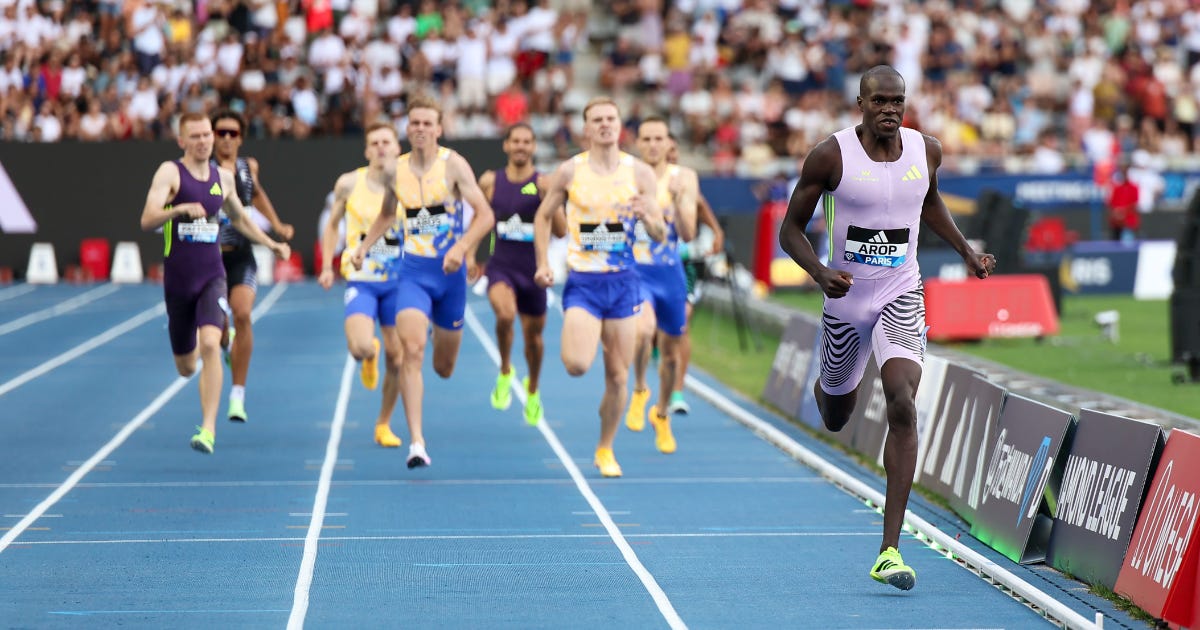
Marco Arop has spent the past few years mixing it up in the 1500m, and has the North American record in the 1000m. Cooper Lutkenhaus—a bit of an outlier in many ways—raced 12 800ms this year, a 600m, one 1500m, and no 400ms. Emmanuel Wanyonyi set the 1000m world record, and though he still possesses a modest 1500m PB, a case could be made that he is actually more of a miler with great 800m speed. Brandon Miller’s first two races of the year were a mile and a 1500m. And if we go back to Josh Hoey’s 2025—his last complete season of racing—yes, he ran the North American indoor 600m record, but he ran way more 1500m/mile races than under-distance ones, and even broke 3:30 in Ostrava.
But it’s more complicated than these guys all being naturally aerobically-inclined.
While competing at Mississippi State, and even for a stretch after going pro, Arop regularly raced the 400m and lined up for 4x400m relay duty. Per World Athletics, he last clocked a 400m in 2022, going 46.10. Coincidentally—or not!—that season he also began to dabble in the 1500m. Just last year as a sophomore, Lutkenhaus placed second in the largest division of the Texas state high school track championships in the 400m, going 46.30. That was one of seven 400m races he recorded during his final year of high school competition. And while at Texas A&M, Miller routinely raced the 400m and slotted into the school’s 4x400m relay squads. His PB is 46.30 as well, which he ran in 2022.
At least in the case of these three fellas, they weren’t born as 800m/1500m guys—they made a conscious decision to become them. But why the disparity at the top of the men’s and women’s 800ms when it comes to choosing a path?
The answer might come from the competition itself, especially those who dominated the event in the recent seasons before this one.
Despite efforts to turn her into a miler, it’s hard to deny that Athing Mu-Nikolayev was—at the height of her powers between 2021 and 2023—a prototypical 400m/800m runner. (She still holds the North American U20 record in the 400m along with the U.S. record in the 800m, after all.) Her customary sparring partner during her most competitive stretch was Hodgkinson, who comes by her 400m/800m bonafides honestly, having last raced a 1500m in 2017. And the only other woman to beat Mu-Nikolayev at a global championship in that time frame, Mary Moraa, is absolutely a 400m/800m runner. With personnel like that at the top of the heap so recently, it could be a tactical move to push your chips toward developing speed just to not wind up 15m behind the leaders at the bell.
That theory holds a bit more water when you consider that 2023—the tip of the iceberg for guys running wicked fast again after a less fallow period for the event—was also the start of the Wanyonyi Era. Is it fair to assign that much weight to the emergence of one man, who happens to have beat the best milers in the world at their own game?
Perhaps! He’s the reigning Olympic and World champ! His lowest finish at a global championship since he burst onto the scene was fourth! Guys know that in order to get on the podium, he’s a major obstacle, and because of his strength, he can race the 800m just about any way he wants to. That’s probably enough for speed-based 800m guys to at least entertain upping the ol’ mileage and for Coach to toss them in a B-heat of an invitational 1500m, early enough in the season to chalk up a lousy result to rust.
Then there’s the fact that for 800m specialists, there really isn’t a group dedicated to training 400m/800m guys. If you want the logistical and financial support of a group, you’re gonna likely have to suck it up and dip your toes into the threshold waters with some world class 1500m guys.
This isn’t to say the 400m/800m male archetype no longer exists; it’s just that he’s been squished through a 1500m-shaped mold over years of strength-building sessions, like a glob of fast-twitchy Play-Doh. One day you’re pulling double duty on the 4x400m at your college conference meet… the next you’re getting your lactate levels read mid-workout, because you know as well as any other world class 800m guy that you need something left in the tank on the homestretch to do anything of note in a race of consequence.
Of course, our current state of strength-focused 800m men won’t last forever. Families Training systems are always rising and falling in America this sport. And “all” it’ll take is a world beater with sub-45-second 400m chops to burst onto the scene for the rest of the top dogs and coaches to reassess their approach.
Plus, there’s the lingering fact that the current world record holders in the 800m—David Rudisha at 1:40.91 and Jarmila Kratochvílová at 1:53.28—were both indisputably 400m/800m runners. Rudisha clocked a hand-time, at-altitude 45.2 400m a year after setting the world record in the 800m, and ran an asterisk-free 45.50 400m in 2010. Kratochvílová’s 400m PB (47.99) is the fourth fastest time ever, and actually has a higher WA score than her 800m WR. No amount of bicarb or 1500m versatility can change the fact that being the best 800m runner in the world requires you to be really, really fast.
In this regard, and this regard only, Broeders-Bol is perhaps best positioned to break an 800m world record in the next 12 months, assuming her experimentation in the distance continues to progress, even at a more modest pace than it has thus far. A relatively blank and prodigious slate like Lutkenhaus could very conceivably lower his 400m speed into 45-mid territory, and likely improve his prospects of running in the 1:40s before his 20th birthday.
It’s conventional wisdom that strength is easier to develop than speed. So if you were picking an athlete who you’d rather coach with the goal of winning an Olympic gold medal in the 800m or even breaking the world record, surely you’d prefer the guy who ran 22.12 for 200m as a 15-year-old who was decidedly not training like a short sprinter… or the woman who has proven herself to be one of the best and also most versatile 400m hurdlers ever.
The 400m/800m archetype isn’t necessarily in vogue right now for men, but if somebody is gonna supplant Rudisha from G.O.A.T. status, they’ll likely have to stay at least a little acquainted with the 400m.
Where’s All The Sponsor Money Going?
The Los Angeles Dodgers have broken baseball.
The reigning American League Cy Young winner, Tarik Skubal, was traded from the Tigers to the back-to-back World Series champions. For the non-baseball fan readers, basically: the most dominant team is becoming more dominant. But the larger implication of this acquisition is that it may have just canceled the 2027 season.
The MLB players union’s collective bargaining agreement is set to expire in December, and the main topic of debate will be a potential team salary cap—something the NFL, NHL, and NBA all already have. The team owners, players, and league management will all be fighting over whether teams should have upper and lower limits to how much they can spend, with no clear resolution in sight. Currently, the Dodgers are happy to pay $180M+ in luxury tax penalties in exchange for a basically unlimited budget, while the Cleveland Guardians keep trying to Moneyball their way to a .500 record. Players deserve their value in a free market, fans deserve a front office that tries to win, but it’s bad for the game if three teams are pricing the other 27 out of a legit shot at a title.
So we’ll probably have no baseball for a bit.
This would never happen in track and field because there is no Player’s Association. Every athlete is piecing together their salary from different money sources, whether it’s shoe contracts, sponsors, meets, federations, or benefactors. There is no single source of income, so there is no single entity to boycott. And without a consistent definition as to who would even qualify as a professional, unionization remains a nice idea in theory, but mostly impractical.
That doesn’t mean action is impossible or meaningless. There is a whole generation of USATF athletes who only remember Nick Symmonds as a whacky YouTuber and not a modern day Prefontaine who sacrificed a World Championship roster spot to fight for better revenue sharing. Many hundreds of athletes have been paid out multiple thousands of dollars because Symmonds caused a fuss. If you are an aging veteran star, try thinking like a Boy Scout before your Achilles pops: how might you leave the sport better than you found it?
The quiet truth is that there’s never been a better time to be a professional track athlete than right now. Contracts are up! Appearance fees are up! Prize money is up! And NIL contracts are circumnavigating child labor laws.
With LA2028 on the horizon, shoe companies are getting aggressive and setting themselves up for maximum exposure. All the while, NIL contracts are giving the kids options because staying in school pays, but those contracts also typically have rights of first refusal baked into them, so once a student-athlete turns pro, their NIL sponsor gets first dibs. Once a brand has invested a few years into a career, they’d usually like to maximize returns beyond the NCAA restrictions. In baseball, the top free agents are choosing between the Dodgers and losing—an easy decision. In track, athletes are choosing between more studying, signing with their NIL sponsor, or waiting out the tail period.
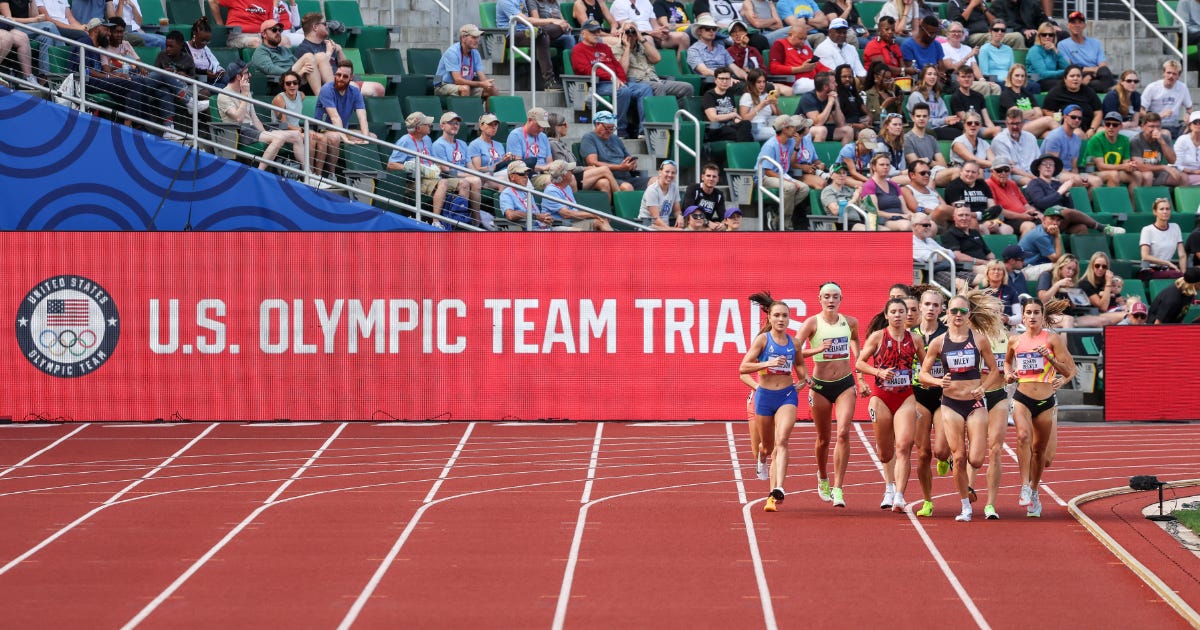
Let’s take a look at the podiums from the U.S. Olympic Trials in 2004 vs. 2024 to see how representation has changed.
2004: Nike (51%), Adidas (15%), Asics (3%), Mizuno (2%), New Balance (2%), NCAA/Unattached/Other (27%)
2024: Nike (33%), Adidas (15%), New Balance (8%), Puma (5%), Brooks (4%), Asics (3%), On (2%), Under Armour (2%), lululemon (2%), NCAA/Unattached/Other (26%)
Economics 101 would suggest competition is good. That 18% dip of market share from Nike opened the doors to other brands to see their way onto the podium, and that’s not including others who still have a presence, like Hoka, Tracksmith, Bandit, Saucony, and other new challengers.
But why the increase in brand diversity?
It’s because athlete sponsorship works, and more brands are recognizing its impact. As a result, we as fans get a better, more interesting product on the track (and it’s easier to tell different uniforms apart). Those lucrative bidding wars are good for the stars, but the trickle-down is creating opportunities for more athletes to chase their dreams and therefore contribute to the depth of performances.
Ultimately, the motivation for a company to pour money into any type of marketing, athlete sponsorship included, isn’t pure benevolence; it’s to convert the dollars spent into sales. Putting the fastest athletes in the world in your gear lends credibility to the product, makes a logo visible, unlocks the potential for storytelling, and helps shape a brand identity. But depending on the maturity of a brand, the motivation boils down to one of two things: awareness or association. For newer, smaller companies, the athletes could have bigger followings than their backers and can provide a megaphone to amplify. For the legacy players that already have distribution channels, it’s about finding credible salespeople for what you’re hawking.
Baseball and track and field are different. (No sh*t!) Sure, Shohei Ohtani is moving a few pairs of cleats for New Balance, but predominantly professionals are making their income from teams. And MLB teams, for the most part, sell tickets and merch by winning. A player’s value can be quantified by a metric called WAR or Wins Above Replacement.
In track and field, determining whether or not you’re a winner in the most literal sense doesn’t require a formula—you just look for where your name slots into the results page. But the good news is that while winning is nice, it’s not everything. Instead the fictional statistic that matters would be something like “IRG”: Influenced Revenue Generated. If an athlete made most of their money from Diamond League appearance fees, the incentives would shift, but the smaller pond actually means all the fish have a better chance to eat.
Players like Tarik Skubal might make $32 million a year… but at least track athletes will have a season next year. We may have many structural problems as a sport, but in 2026, parity isn’t one—and for that, we’re fortunate.
More News From The Track And Field World 📰
– A few more notable events we didn’t highlight earlier from the Commonwealth Games: Chukwuebuka Enekwechi of Nigeria took down Tom Walsh in the men’s shot, with a best throw of 21.07m; reigning Olympic triple jump champ Thea LaFond took the title here as well thanks to a 14.60m leap; Rumesh Tharanga of Sri Lanka won the men’s jav with an 89.75m heave; Georgia Hunter Bell won the women’s 800m in 1:59.51 off of a negative split; Samuel Ogazi claimed the men’s 400m title in 44.25; and Elise Thorner broke out big time with a 9:05.45 run in the women’s steeplechase for silver over two-time Olympic medalist Peruth Chemutai.
– At the IFAM Oordegem in Belgium, Waberi Houssein won the men’s 5000m in 12:56.12 just ahead of Abdi Nur who went 12:57.32; Ethiopian 18-year-old Saida Tsehaye won the women’s 800m in 1:57.96—a new national U20 800m record; Rachel McArthur won the 1500m, going 4:02.90 (a PR); and Georgia Griffith, left off the Australian Commonwealth Games squad, won the 5000m in 14:44.64 ahead of Alicia Monson, who ran 14:50.63.
– Always the premiere 11.273-kilometer race on the circuit, the Giro Podistico Internazionale di Castelbuono drew a slew of top-tier male marathoners to its picturesque course, and Tamirat Tola prevailed in 34:26.
– Hoo? Vin Lananna is leaving the University of Virginia to take the CEO position with the USA Track & Field Foundation.
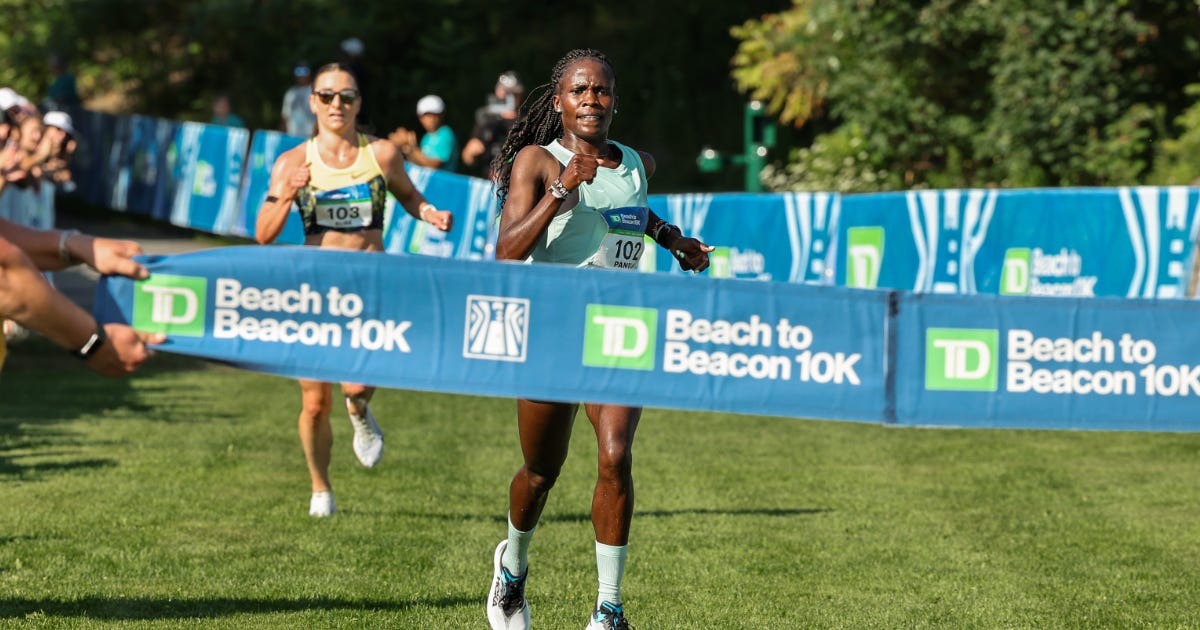
– Habtom Samuel won the Beach to Beacon 10k in Maine in his professional debut, breaking the tape in 27:40; his New Mexico teammate Pamela Kosgei claimed the women’s title just ahead of Elise Cranny, 31:50 to 31:52.
– The saga surrounding Brazilian marathoner Daniel Do Nascimento has come to a happy conclusion. Missing since late June, the South American record-holder over 26.2 was spotted and reunited with his family in good physical condition. According to his family, Do Nascimento has struggled with his mental health since returning home after he was issued a five-year ban for doping.
– Anyone looking for a master’s degree? Last weekend, a Colorado judge issued an injunction extending the NCAA’s “five in five” policy to athletes in the Class of 2022, meaning those who exhausted four years of eligibility in that year could theoretically return to college athletics, at least until the next court case comes down.
Interested in reaching 20,000+ dedicated runners and track and field fans? Advertise with us here.
I disagree with calling someone a "sore loser" when they lost to someone who, knowingly or not, has taken PEDs and served a ban for them
As a proud Canadian who values our membership in the Commonwealth, your comments about it are offensive and arrogant.
As our long time supposed ally, the USA is showing its true colours and has proven itself to be an enemy. Your country’s leader has repeatedly spoken of annexing our country, a sovereign nation which has absolutely no interest in being a part of the dumpster fire to the south of us.
The well-known American exceptionalism is blatant in your comments - how dare you criticize other countries when your own country, alongside Israel, is the biggest bully in the world.
Clean up your own horrible country before you start questioning the “ethics and morals” of the Commonwealth.