

Presented by Sedona
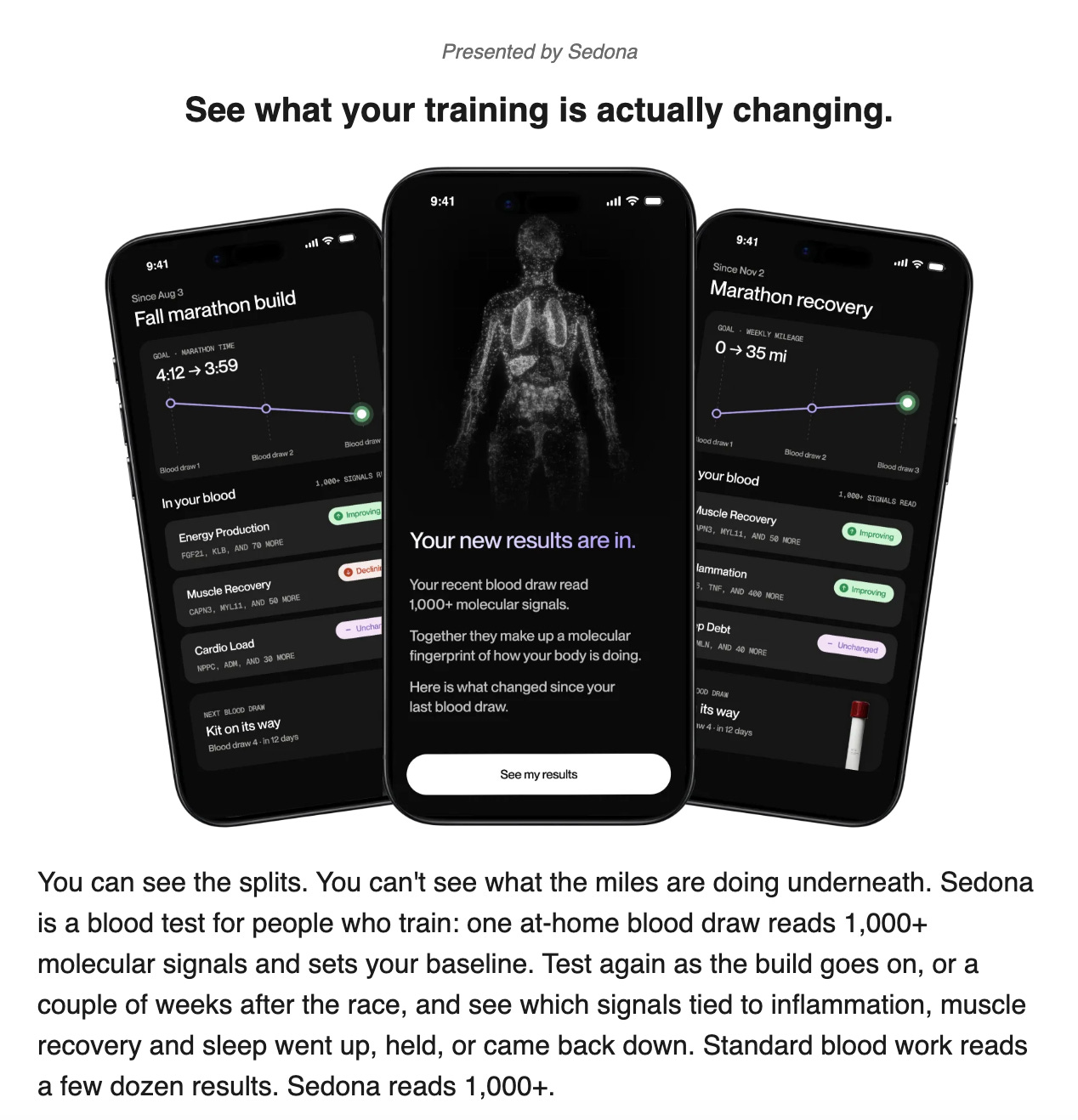
See what your training is actually changing.
Chicago’s done. New York is 11 days out. What did the miles actually do? Your log shows every mile of this fall’s build. It can’t show you what those miles did underneath. Sedona is a blood test for people who train. One at-home blood draw reads 1,000+ molecular signals and sets your baseline. Test again as the build goes on, or a couple of weeks after the race, and see which signals tied to inflammation, muscle recovery and sleep went up, held, or came back down. Standard blood work reads a few dozen results. Sedona reads 1,000+.
Members of the CITIUS MAG team are trying the kit for ourselves, and we’ll share what results show later this fall.
Sedona is invite-only. Request an invite: founding members get it for $99 a month, price locked for six months, and a say in what Sedona builds next. The price goes up at launch. Change your mind before your kit ships and you pay nothing.
Compiled by David Melly, Paul Snyder, & Kyle Merber
Depth Never Goes Out Of Style 🖐️
It’s that time of year when cross country gets real again.
For those of us who aren’t actively on a collegiate cross country team and are merely fans of the sport, there’s not a lot to catch the eye in the first six weeks or so of the season. Unlike, say, NCAA football, where every weekend has playoff implications, the back-loaded arc of the cross country season means that none of the top contenders truly show their cards until mid-October at the earliest. But now, with back-to-back weekends of Nuttycombe and the Pre-National Invitational, we have a bit more to talk about.
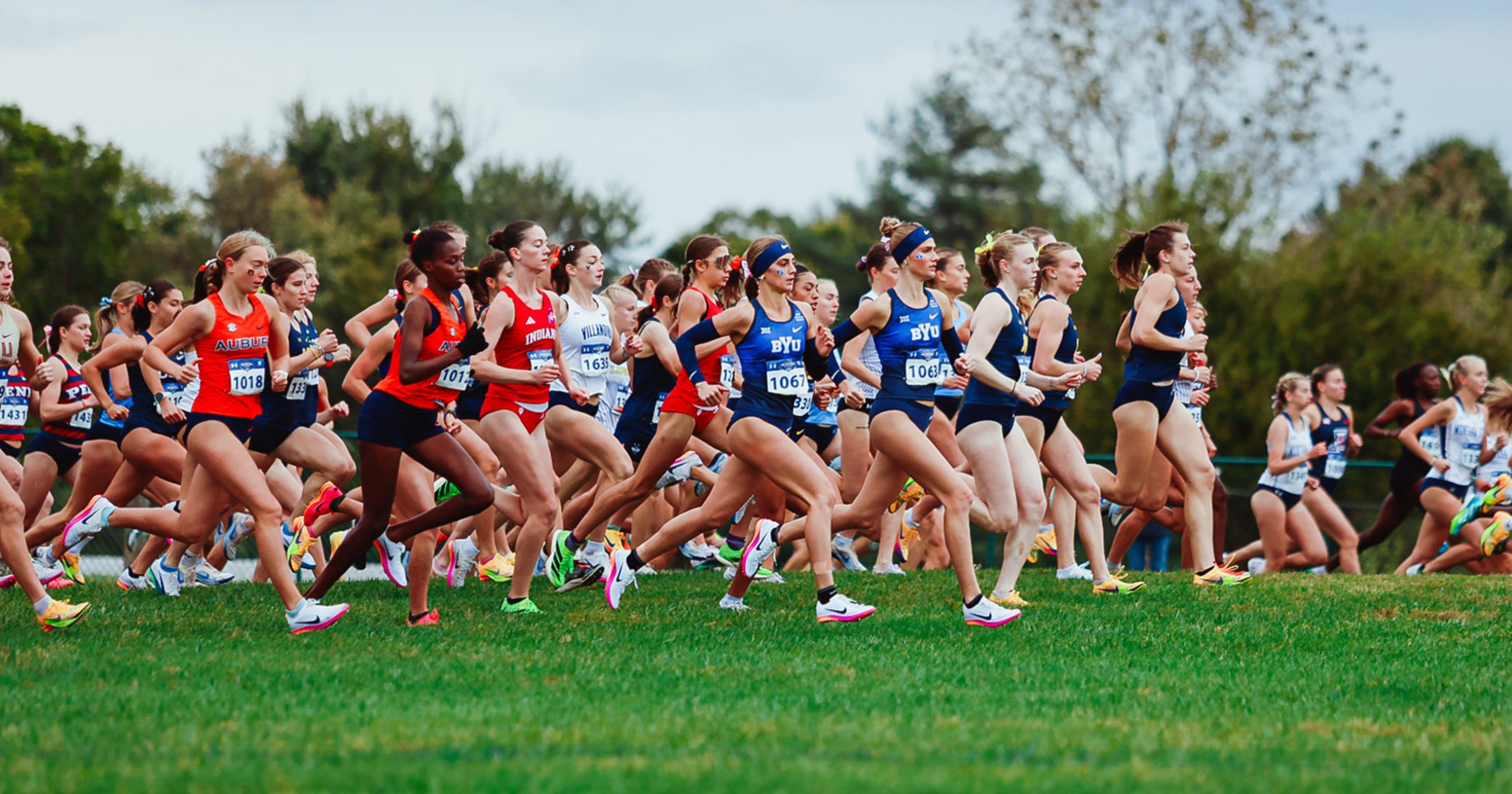
All the major team contenders, with the exception of reigning men’s champs Oklahoma State, took to the grass one of the last two weekends. Up in Wisconsin, last year’s runner-up, #1-ranked New Mexico, rolled through Colorado, BYU, and Arkansas with a 59-point total and their fifth runner taking 22nd place overall. Combined with their dethroning of Oklahoma State at the Cowboys’ home meet in September, the Lobos look to be the team to beat on the men’s side.
The women’s heavy-hitters largely descended on Terre Haute, Indiana, this past weekend instead. If you were just watching the finish-line highlights, the performance that stood out was Hannah Gapes’s dominant 18:57.6 victory in the 6km for NC State. Gapes is a very solid track runner, with a 4:07.44 1500m and a 15:25.93 5000m for PBs, but the Kiwi is really a cross country coach’s dream: grass and hills are where she thrives. She’s already got two top-ten finishes at NCAA XC entering her senior year, leading the Wolfpack to a team title with a fifth-place run in 2025, and she even finished top-20 for New Zealand at World XC this past January.
Don’t call her the outright favorite just yet. BYU was running without Jane Hedengren, who skipped the meet due to a mild illness. Hedengren already has one loss on her card so far in the 2026 season, finishing third at the Cowboy Jamboree behind two Cowgirls, but you’d be foolish to count out the sophomore with two NCAA titles already under her belt.
Most intriguingly, the Cougars eked out a win without Hedengren over the reigning national champs in their first matchup since NCAAs last year. BYU scored 84 points to NC State’s 88 with a team performance that sure made it seem like cougars, not wolves, are the animals known for pack running. Taylor Rohantinsky, the top BYU finisher, finished ninth, behind NC State’s second runner… but then the Cougars put a remarkable five finishers in the top 25 and seven in the top 30. BYU’s final scorer finished ahead of NC State’s fourth runner, which in turn used displacement of points to basically deliver the margin of victory.
Ironically, it was a bit of a role-reversal from last fall. Back in Missouri, Gapes led NC State as their top finisher but she was behind two BYU runners (Hedengren and Riley Chamberlain), and the Wolfpack took the win with a superior 3-4-5. When everybody has a couple low sticks, the comparative advantage up front doesn’t actually matter as much as your fifth runner’s ability to finish ten places higher than expected.
The men’s race told a similar story. Syracuse, a program that’s become synonymous with gritty cross country success via a roster of under-recruited future marathoners, was the only team in the top four to not have a finisher in the top ten. Instead, the Orangemen’s top four took 15-16-28-22, and a 44th-place finish from Connell Alford sealed the deal. At the other end of the spectrum, Wichita State runners took second and third overall but ended up fourth as a team with no other runners in the top 50.
While it would’ve been great to see Hedengren and Gapes battle to the line, the reminder of what truly makes cross country great was just as exciting. It is very hard—near impossible—to win anything meaningful on the strength of a single low stick, which means the action that matters most to the outcome of the meet is often occurring dozens of spots behind the winner. Runners like Hedengren will have plenty of time to shine throughout the year, especially during the more individualistic track season, but last weekend the heroes were runners like Lexi Goff, who moved up from 37th at 2k to 18th at the finish as BYU’s third scorer.
The greatest quarterback in the world is going to get absolutely crushed if he doesn’t have an offensive line to block for him or an open receiver to throw to. In running, the return of true team competition to our largely individualist sport is as welcome a sign of fall as apple pie or crunching leaves. As cross country starts to matter again, so too does the logo on the front of your jersey and the lengths every runner is willing to go to do it justice.
What International Cross Country Gets Right 📏
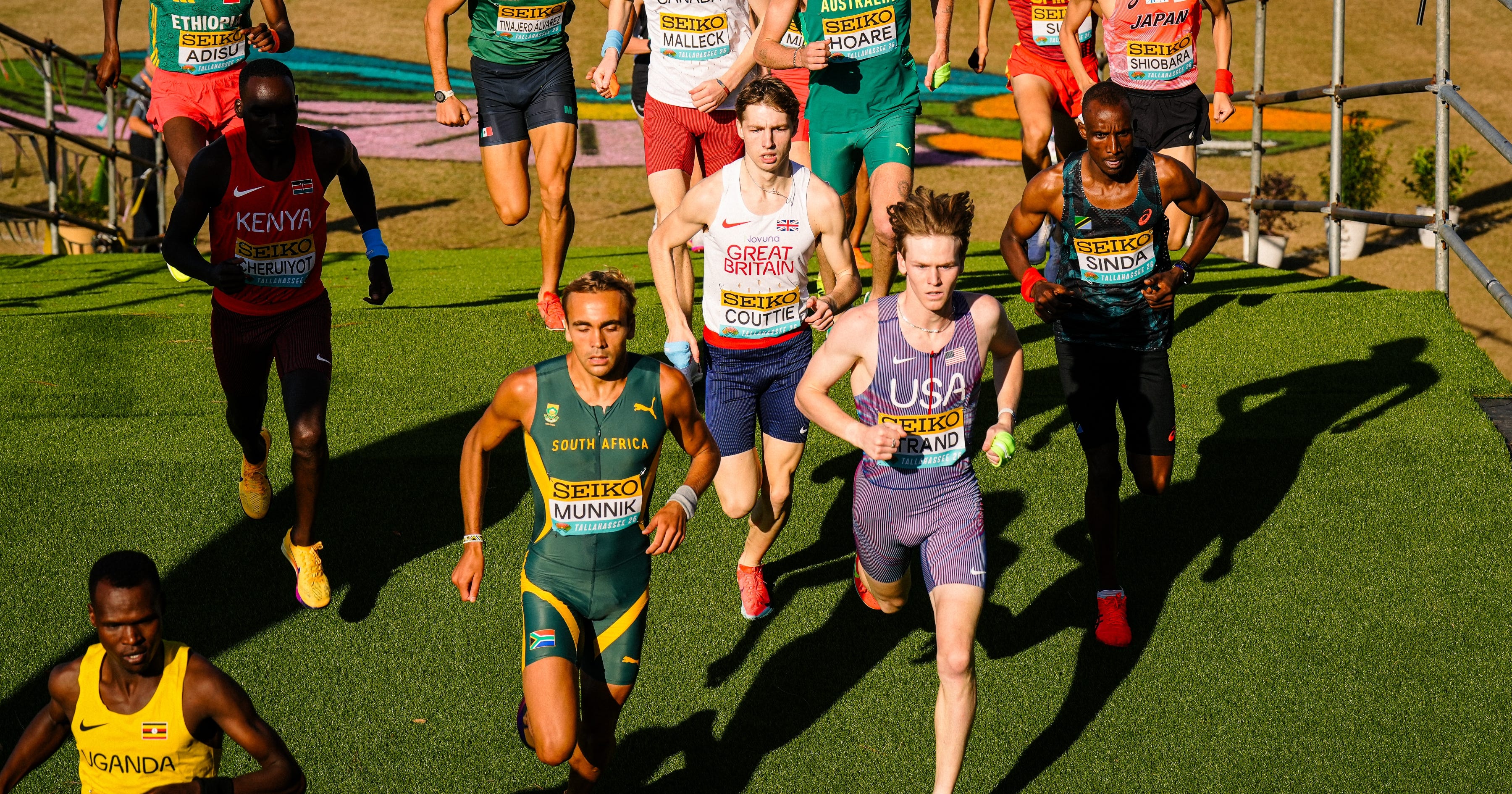
Take note, broader NCAA cross country community: at last weekend’s 72nd Cross Internacional Zornotza in Amorebieta-Etxano, Spain, both the men’s and women’s races were contested on the exact same course. Yes, the women and men ran the same distance, which is neat, and a topic we’ve dipped our toes into before.
But this week’s fixation on cross country distance has to do with the distance itself—which was proudly listed as 8.7 kilometers. You might assume that converts to a standard distance in miles, but you’d be wrong… unless there’s something significant about 5.4 miles we don’t know about. It seems this is just a historic race that has at various points in time held races over longer and shorter distances, but settled on 8.7km as the sweet spot.
Very well. Burundi’s Egide Ntakarutimana won the men’s race in 25:19 and Likina Amebaw of Ethiopia, broke the tape for the women in 28:43.
Are those good times for an 8.7-kilometer cross country race?
Probably!
Ntakarutimana is the Burundian national record holder over 5000m and Amebaw was the 2026 5000m world leader.
But also… who cares? It’s cross-country. Time doesn’t matter. And the simplest way to make sure time doesn’t matter in cross country racing is to avoid the trappings of the standard distances contested in the NCAA—your 5- or 6- or 8- or 10-kilometer options—because these inherently invite comparison across courses, which cheapens the very identity of the sport.
We all know that looking at a time an athlete posted on a dubiously measured, bone-dry 8km course that’s been steamrolled and contains minimal turns is not equivalent to what their competition ran across the country through a mountainous bog in a Nor’easter. And yet, we talk about cross country times in a vacuum, instead of merely as a way to gauge how quickly a particular course ran on a given day. This invariably leads to a nation-wide arms race to make courses faster.
The professional European model avoids this—incidentally—by throwing athletes onto 9.28km, 9.707km, 9.3km, and all other lengths of courses, and continuing to hold meets that have existed for 70+ years. But what the NCAA lacks in quirked up, old-as-hell racing, it more than makes up for it with something the World Athletics circuit lacks: a truly meaningful team component.
The drama and intrigue of a fifth—or, if you’re a real sicko, sixth—runner determining the outcome of a major invitational trumps just about anything you’ll see on any cross-country course on the planet. So why not also ensure that the cross-country courses hosting these moments are, well… actually cross-country courses? Ones with variable terrain and mud and hills people genuinely fear.
The NCAA need not roll out bizarro distance courses or change its stated championship distances to achieve this goal. Meets should just list their actual distances. If a race is really only 7.9km or 4.9km, go ahead and say it! Lean into the notion of course character! There’s less incentive for another meet to morph itself into a speedway when it knows definitively the times posted elsewhere in the country weren’t run over 8km or 5km. And similarly, if your notoriously slow course is the way it is because it’s a touch long, congratulations—you’ve got yourself a beautiful 8.2km or 6.1km cross country venue capable of attracting big name programs that might think their 10,000m runners would benefit from the extra distance.
XC isn’t even unique in its love of uniqueness. Something major-league baseball does that is very cool is that every stadium is slightly different. Hitting a homer in Denver isn’t the same as hitting one in Boston. As sports in general become less art, more science, seemingly more every year, let’s look for the little things that keep things chaotic and non-optimized.
Sponsored by Unhinged
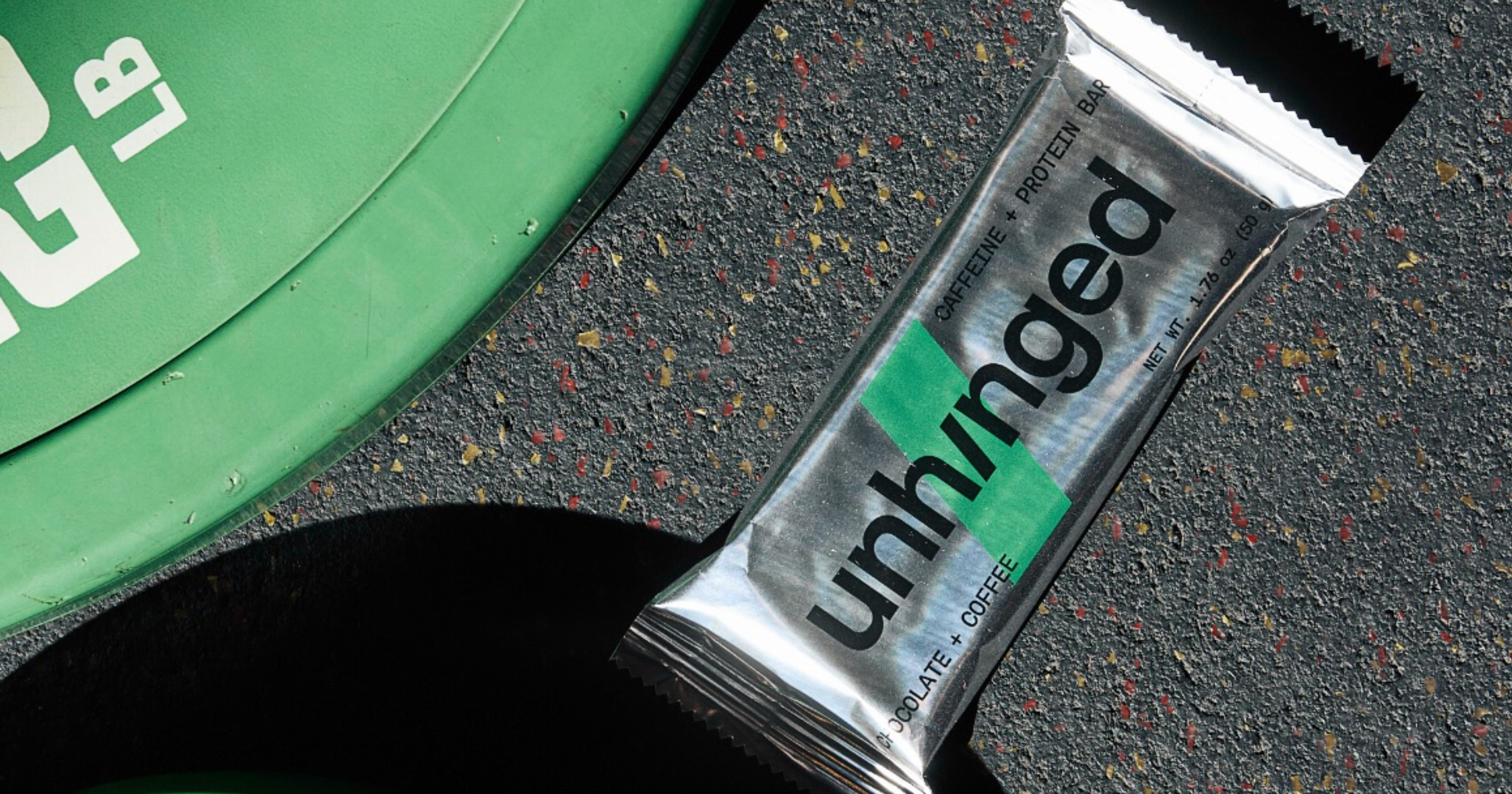
Your 3pm coffee, in a bar you can eat.
Unhinged’s Chocolate Coffee Caffeine + Protein Bar packs 75mg of natural caffeine from coffee and coffee fruit, plus 11g protein and 8g fiber to hold you between meals or before/after a run. No sugar alcohols, no seed oils, 2g added sugar, and a 2026 Superior Taste Award to back up the flavor.
Grab a box of 12 for $36, or subscribe and save 10%. Use code CITIUS20 for 20% off your orders today at the link here.
Q&A: Ryan Montgomery Is Chasing History In The 24-Hour Race ⏳
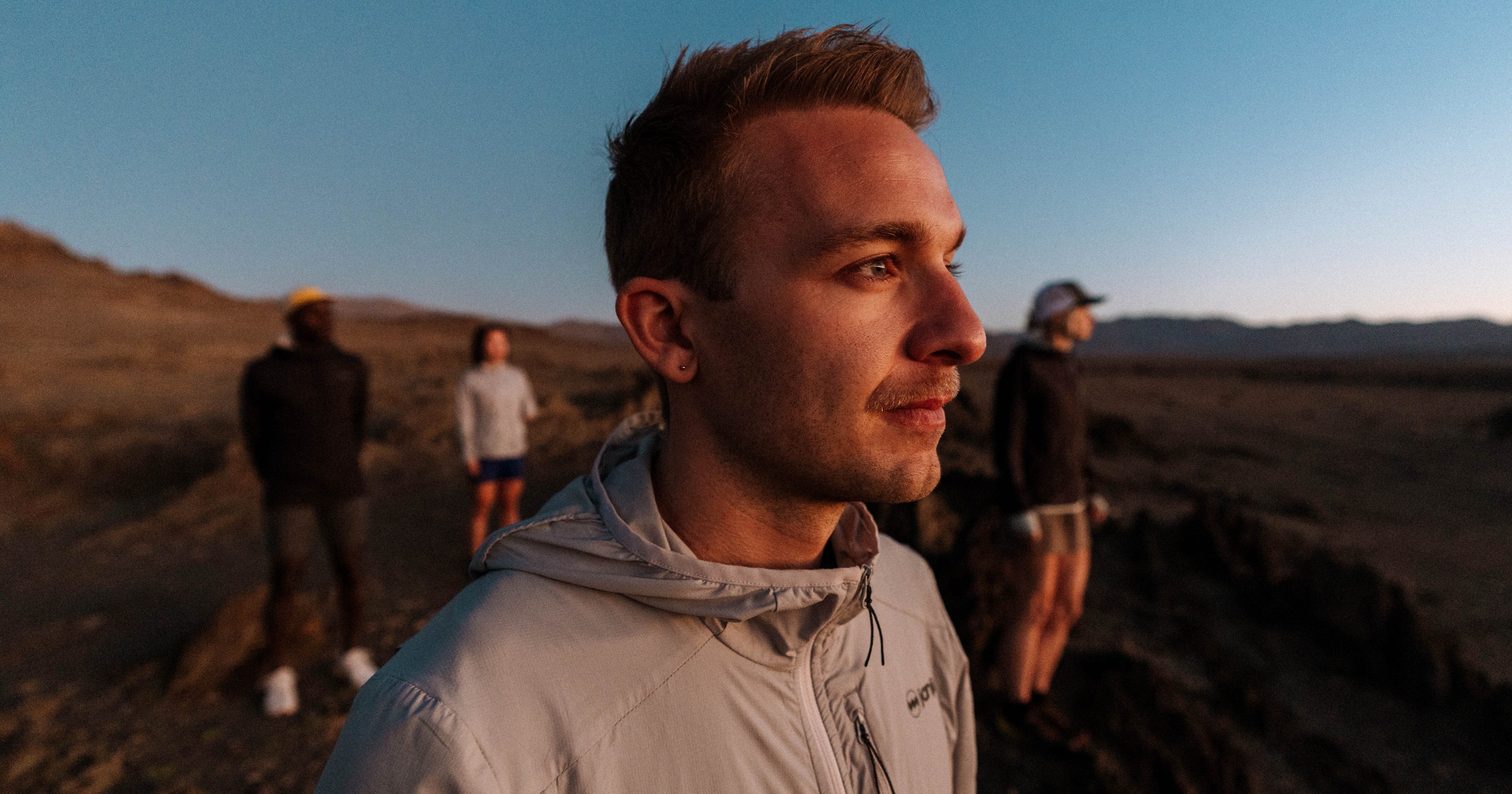
Ultramarathoner Ryan Montgomery is planning to tackle the world record for the 24-hour race at the 2026 Desert Solstice Track Invitational on December 19. The current world record is held by Lithuanian Aleksandr Sorokin, who ran 198.6 miles in 24 hours—continuous 7:15 mile pace—in 2022. Montgomery (who identifies as non-binary and uses he/they pronouns) ran 154.7 miles in his debut at the distance in 2020, and has since gone on to become one of the nation’s top trail runners, most recently finishing third overall at the Western States 100-mile in 13:53:55, 15 minutes under the previous course record.
Montgomery sat down with The Lap Count to share more information about his world-record ambitions, preparation, and approach to the race. The following excerpt, which has been lightly edited for clarity, is part of a longer interview which can be read here.
THE LAP COUNT: Great to sit down with you, Ryan. Tell us what you’ve got planned and why you’re announcing it today!
RYAN MONTGOMERY: I’m feeling so inspired seeing so many “called-shot” world records and people backing it up with results. The sport, generally speaking, is on a rocket ship in terms of performance. So I’ve been very inspired watching that, combined with my recent third place at Western States this summer. I’m excited to put a really bold goal for myself out there.
I plan to go after the 24-hour world record at the Desert Solstice Track Invitational on December 19 in Phoenix, Arizona. The race is held on a 400-meter track to see how far you can go in 24 hours. Right now, the record is 198 miles and some change, which is an average pace of about 7:15 per mile. So the goal would be to do over 200 miles—two back-to-back 100-milers—in 12 hours each.
TLC: They’re both ultras, but this is so different from Western States. Why do you want to take on such a different kind of goal?
RM: I think it speaks to the type of athlete I am. I’m obviously a 100-mile specialist in ultrarunning, but I still do marathons, because I think it’s fun to change it up, and there are a lot of benefits from marathon training. Earlier this year I ran London as part of my Western States build. Two years ago I ran Boston. And as part of this specific build for the 24-hour world record, I’m doing New York and I’m also doing CIM.
It’s fun to change things up. The fun thing about ultrarunning, unlike marathoning, is that with a marathon it’s very clear what you’re doing. It’s a marathon on a road. There might be some hills here and there, or it might be flat. But in ultrarunning, there are 100-mile races in the mountains, 100-mile races on the road, track ultras, multi-day ultras. There’s so much variety, and I think it’s fun to try on all those different hats.
TLC: For casual track fans, anything longer than a marathon seems the same, but they’re really different. In a way, it’s your “Femke-Bol-going-to-the-800” moment. The potential is there, but it’s also a huge change. Can you get into how you’ve trained and prepared differently compared with a trail ultra?
RM: I’m going to warn you: it’s not very exciting. Over the past month, I’ve started to get more into the specificity of the training, which has included a lot of track running. Two to three times a week I’m doing my runs on the track. I think last week I did over 80 miles on the track. Two of those were workouts: one where I did 20 miles on the track at sub-six-minute pace with intervals sprinkled in, and another where I ran a marathon on the track at sub-goal pace. So it’s a lot of laps, a lot of loops, a lot of Spotify.
Part of the construct of the race is that every four hours you change directions, so I’m getting used to changing directions every hour, every couple of hours. And then I’m combining a hard workout with a really, really long run. As much as I want to be trail running right now, I’m running pretty flat, on rail trails and dirt roads. This last Sunday I ran four hours on a dirt road.
TLC: The craziest thing about this whole effort is doing it all on a track. How do you mentally prepare for that level of monotony?
RM: For better or worse, I actually do have context on this race. In 2020, during the pandemic, I did my first 24-hour race, and I realized a couple of things. One is that you’re seeing your crew and your people every 400 meters. And not only that, there are going to be other people on the track. I think the race has about 20 people, total. It’s a small group, but 20 people on a 400-meter track is still big enough that you’re talking and passing people the whole time. And I believe there are other people going for different world records, whether it’s the 100-mile or something else. So it’s actually quite social, at least when I reflect on it from six years ago.
I’d say the hardest part is going to be the nighttime, when it’s kind of mind-numbing and you’re over 12 hours in. The other thing is, if I’m going for this record, I’m going to have to optimize every single minute and second. There are porta-potties on the track, but I’m almost wondering if I’m going to have to pee in a bottle on the backside of the track or something.
TLC: You have a huge queer fan base, and a lot of them are going to be following along with this attempt. How do you bring that storytelling component—and your identity as a queer athlete—into what you’re trying to accomplish athletically here?
RM: This is a big part of how I’ve been showing up as an athlete recently: bringing elements of “queer flair,” I guess you could say, into my training and my races. So that’s my plan. I’m also planning to do a lot more storytelling leading up to this, almost building momentum around my training and what’s going on in my life as I build up to it.
Over the past few weeks I’ve been sharing my training a lot, and people have been saying, “What are you doing? What’s going on? Why are you running three hours on a track?” There’s this element of people wanting to know what’s going on and wanting to be along for the ride, especially when it’s something very specific. So my intention is to bring people along for that story as I build for this—all the good and the bad. And there’s definitely going to be some “here’s me being fabulous today.” Who knows, maybe some special nails will make an appearance on race day. In the meantime, I’m just going to be myself.
More News From The Track And Field World 📰
– At the Toronto Waterfront Marathon, Leonard Langat (2:06:51) and Leah Jeruto (2:21:19) were the outright winners, while the Canadian championships went to Andrew Davies (2:08:48) and Dayna Pidhoresky (2:26:02). Davies set the record for fastest Canadian debut, and Pidhoresky, at 39 years old, ran a three-minute PB for the first time in seven years.
– Across the Atlantic Lemi Berhanu (2:03:33) and Buze Diriba (2:16:12) were the top finishers on a fast day at the Amsterdam Marathon. In an astonishing display of both the depth of the event and how fast marathoning has gotten, 16(!) men broke 2:07 and 2:04:57 was only good for eighth.
– Tamirat Tola went 2:03:10 and Anchinalu Dessie ran 2:20:36 to make it an Ethiopian sweep of the titles at the Beijing Marathon. We’re dying to know the size of the bag they threw at Tola, the Olympic champ and 2023 NYC champ, to skip out on a fall World Major for this one.
– And at the Ljubljana Marathon, Enock Onchari (2:04:55) and Haftamnesh Tesfaye (2:19:17) took top honors. You “ljub” to see so many rock solid road racing results in the same weekend, amiright?
– Now moving down in distance: Agnes Ngetich (1:04:23—a full four minutes ahead of second!) and Alexander Munyao (59:51) won the Tokyo Legacy Half Marathon.
– At the Delhi Half, Charles Matata (58:52) and Wudinesh Alemu (1:06:35) were victorious.
– It wouldn’t be an Olympic Trials Marathon qualification cycle without a handful of athletes agonizingly running OTQ times on technically non-OTQ-compliant courses.
– U.S. indoor high jump champ Charity Hufnagel and BYU freshman distance runner Addy Guymon each sustained serious injuries after being struck by drivers in two separate incidents. Fortunately Hufnagel and Guymon both appear to be recovering.
– Congratulations to Athing Mu-Nikolayev, who announced she is pregnant with her first child!
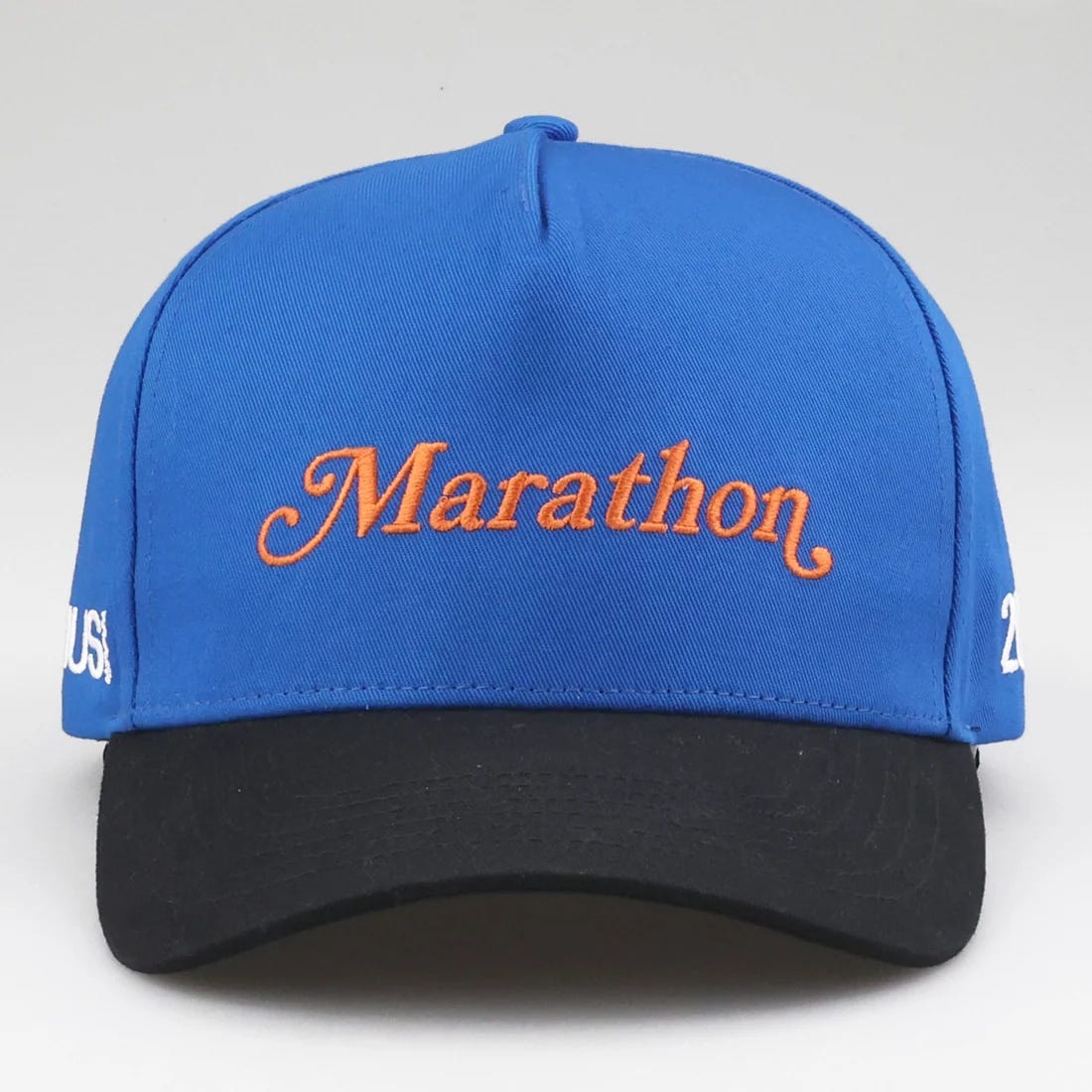
– And last but not least, commemorate the top marathon in the world (you know… the big one at the beginning of November in the Big Apple) by covering the top part of your body (your head) with a special, limited edition CITIUS MAG marathon hat.
Interested in reaching 20,000+ dedicated runners and track and field fans? Advertise with us here.