

Sponsored by Suunto
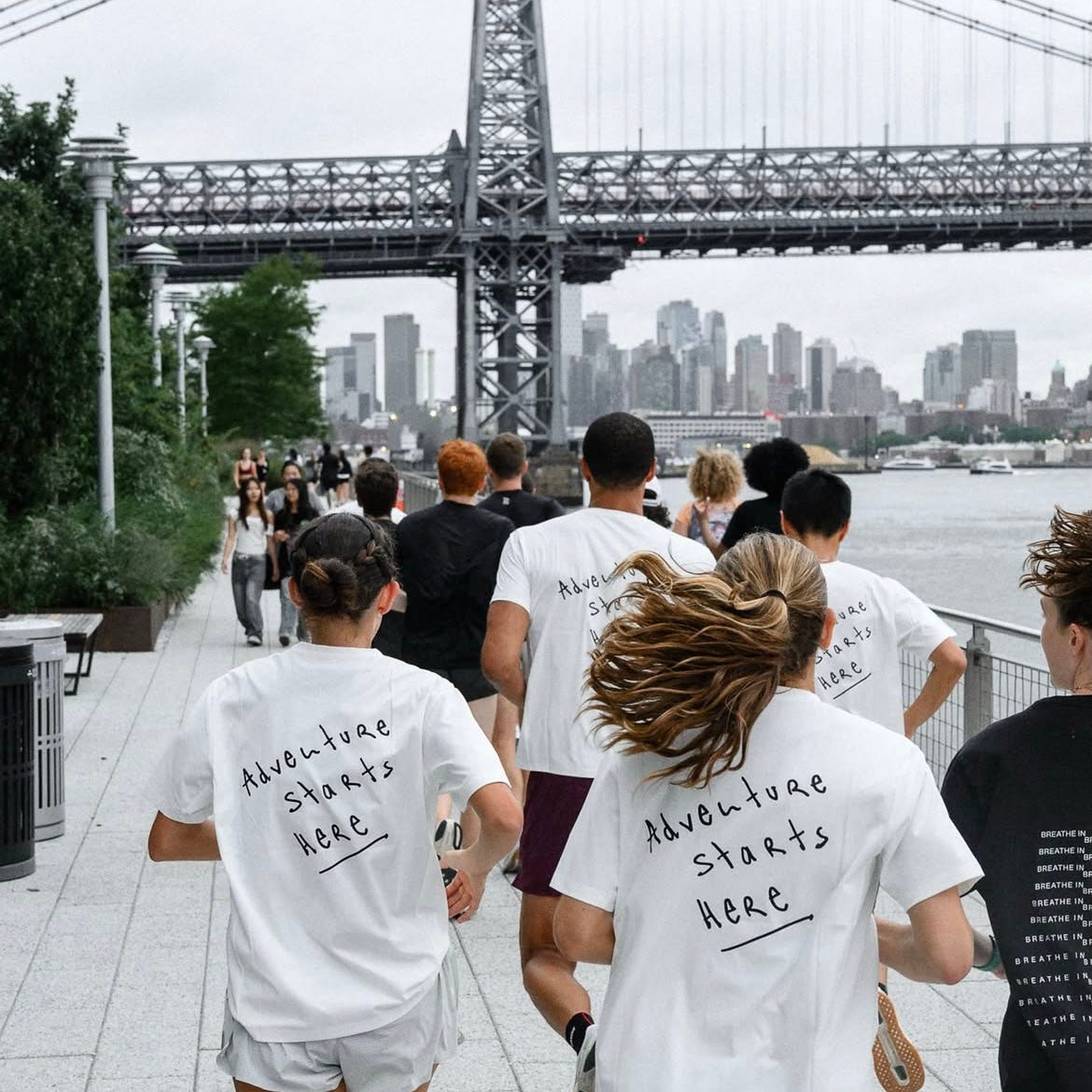
We teamed up with Suunto to launch the Run 2 and invited a dozen 2028 U.S. Olympic Marathon Trials qualifiers and hopefuls in New York City to get the first look, on a run along the Brooklyn waterfront with us.
Shines brighter. Runs longer. Tracks better. The Run 2 is built specifically for road running and the marathon, for anyone chasing a Trials standard, a personal best or a comeback.
Most of the athletes at the launch are chasing sub-2:16 or sub-2:37 while working full-time jobs and logging 100-mile weeks. Putting them first on the Run 2 continues Suunto’s support of American marathoners on the road to St. Louis in 2028.
If you’re in the market for a new watch, check out the Suunto Run 2 here.
Compiled by David Melly, Paul Snyder, & Kyle Merber
The Lap Count Year-End Power Rankings Are Here 🥇
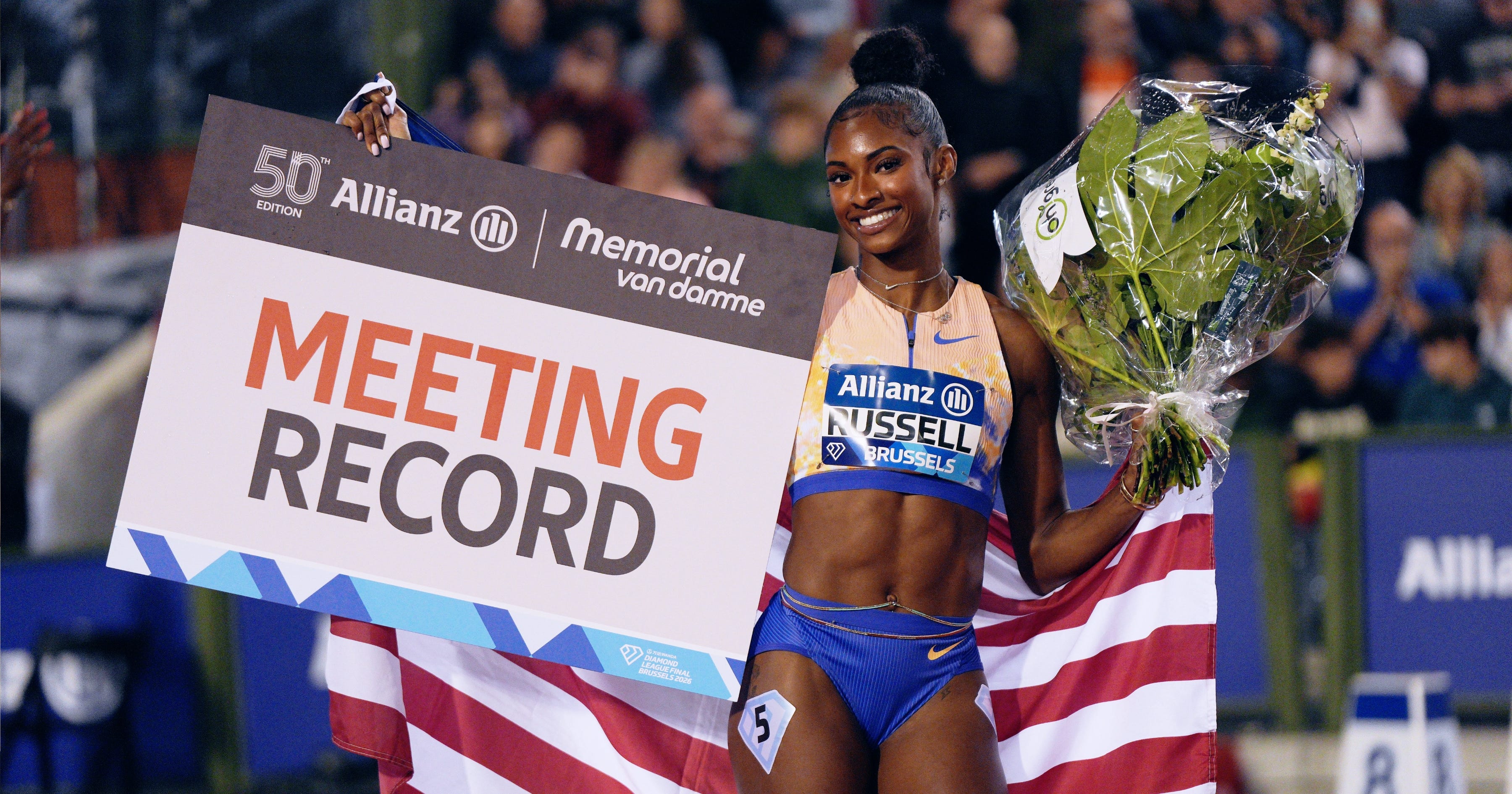
Unlike “normal” global championship years, this professional season ended with three championships of a sort: the Diamond League final, World Ultimate Championships, and World Road Running Championships.
As its name implies, the “ultimate” championship feels like the closest thing we had this year to a be-all-end-all determination of who’s the best athlete in their respective events, but it’s easier to look at the calendar and suggest that success in other forays—whether it’s the European Championships, regular-season DL circuit, Commonwealth Games, or something else entirely—could mean the same or more than a trophy in Budapest.
That made sorting out our year-end power rankings all the more challenging. How do you account for a steeplechaser who didn’t have the option of competing at WUC? Or a sprinter who ran really well, but didn’t necessarily face the same competition as a U.S. championship? When we first took on this assignment in June, World Indoors was the single biggest event on the schedule you could point to as evidence of championship mettle, and spillover good vibes from 2025 were still in the air. That’s no longer true. 2025, and even this year’s indoor season, are both increasingly distant memories. What have you (the top 25 athletes on the track and in the field) done for us lately?
As always, there’s a healthy dose of subjectivity that goes into these rankings. How do you compare a single-event specialist against a more generalized sprinter or distance runner? How much does consistency over the regular season matter compared to winning when it “counts?” How much does the top-end talent of an event or event group like the women’s 800m or the men’s pole vault elevate a star who didn’t win all that much? How much should you weigh consistently beating a deep field of competition, like in the women’s 100m hurdles or men’s 100m?
Our team of semi-informed, highly-opinionated experts combed through meet results, world rankings, descending order lists, and our own 10,000 hours of track and field viewing to put together a definitive (until it gets torn apart in the comment section) list of the best track and field athletes of the season. They are:
Top 25 Track Athletes of 2026:
Masai Russell
Alison dos Santos
Melissa Jefferson-Wooden
Audrey Werro
Josh Kerr
Ja’Kobe Tharp
Collen Kebintashipi
Kenny Bednarek
Marileidy Paulino
Julien Alfred
Rai Benjamin
Emmanuel Wanyonyi
Oblique Seville
Klaudia Kazimierska
Georgia Hunter Bell
Cameron Myers
Jakob Ingebrigtsen
Faith Cherotich
Likina Amebaw
Keely Hodgkinson
Cooper Lutkenhaus
Emma Zapletalova
Gabby Thomas
Djamel Sedjati
Femke Bol
Top 25 Field Athletes of 2026:
Mondo Duplantis
Chase Jackson
Yan Ziyi
Rumesh Pathirage
Yaroslava Mahuchikh
Emmanouil Karalis
Jessica Schilder
Andy Diaz Hernandez
Valarie Sion
Miltiadis Tentoglou
Ethan Katzberg
Eleanor Patterson
Sally Sarr
Hana Moll
Camryn Rogers
Tara Davis-Woodhall
Sandi Morris
Gianmarco Tamberi
Kristjan Ceh
Rajindra Campbell
Sarah Mitton
Larissa Iapichino
Nicola Olyslagers
Leo Fabbri
Haruka Kitaguchi
Congratulations in particular to the great Masai Russell, who took issue with her #12 mid-year ranking and proceeded to break the world record, win WUC, and cap an undefeated season just to prove us wrong. And while he had to fend off a few strong challenges from the ascendent Manolo Karalis, Mondo Duplantis has leapt high enough, often enough to retain his #1 overall ranking in the field events. The competition was so fierce this year that poor Ja’Kobe Tharp was able to break the world record in the 110m hurdles but not crack the top 5, and Marileidy Paulino finished the year ranked 9th despite completing an undefeated season in the 400m. That’s not to say that they didn’t reach consistently high heights worthy of praise all season, just that others soared even higher.
The unusual nature of the 2026 season not only makes it more complicated to wrap up the year in a tidy bow; it changes how we think about what constitutes excellence. Take an athlete like javelin wunderkind Yan Ziyi: she won five of her six competitions this year, all Diamond Leagues, including a world junior record of 71.74m and the Diamond League final. At 18 years old, she’s now the second farthest thrower of all time. Her sole blemish is that she finished second in the World Ultimate Championships to a surprise three-meter season’s best from Haruka Kitaguchi. Does Kitaguchi’s one big throw outweigh Yan’s year of dominance? This year, we say no. But would it make a difference if that throw came in the Olympic final versus a World Ultimate Championship? That’s a slightly tougher question.
Power rankings are, as always, excellent fodder for debate. Feel free to take on and tear apart our hierarchy on long runs with your friends or at dinner after practice, keeping the 2026 season alive for a few more weeks as we digest and reflect on everything that happened. We can’t wait to hear what you think!
2025 vs. 2026: The State Of The Sport 🗓️
2026 was supposed to be an off year.
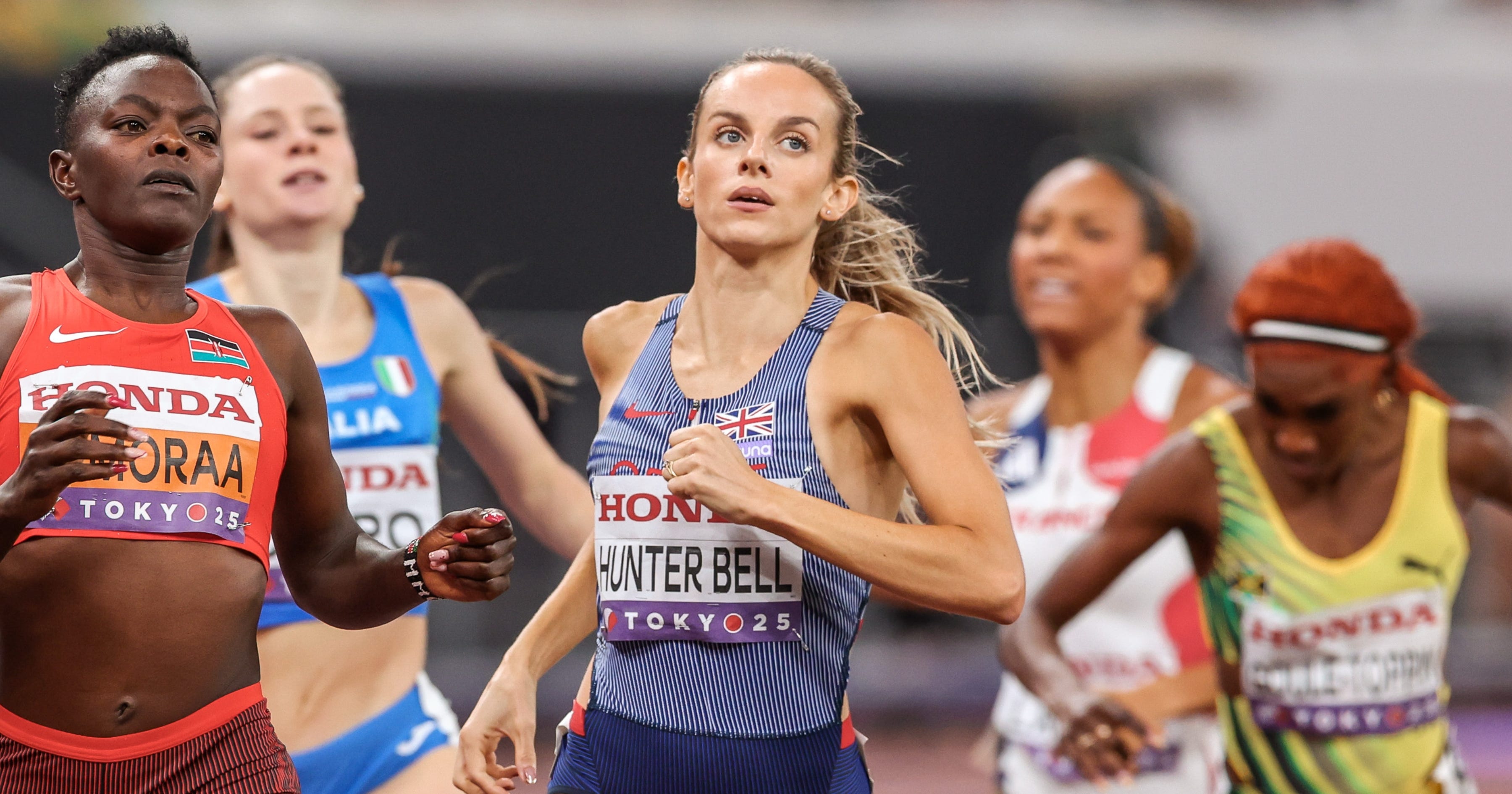
Try telling that to someone like Georgia Hunter Bell, who competed and medaled at World Indoors, Europeans, The Commonwealth Games, or World Ultimate Championships. Entering this past season expectations were mild. We had planned absences from Sydney McLaughlin-Levrone and Beatrice Chebet, it was known Grant Holloway and Jakob Ingebrigtsen were battling injuries, and Yomif Kejelcha looked towards the roads.
If, at the start of the year, you had a very selective crystal ball that revealed to you Noah Lyles, Kishane Thompson, Faith Kipyegon, and Shericka Jackson would all be sidelined for the biggest meets of the year, you’d have naturally assumed things looked apocalyptic for the sport.
But here’s the thing about track and field: it’s bigger than any one athlete.
With certain stars missing, others stepped up. It was the year of Masai Russell, rebounding from the disappointment of the 2025 World Championships to go on an unprecedented undefeated streak, capped by a world record of 12.09 in the 100m hurdles. The big three turned into the big one, with Alison dos Santos dominating the 400m hurdles and clocking a surprise world record of his own, at 45.80. Ja’Kobe Tharp validated the prelim magic of Hayward Field by backing up his record run of 12.75 with an Ultimate Championship. Audrey Werro dipped below 1:54 on three occasions to show fans something they have not seen since 1983. And Collen Kebinatshipi demonstrated remarkable patience and consistency on his way to six sub-44 second clocks in the 400.
Without an Olympic or World Championships on the line, athletes were free to build schedules around their own motivations. That meant we only saw Josh Kerr infrequently, but when we did, it was special. Meanwhile Jamal Britt raced 44 times, contesting 31 meets across 11 different countries. And Jess Hull demonstrated her strength by doubling at World Indoors, Australian Nationals, Commonwealth, and at World Ultimate Championships.
The lack of a traditional global championship didn’t mean performances faltered. If you scored the fastest times of the year from 2025 vs. 2026 as a track-only dual meet, the latter only loses out 7 to 11 (with the removal of the 10,000m).
But when looking at the competition scores of how the best invitationals stacked up in comparison to the prior year, it gives a clear picture of just how good this year was. In a head-to-head comparison of the best meets in 2026 vs. the best meets in 2025, this year was far and away more competitive. That’s reflective of the fact that the best athletes were showing up to race each other more frequently.
Unfortunately the depth of performances scaled back marginally, which is not unexpected. Athletes were not chasing standards and with a top-heavy qualification system for the World Ultimate Championships there was less incentive for the second or third tier of athletes.
Nevertheless, here’s a breakdown of some of the relevant numbers:
Men’s 100m sub-10.00 (35 in 2026 vs. 45 in 2025)
Men’s 800m sub-1:43 (10 in 2026 vs. 17 in 2025)
Men’s 1500m sub-3:30 (5 in 2026 vs. 17 in 2025)
Women’s 800m sub-2:00 (88 in 2026 vs. 100 in 2025)
Women’s 1500m sub-4:00 (25 in 2026 vs. 36 in 2025)
The women’s 100m was one of the few exceptions to the rule as exactly 38 women dipped below 11 seconds in both years. Only 25 were under that barrier in 2024, so don’t be surprised if there is a significant jump in that event come 2027, especially with a standard of 10.96.
On the horizon, 2027 features a less congested calendar that will give athletes fewer restrictions to participate on the circuit, and no major championships to focus on except for Worlds in Beijing in September. Aside from a European Indoor meet in March and a European Team Championships in June, there is really nothing going on—not even a World Relays or World Cross Country Championships. Instead, expect athletes to test out the chops on the roads or fly down under to enjoy the Australian “summer” circuit.
If anything, next year might feel more like an off-year… but there will still be unexpected twists, legendary head-to-head battles, and maybe even some fast times are all in our future. Because after all, it’s going to be another year of track and field.
The Fleeting Joy Of World Road Running Champs 🛣️
If you felt like Copenhagen came and went in the blink of an eye, you wouldn’t be alone.
For those reading this newsletter from the Western Hemisphere, it’s highly likely that you slept through at least two-thirds of the 26th World Road Running Championships. The mile and half marathons took place around 4am Eastern on Saturday and Sunday, which is a shame, because the races were pretty great.
And if your reaction to the paragraph above was, “wait—the 26th?!,” that’s also understandable. The event, which was first held in 1992, has been known as the World Half Marathon Championships for most of its existence, except for a brief two-year period where the race distance was 20km. It may be more accurate to say this is just the second edition of the championships in their current format… and last! The 2027 World Road Running Championship won’t feature a road mile like Copenhagen this year or Riga in 2023.
That’s a shame! Because the second and potentially final World Road Mile races were two of the feel-good stories of the whole weekend.
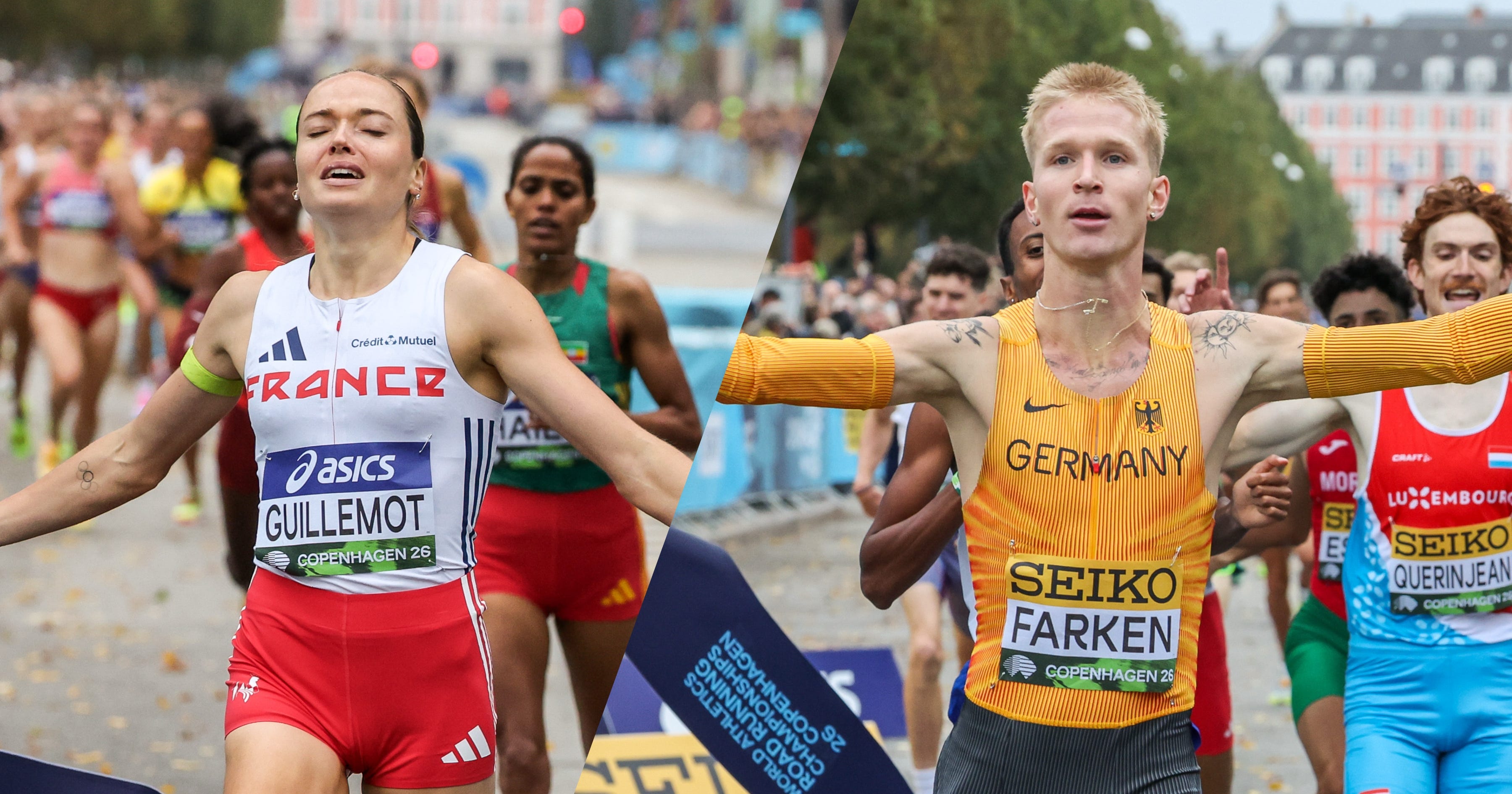
It was a particularly great eight-ish minutes of racing for the On marketing team, as Robert Farken and Agathe Guillemot took gold in the men’s and women’s races, respectively, wearing the company’s newest road-racing shoes (men’s silver medalist Yared Nuguse wore them, too). But even if you aren’t a retired Swiss tennis star, there was plenty to like about the results.
Farken, a 29-year-old German who trains with OAC in Colorado, and Guillemot, a 27-year-old French former heptathlete, aren’t exactly household names to the casual track fan, especially in the U.S. But they’re probably familiar to anyone who’s tuned in to more than half the 15 Diamond Leagues this season or the real freaks who love a World Championship semifinal.
Thanks to his third-place run behind Josh Kerr’s world record in London this summer, Farken is now the German national record holder in both the 1500m and mile and the 16th fastest man in history in the latter at 3:46.82. He’s a two-time Olympian and nine-time national champion whose best career finish in a major championship came just last year, when he took sixth in the 1500m at Worlds in Tokyo. He has 14 races on his card this season, including Millrose, World Indoors, Euros, the Diamond League final, and the World Ultimate Championship, but no signature wins before last weekend.
Guillemot, similarly, is at 19 races in a year that began with her taking the baton in the World Cross Country 4x2km relay and carrying the French team to a silver medal finish. At the Paris Diamond League, she broke her own national record with a 3:56.24 run for third behind Freweyni Hailu and Georgia Hunter Bell, which was surely the highlight of her summer before last weekend. As a 3:56 runner, she’s something of a French Nikki Hiltz or Sinclaire Johnson: she can hang in DL races and World finals, but hadn’t yet cracked the podium. In Diamond League races this year, she finished between third and sixth five times, and she finished a heartbreaking fourth at both the European Championships and World Indoors.
In addition to crossing paths on their warmups at literally dozens of races, Guillemot and Farken have a lot in common. They’ve spent the better part of their 20s being really, really good at middle-distance running. But not the best (at least on a global scale). They show up to pretty much every race they can get into and put in an honest effort, but they don’t have the hardware or career earnings of a Jakob Ingebrigtsen or Faith Kipyegon. And they’re generally fun, likable personalities to the fans who do know them well – as evidenced by Guillemot’s post-race dip and Farken’s YouTube channel.
Perhaps the perfectly painful metaphor for the specific combination of achievement and frustration of being this very specific level of runner came earlier this month at World Ultimates, where both Guillemot and Farken found themselves at the front of the rabbitless 1500m fields. They were saddled by fate with the unenviable task of making things honest over the first half of the race, and of course, that meant they got resoundingly outkicked. They finished eighth and 11th, respectively.
Congrats! You made it to Budapest by virtue of being one of the 12 best milers in the entire world this year. Your reward? The ignominious role of being a de facto pacer for your rivals. In a sport where, at best, we think of fourth place as first loser, it’s hard to find ways to articulate admiration and appreciation for finishing in the middle of a truly elite pack, time and time again.
But being so close to the top means it only takes a slight shake-up to put a gold medal within reach. In this case, the secret sauce came in the form of an outdoor course with a slightly different field of competitors at the end of a long season. Haters will say that Farken and Guillemot only claimed gold because several of their rivals from Budapest and Brussels weren’t on the start line, but both had to take down a few true studs to break the tape. On the women’s side, Guillemot powered past Hailu, a two-time World Indoor champ, to a 4:22.74 win, and on the men’s, Farken beat his training partner Nuguse, an Olympic medalist, and broke the tape in 3:51.80.
With the road mile global championship going the way of the dodo—maybe forever—the results in Copenhagen as a perfect example of why the race should stay on the calendar. Two extremely capable but underappreciated middle distance runners showed up, represented their countries, and were finally rewarded for years of top-tier running with their moment in the sun. If this race simply produced a third iteration of a Diamond League or World Ultimate final, with the same cast of characters finishing in more or less the same order, perhaps it would be superfluous and deserving of the ax. But that’s not what happened here.
Ultimately, the business of sports is all about the construction of moments that make an impression. Something that sticks with the hardcore fans and the passing casuals, the analysts and even the athletes themselves. Whether it’s at the water cooler on Monday morning or passed on in bedtime stories to grandchildren decades later, the whole point of a well-executed sporting event is that it’s both thrilling at the time and memorable after the fact. If taking things to the roads means that we get more of those moments for runners who keep just barely missing out on the track, that’s even better. Let’s keep doing it.
More News From The Track And Field World 📰
– Also out of Copenhagen, Ethiopia’s Likina Amebaw followed up her ‘W’ in the 5000m in Budapest with a win on the roads over 5K, going 14:41; 21-year-old Eritrean Dawit Seare blew past Ingebrigtsen over the final 100m to claim an upset win in the men’s 5K in 12:56; the following day’s half marathons saw Agnes Ngetich of Kenya take the victory in a new women’s-only world record of 1:05:15, and Andreas Almgren lowered his own European record to 58:06 en route to the championship, a promising sign ahead of his November marathon debut.
– ATHLOS London treated fans to an entertaining evening of track and field, with the favorites prevailing in just about event: Sha’Carri Richardson in the 100m (10.80), Gabby Thomas in the 200m (22.13), Marileidy Paulino in the 400m (48.73), Keely Hodgkinson in the 800m (1:56.40), and Klaudia Kazimierska in the mile (4:19.43).
– In Ames (Spain, not Iowa), Americans Courtney Olsen and Charlie Lawrence took home the IAU 100k World Championship titles. Over the course of 20 5k laps, Olsen gradually tightened the screws to emerge victorious in 7:10:31, while Lawrence led the entire back half of the race and broke the tape in 6:09:25.
– The NCAA cross country season is underway, and at least at this juncture, you can more or less copy and paste your past years’ understanding of the state of play onto this year’s: BYU’s men are good and so are NAU’s women, and Alabama looks pretty formidable as well, with a new class of Kenyan talent at the helm. This is all, of course, subject to change, as none of the top squads have faced a true test yet!
– 500 or so trail runners descended upon Frozen Head State Park for the 2026 Barkley Fall Classic, the one-lap version of the famed Barkley Marathons. The 50km race (which likely clocks in closer to 40 miles) is no cakewalk, however, as only 62 runners completed the course before the cutoff (an increase from the 20 that finished last year). Winners Seth King (10:20:07) and Lauren Hendrickson (10:59:53) earned the dubious honor of entry into the full, five lap “Big Barkley.”
– You know what they say… “you never know what to expect at the Stadion Śląski in Chorzów, Poland!” Despite the non-exhibition track season being fundamentally done, the Orlen Janusz Kusocinski Memorial meet was held on the 18th, and Romell Glave was there, winning the 100m in 9.97, along with Chris Nilson, who vaulted a season’s best 5.93m.
– The New York City Marathon course will take a slightly different route through the Bronx this year, in an effort to minimize disruptions for residents of the Mott Haven neighborhood, who have limited access to grocery stores even under normal circumstances.
Interested in reaching 20,000+ dedicated runners and track and field fans? Advertise with us here.