

Sponsored by Altra
The new Vanish Carbon 3 was built for race day. A patent-pending split-toe carbon plate delivers the rigidity you need for speed while letting the big toe engage in a more powerful way. Underneath it, a supercritical two-piece full PEBA foam — Altra’s lightest and most responsive ever. And Altra’s Racing FootShape leaves room for your toes to splay and generate power.
The result: a 2.6% running economy improvement over the Vanish Carbon 2, rivaling the current super shoes on the market.
Don’t just run. Vanish. Head to AltraRunning.com and use code CITIUS10 for 10% off your first purchase.
Compiled by David Melly, Paul Snyder, & Kyle Merber
From Brussels To Budapest: What Changes? 🤷♂️

The de facto end to the 2026 season takes place this Friday with a huge European pro meet bringing the best athletes in the world together for a densely-packed schedule, generous prize money, and small fields that took all year to qualify for.
And if this all sounds like Groundhog Day to you… well… yeah. This is not a re-run of last week’s newsletter before the Diamond League final in Brussels. No, we’re turning our focus eastward to Hungary and the site of the 2023 World Championships for the inaugural World Ultimate Championships, a three-day invite-only affair designed to plug the hole in non-championship years (except in 2028, when it follows the biggest championships of all, the LA Olympics).
Now that you’ve successfully reoriented yourself in time of space, the obvious next question might be: Why? Why are these two different meets? Why not have Worlds every year? Why should we expect different results from pretty much the same fields as before?
You’re not alone in asking this. In a wide-ranging interview before last week’s Diamond League final, World Athletics president Sebastian Coe was candid, sometimes defensive, and occasionally a bit combative in response to reporters’ questions about the place, importance, and orientation of this new meet to the rest of the global track and field calendar. Clearly, WA believes there’s a need to have both events, and whether by choice or by necessity, they don’t see an insurmountable downside to holding both in such close proximity.
In that interview, Lord Coe uses the word “different” six times. It’s clear that the party line is that what makes WUC stand apart (and justifies its value) is that the new event is designed to not match either a standard World Championship or a Diamond League final. But what exactly is different about this weekend compared to last, and is it better, worse, or simply just… new?
The “Ultimate” is supposed to stand for “exciting.” Very consciously, the format of WUC has been structured to prioritize entertainment value. At surface level, that’s great! Track and field being less boring more entertaining can’t possibly be a bad thing, right? However, exactly how the meet purports to deliver a more high-energy product, especially on television, involves tradeoffs, some of which are less-than-universally adored.
The obvious place to start is with the three-day competition format, compared with nine for World Championships (or just two for the DL final). 18 of the 30 events scheduled to hit the track are finals, meaning a far larger chunk of what you’re watching has high stakes. The relays and the field events are all straight finals, and no event has more than two rounds of racing. Real sickos may miss the thrill of culling a 40-person 1500m field to 36 semifinalists, but that’s probably not a significant chunk of the viewership. Fewer races in more days than the DL final is great for athletes who may want to double, as combos like the 1500m/5000m and 400m/400H are fairly doable.
Of course, steeplechasers and shot putters may have a slightly different view of things. In crafting a three-day calendar, WA made the tough decision to cut out a number of distance and field events, with only 28 total events on offer compared with the 49 at normal World Championships. The Diamond League has, for years, not been accommodating to the 10,000m or the hammer throw, but this is a new—dare we say Michael-Johnsonian—level of cut. Further, the field events that are contested will cut down quickly over the course of just four rounds, meaning competition will be shorter, with fewer opportunities for athletes to shine. Clearly, many in positions of power believe that track and field has to shrink to grow, and the WUC is the latest embodiment of that ethos.
Same racers, no rabbits. The 800m, 1500m, and 5000m will feature many of the same names as last week. Five of the six Diamond League final winners will look to pull off the double in Budapest, with the lone exception being men’s 5000m champ Birhanu Balew. Before you kvetch that the quality of the field suffers, take another look at the entries: Olympic champ Jakob Ingebrigtsen is facing off with World champ Cole Hocker—potentially in both the 5000m and 1500m, but Norwegian media seems to think Jakob is only running the 5000m—so Balew’s absence will barely cause a blip on the radar. Throw in the return of Keely Hodgkinson to the 800m and Josh Kerr to the 1500m, and it’s clear that at least some of the top pros consider this a higher priority than the Diamond League final.
The twist comes from the “Championship” part of “World Ultimate Championships.” Like the Olympics and Worlds—but unlike the DL final, which we will grouse about more later—there will be no pacers for the distance events (more on that below). That change alone should sufficiently alter the race dynamics in the distance races enough from Brussels to hopefully result in different outcomes… although betting against Emmanuel Wanyonyi and Audrey Werro in any kind of race feels increasingly futile at this point.
World rankings matter—unless… With small fields selected almost entirely on world rankings, part of the sell of World Ultimates in a non-championship year is that it forces athletes to race their way into qualifying position for fields as small as eight (and no larger than 16). Of course, rules were meant to be broken, and broken again, as World Athletics gave itself a “wild card” out to add deserving but unqualified athletes into the mix. And then, they broke their own “one wild card per event” rule to engineer a stacked men’s 1500m featuring Ingebrigtsen (again, maybe?) and Kerr.
No one (aside from Vince Ciattei, the first guy out in the 1500m) is likely to complain or care about the logistical gymnastics required to put the last six global champions all in the same race. It’ll be interesting to look past Budapest, however, and see what downstream effects the full reliance on ranking has on future championship selection processes. The qualifying criteria for Worlds in 2027 has already been released, but if the “screw standards; race your way in” attitude persists into 2028 and beyond, the path to future global championships could look very, very different in years to come.
Relays are served neither shaken nor stirred. There are just two relays on the WUC calendar, compared to five at a standard World Championship. Instead of men’s and women’s races, WA is doubling down on relays of a mixed variety, introducing the highly-volatile mixed-gender 4x100m for the first time outside World Relays. This is inarguably bad for the B-tier 400m runners of Team USA, but great for smaller nations like the Netherlands or Canada, who now only need two men and two women to rise to world-class standards in order to contend for the medals.
Given how little of a focus relays have received in this championship, this is one of those changes that probably comes out in the wash. It’s a nice, moderately-sized payday for a handful of athletes that wouldn’t necessarily walk away from championships with a fat check otherwise, but the prestige and historical significance attached to a bronze medal in the World Ultimate mixed 4x400m is… dubious, to say the least.
Track on TV! Another (positive) way in which the 2026 World Ultimate Championship diverges from the Diamond League final is that, at least in the U.S., NBC Universal has the broadcast rights and the entire meet will be streamed on Peacock. Friday and Saturday are on NBCSN and SUnday is on regular ol’ rabbit-ears NBC, which still has a huge impact on overall viewership and new eyeballs. With all due respect to our friends at Flotrack, no bar in America is shelling out $29.99 to put Brussels on the big screen, and if the whole point of this new endeavor is to sell track and field to the wider sporting world, the wider sporting world needs to actually have the capacity to watch.
So while events like the men’s and women’s 400m, the men’s 100m, and the hurdles could start to feel a bit like déjà vu with Brussels swapped out for Budapest, the perceived success or failure of this new first-time meet format could have broader implications for the sport writ large. The differences between the Diamond League and WUC aren’t decorative; they’re directional. And Seb Coe’s latest grand experiment to bring track and field to the masses is betting big that doing things differently is a recipe for long-term success.
One Final Final Complaint About Pacesetting 😒

Would you rather win a race or run a personal best?
Or better yet… would you rather your favorite athlete win a race or run their personal best?
How you answer serves as something of a litmus test for whether or not a meet matters. If the only takeaway from a race is the time, then really you could hold it anywhere. The history and stakes of any particular event are rendered meaningless in an ongoing swirl of trackflation and stepping-stone qualification.
The 2026 Diamond League season was fantastic and packed full of exciting moments. But with World Athletics’s current point structure and ranking system in place, the DL circuit—even its crowning event, the Memorial Van Damme—every stop along the way is the equivalent of a regular season baseball game: a good place to eat a hot dog, but also acceptable to leave in the top of the 8th inning to beat traffic.
For a meet that turns 50 years old next year, it doesn’t feel like “Memorial Van Damme champion” really holds any particular significance outside Belgium in the wider track world. And if it does, it’s very hard to say with certainty whether it means more to win in Brussels, or Rome, or Xiamen when the races so often play out the same way.
Watching somebody run fast is exciting, but it’s not quite the same as sitting on the edge of your seat, totally unsure about what’s going to happen next. It’s the removal of certain varieties of strategy and gamesmanship to make an already simple sport even simpler, all in the interest of goading the field into running a little quicker. (Because DL meets are ultimately competing against one another to see how often they can trot out that cardboard “MEETING RECORD” sign.)
And this is not a diatribe against rabbits at-large because. There’s plenty of value to having them in the case of Audrey Werro’s 1:53.70 or Josh Kerr’s world record. But over the last three years, across the 800m, 1500m, 5000m, and 3000m steeplechase, there have been just two world leads set at the Diamond League final. That’s an 8% success rate—hardly enough success from the herd to justify keeping the rabbits around.
Of course, if the rabbits are removed then whose fault would it be if a race is a total stinker? They’re always the easy scapegoats! In fact, rabbits screw up so often that we relish in and celebrate the occasion when one actually adds value. Again… not a great reason to continue employing rabbits at the final.
There are 14 other Diamond League meets throughout the season at which we can learn who is the best at running pace. Can we spare just one to see who is the best at racing? It gets repetitive!
What it all comes down to, ultimately, is whether Memorial Van Damme is the Diamond League Final or just the final Diamond League. The organizers seem determined to frame this particular meet as a championship of sorts, given that competitors have to qualify via regular-season points and receive extra prize money. But unlike every other championship race, there’s no championship-style racing, which only furthers to muddy the waters of what kind of spot the Brussels DL takes in the larger narrative.
World Athletics’s quest to provide something different could also work backward: instead of making new things novel, what if we tried to make our existing products a little less same-y? Taking rabbits out of the Diamond League final is an easy, no-cost (actually money-saving!) step toward differentiation of a season that can feel repetitive, and the net result is that it makes winning feel like winning.
An Open Letter To Kenny Bednarek ✍️
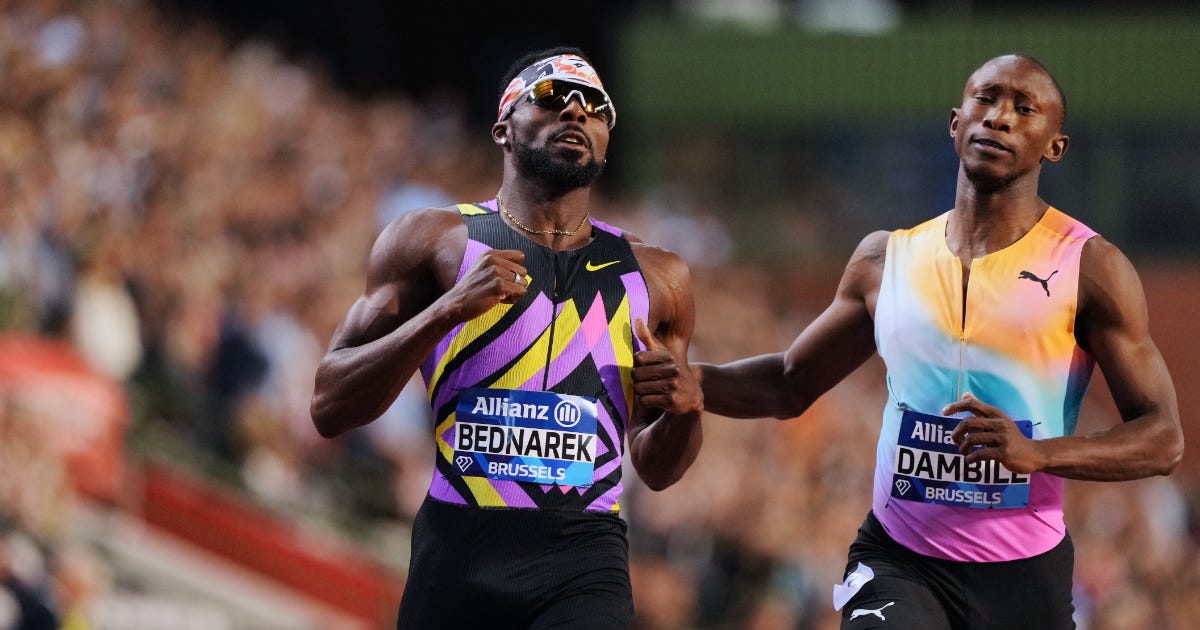
Dear Kenny Bednarek,
One of the innovations that’s flown under the radar around the World Ultimate Championships is the “Lane Draft” for the 200m, which allows athletes to pick their starting position. With Noah out, Letsile looking vulnerable, and Tate having school, that makes you quite the heavy favorite.
In addition to being undefeated in 2026 and the world leader, you have the three fastest marks on the season, which is not bad since you have only raced the 200m four times. I know you know your stats, but for the fans at home, you just won your third Diamond League 200m final, have run under 20 seconds on 40 different occasions, and have won four global silver medals.
It’s time for you to get your gold!
We know already the haters will say this one doesn’t count or they’ll ramble on about who is not there. I don’t see it that way. What I see is an incredible body of consistent work that is overdue to be celebrated. And that’s why a statement needs to be made from… not just winning, but winning in style.
So that’s why when they ask you what lane you’d like with the first pick in the inaugural World Athletics Ultimate Championships 200m Lane Draft, you should choose the lane that nobody in their right minds would pick: lane one.
That’s a statement.
“I will show you just how good I am. I am gonna win it the hard way!”
Of course there’s still a prelim and you’ll get reseeded for the final, so it doesn’t really matter. And there’s the fact that this move will only get the attention of a few dozen people who pay attention to lane draws, but it’d be a baller move. But all the track and field newsletters would probably be singing your praises next week.
There is, however, a more real and tactical—and fun!—element of chaos this decision would inflict on your competitors. It’s not just their lane athletes are picking, they have to pick their heat too. So later on in the draft some poor sap will have to choose between risking their odds against you or a worse lane draw with one less guaranteed Q.
Okay… not biting? Let us instead appeal to your sense of fairness and dignity! It doesn’t make any sense that the fastest people always get the fastest lanes. Why are we giving advantages to the people who don’t need them? If anything, it should be the complete opposite: the faster you are the lower the handicap.
Whatever your preferred justification, we sincerely hope you take the road less traveled by choosing the lane least preferred. Tighter turn or not, you’re good enough to hawk down the entire field, one by one. Consider giving the fans in Budapest and at home something to truly gawk at. Because ultimately, what is the point of elite sports if not to gawk at incredibly talented athletes doing wild things?
More News From The Track And Field World 📰
– The fields are set for this weekend’s Fifth Avenue Mile, headlined by two-time champ Jemma Reekie on the women’s side and a relatively open race on the men’s, featuring Drew Hunter, Olli Hoare, Jake Heyward, and more.
– Marco Langon (3:52.8) and Reekie (4:23.3) picked up the wins in the Kö Meile. In the event’s 5k race, Moh Ahmed (13:15) and Celestine Biwot (15:18) prevailed. We don’t know… something about “more like MarKö?”
– More cool road racing results! At the descriptively named Prague 10K Night Race, Rodrigue Kwizera (27:15) and Chaltu Dida (30:04) took home the Ws.
– John Reniewicki and Lindsey Butler nabbed a pair of victories at the Monument Mile in 3:52:08 and 4:26.60, respectively. Also of note, Dutch middle distance runner Rick van Riel chugged a can of vile Scottish liquid Irn-Bru, trackside, in 10.25 seconds.
– In New Haven, Charles Hicks (58:06) and Rachel Rudel (1:04:58) won the U.S. 20k Championships, a normal and cool distance that is not at all similar to the half marathon and that we definitely need to have a national championship for.
– Bummer: After sustaining a concussion during a car wreck, Tara Davis-Woodhall has decided to end her 2026 season.
– More bad news for World Ultimate competitors tasked with programmatic elements of the meet: Noah Lyles is also done for the year.
– Watch out, Windy City! Clayton Young has announced his intent to chase the American marathon record at next month’s Chicago Marathon.
– And now let’s close things out with a major downer, our Doping Updates Section. Ugandan road-running ace Harbert Kibet has been provisionally suspended by the AIU for using prohibited substances.
– The AIU also banned another high-profile distance runner, Tiruye Mesfin of Ethiopia—she’ll serve a three-year suspension for biological passport abnormalities.
Interested in reaching 20,000+ dedicated runners and track and field fans? Advertise with us here.
Solid newsletter in lieu of it being a “repeat.” But I just don’t get the name “Ultimate” at all. There’s a sport called Ultimate, so why muddy the waters, Seb?
Continue to love the information, topic selection, reporting, humour and sarcasm within your newsletter. This weeks was particularly hilarious. Keep it up!