

London Calling ⏱️
Lap 281: Sponsored by CORE & Bandit
Sponsored by CORE

There’s a reason why the top cyclists and triathletes in the world are jumping in painter suits to do heat training blocks ahead of big races. The science is clear: heat training can induce performance-boosting adaptations like increased hemoglobin mass and VO2 max, which can match the same gains you get at altitude, minus the trip to the mountain. CORE’s thermal sensor streams your real-time core temp and other heat data straight to your watch, so you can safely and effectively conduct heat training without overcooking yourself.
Stop guessing what your body is telling you and try it today. Readers get 10% off the CORE 2 Thermal Sensor using code CITIUS10 at corebodytemp.com
Compiled by David Melly, Paul Snyder, & Kyle Merber
Why Josh Kerr Will—Or Won’t—Break The Mile World Record💂
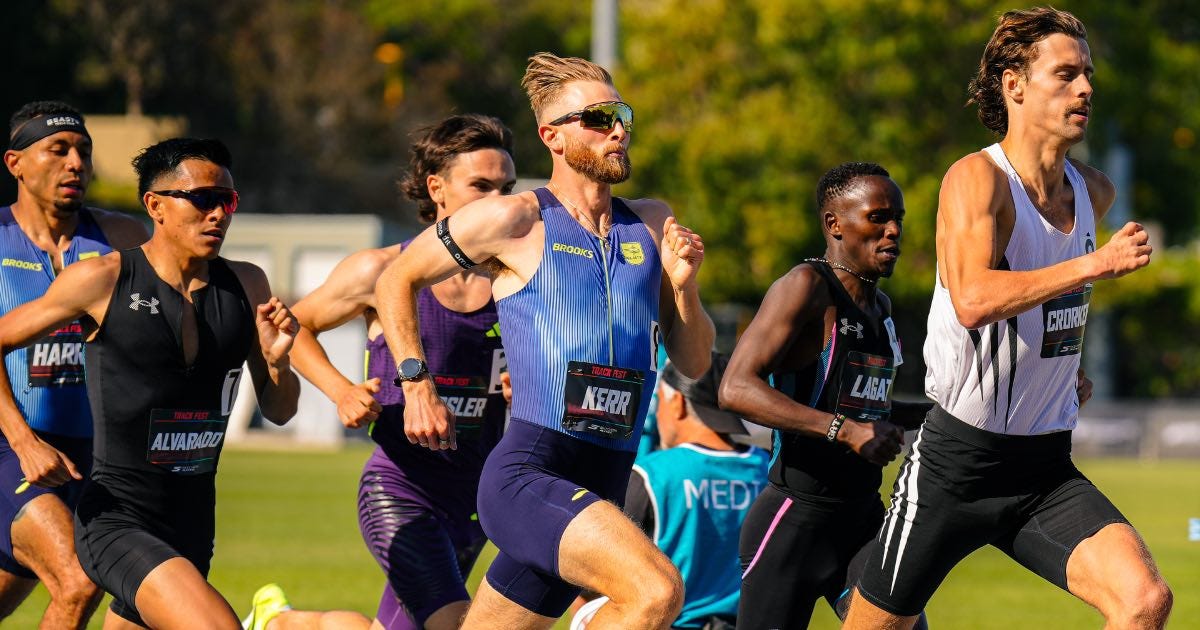
All eyes turn to the London Eye this weekend. Or, more accurately, a few miles northeast, to Queen Elizabeth Park and the city’s Olympic Stadium, where British record holder Josh Kerr will take a much-publicized shot at Hicham El Guerrouj’s world record in the mile.
Kerr and the Brooks camp have dubbed it “Project 222,” circling this date on the calendar months in advance and calling his shot at 3 minutes and 42 seconds. (Not to be pedantic… but technically, Kerr could fall short of 222 and still succeed, as Ej Guerrouj’s world record, which just celebrated its 27th birthday last week, stands at 3:43.13, or 223.13 seconds.)
Kerr has a personal best of 3:45.34, set at the Prefontaine Classic two summers ago. At the same meet nine months earlier, Jakob Ingebrigtsen and Yared Nuguse worked together to give Ej Guerrouj’s mark its closest scare yet, running 3:43.73 and 3:43.97, respectively—the third and fourth fastest marks in history. It was the first time since the record was set that anyone not named Hicham got within even two seconds of the mark.
Since then, Kerr has picked up his second Olympic medal, PRed in the 1500m, and set a world indoor best in the two mile. After winning his second World Indoor title over 3000m this past winter, he’s raced sparingly outdoors but has clocked an outright PB of 1:44.60 in the 800m. All indications suggest that, in theory, Kerr is capable of achieving the goal he’s set for himself, but such an ambitious attempt requires not just ability, but also for circumstances to align favorably.
Just like everyone else this week, we’re asking the same question: “Can he do it?” And frankly, it could go either way.
Why he’ll break the record
Science has been good to the middle distances: Bicarb, Wavelights, shoe tech, singlets with silly little holes in them… you’ve heard it all before. The net result has been the resetting of eight different world records in men’s and women’s middle-distance events from 2020 onwards. With Emmanuel Wanyonyi finally taking down the 27-year-old 1000m mark last weekend in Monaco, the mile and 1500m records are the last remaining men’s records between 800m and 10,000m that come from the 1990s. No record lasts forever, and eventually El Guerrouj will be bumped from his spot atop the record books just like every man who came before him.
London has a beautiful evening in the forecast: The one factor meet organizers can’t completely control seems to be agreeing so far, with temperatures in the mid- to high-70s Fahrenheit and a smattering of clouds in the forecast for Saturday afternoon in the UK. Just as crucially, as it stands neither the wind nor the humidity are currently throwing up major red flags either. Part of any successful record attempt is good luck, and so far, the weather gods seem to be on Kerr’s side.
This is Kerr’s goal race: It’s one thing to ride the high of good mid-season form to a PB, and it’s another to time your peak perfectly for championship season. In a normal year, distance runners rarely get the opportunity to do both at the same time, but this isn’t a normal year. As we’ve said already, the unique nature of the “off year” allows the very kind of risk-taking that makes this brave chase possible.
Two words—Yared Nuguse: Even the best rabbits in the world can only take you so far, and then you’re stuck doing the hard work up front all alone for the hardest part of the race. Except! Throughout Kerr’s career, he’s been fortunate in many of his best races to be taking on strong challengers who aren’t afraid to lead, from Jakob Ingebrigtsen to Grant Fisher to Yared Nuguse, the American record holder who’s toeing the start line alongside the British headliner. Nuguse hanging onto Kerr’s heels, or even taking the lead himself in the back half, may be just what they both need to dip under the 3:43 barrier.
Why he won’t break the record
The excitement leads to a pace that’s too hot to handle: It happens to the best of us. The roar of the crowd and the glare of the lights can get in the heads of even the most seasoned professionals, and nervous energy sends a little too much adrenaline coursing through their veins. All of a sudden, the pacer(s) and/or the race leaders are ahead of the Wavelights and the legs go from fresh to cooked a few meters too early. When you’re trying to ride the razor’s edge in pursuit of a historic time, the margin for error is infinitesimally small, which can lead to miscalculations and missteps that throw the whole effort into disarray.
The rabbits end up hurting more than helping: The converse of rabbits that get overexcited are rabbits that, frankly, don’t get the job done on the day. We’ve all watched a race where a record attempt gets derailed because the pacer is absolutely rigging while doggedly trying to hit their assigned distance. Then they won’t get out of lane one, forcing the runners they’re trying to help to either slow down or swing wide, a tough decision in the moment. Rabbits Brannon Kidder and Žan Rudolf are solid middle-distance runners in their own right, but Kidder’s 1000m PB is 2:17.21 and Rudolf’s is 2:19.03. A kilometer at 3:43.13 pace is 2:18.67, and that won’t come easy, or necessarily evenly paced.
Kerr picked the wrong Diamond League: Historically, the fastest 1500m/mile tracks in the world are located in Monaco, Eugene, and Rome. (Those Diamond Leagues have already happened already, in case you missed them!) Few fast miles have been run in London’s Olympic Stadium, and the swiftest 1500m being Phanuel Koech’s 3:28.82 winning mark from last year, which stands only 55th on the all-time list. It’s great for the ambiance and the storyline that Kerr wants to break the record in front of a home crowd, but if optimization is the goal, there isn’t a lot of evidence to support the notion that London was the best spot to host this attempt.
Two words—Yared Nuguse: In order for Josh Kerr to break the world record in the mile, he first must win the race. It’s not totally implausible that Kerr could run faster than 3:43.13 and finish second. Nuguse has a personal best 1.3 seconds faster than Kerr, and he’s been running great all season, picking up two Diamond League victories and another pair of runner-up finishes. Kerr remains the odds-on favorite, but in nine career head-to-head 1500m/mile races, he’s only got a 5-4 advantage against Nuguse, so it’s not like it’s never happened before.
Given how long Kerr, his camp, and London meet organizers have given fans the chance to get excited, expectations will be sky-high. And all parties involved get a lot of credit for choosing to stage this audacious endeavor at a real, sanctioned race with all the history and prestige that comes with it, rather than a glossy brand-controlled time trial. Success is far from guaranteed, but that’s what makes it fun to watch.
Why Is Almost Everyone Running The 400m Wrong? 🙅
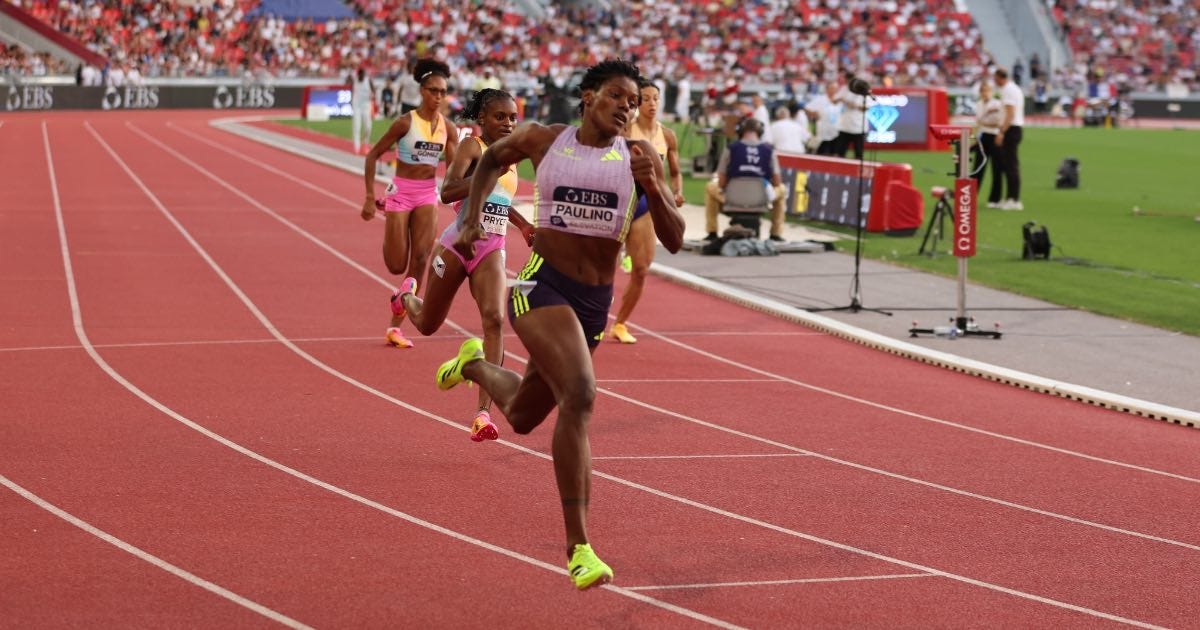
It’s been a banner year for the one-lapper. While neither world record has gone down (yet), both the NCAA and Diamond League records have fallen over the course of the last month, with no end in sight to fast times.
Both 2024 Olympic champ Marileidy Paulino and 2025 World champ Busang Collen Kebinatshipi are riding four-race win streaks and coming off dramatic wins in Monaco. Paulino is running it back in London this weekend, but Kebinatshipi is skipping out—perhaps an intentional decision on the part of meet organizers to give a homer like Matthew Hudson-Smith some time to shine. But it’s not just their winning record that’s turned heads.
Both world leaders are running really, really fast, really consistently, and they’re doing it by running very differently than their competitors. No one on the professional level even-splits a 400m, but both Paulino and Kebinatshipi have become known for their hard-charging closes down the finishing straight. Technically, they’re still slowing down just like everyone else, but compared to their competitors, it looks like they’re finding another gear and kicking it in.
Let’s look at Paulino first. In Monaco, she hit halfway in 23.87, sitting in fifth-place out of eight, and nearly a second behind early leader Lurdes Gloria Manuel. Yet Paulino ended up taking the win in 48.67, with a 0.93-second differential between her first and second 200ms. By comparison, runner-up Aaliyah Butler also broke 49 seconds, but her positive split was more than double Paulino’s—23.23-25.61, for a +2.38 differential.
In Paris, when Paulino set the now-Diamond League record of 48.48, she was in third place at halfway. She ended up winning that race by nearly a full second over Manuel. Poor Lieke Klaver, who led both Paris and Monaco at halfway, ended up fourth and fifth, respectively.
Kebinatshipi’s race splits tell an even more dramatic story. Across four Diamond League victories, Kebinatshipi has not hit halfway in the lead in any of them, and in his two league-record performances this year, he’s positive-split by less than a second. His 43.44 run in Monaco was absolutely ridiculous by professional sprinting standards, not because he ran historically fast but because he did so by going out in seventh place in 21.47, positive splitting by only 0.50 seconds and closing his final 200m under 22 seconds.
It’s hard to put into words how unusual that is, but here’s a quick comparison. Kebinatshipi is now tied with Hudson-Smith at #6 on the all-time list. Hudson-Smith ran his personal best in the 2024 Olympic final, which unfortunately does not have official 100-meter splits like the Diamond League, but a slowed-down rewatch of the race video has him hitting halfway around 20.5 seconds, nearly a full second up on Kebinatshipi two years later, while they crossed the finish line in the same time. As you may recall from that race, Quincy Hall’s dramatic come-from-behind finish for gold stole the show, but even Hall in that race still split roughly 21.3 at 200m.
The one time this strategy didn’t quite work for Paulino was in Tokyo last fall, when both she and World champion Sydney McLaughlin-Levrone closed in 24.8 but Sydney got a 0.14 second advantage at halfway, which ended up being pretty much the margin of victory at the finish (okay, it was 0.20 seconds). They both clocked positive splits in the 1.8-second range, a bit more normal, but still a relatively evenly paced effort.
Weren’t they running such similar races because they were the two top dogs racing each other to the line? Yes and no. Competition is certainly a factor, as the best athletes are pushed by their desire to win. But the 400m/400H, perhaps uniquely as the longest races run entirely in lanes, are so entirely dependent on being able to perfectly gauge your own effort.
The two fastest men in history took two different approaches. When Michael Johnson set his then-world record in 1999, he executed a fairly even effort, splitting 21.22 and hanging on for the coveted sub-22 second half to run 43.18. Current world record holder Wayde van Niekerk set his 43.03 mark running blind – and scared – in lane 9 at the Rio Olympics, and you can tell from the splits: his first half was 20.54, and he unofficially ran a ridiculous 9.78 from 100m to 200m.
So Monaco, and all the history that preceded it, lends itself to two natural conclusions. Either: that pretty much every other long sprinter in the world is going out too hard in the 400m. Or: both Paulino and Kebinatshipi, but especially Kebinatshipi, could run faster in their next races by simply getting out harder. The truth is probably somewhere in the middle, but with their sample sizes growing by the week, there’s a good argument that the pros on the circuit who keep losing to the same runners in the same way may want to change tactics.
While Kebinatshipi’s 21.47 split in Monaco isn’t quite as earth-shattering as Dick Fosbury’s radical decision to jump backwards, it’s notable that four of the last six global titles have been won by runners, male and female, who’ve produced historically fast results with the same race strategy. If you can’t beat ‘em, copy ‘em.
Sponsored by Bandit

“I know for sure before I move on from the sport, I want to give the marathon a real honest go before I move onto the next chapter in life. I think the ceiling there is really high… I always told myself if I was going to run after college, if there was at least a one percent chance I could make a team, then it’s worth it. If there’s some hope, I want to keep chasing it. With the marathon especially, it seems like there’s the most upside there with what I’ve shown in practice and workouts.” – Evan Bishop on coming out of the NCAA after injury-riddled seasons and untapped potential
He will be one of the runners participating in Bandit’s Unsponsored Project at the 2026 USATF Outdoor Championships. Learn more about him here.
American Track’s Lack Of Elitism Is What Makes It Elite 🏆
Well, the U.S. Men’s National Soccer Team has been eliminated from the World Cup. They performed more or less exactly as everyone expected, and we know just who to blame: it’s the kids’ fault…
Sort of.
Every four years, casual soccer fans become deeply—and temporarily—invested in a handful of games the American men play well in. We even allow ourselves to believe “we” could win it all! Then before returning to our default state of soccer-ambivalence, we point our angry fingers at the fragmented for-profit youth system that seems directly responsible for the USMNT’s middling results.
But for the team representing our particular country on the international stage, is there not a better symbol of our most defining values than a team that has been developed and assembled through pure unfettered capitalism? The United States’ current pay-to-pay youth system differs greatly from the rest of the world. While the countries that routinely beat our asses tend to have an infrastructure in place propped up by multi-billion dollar clubs, the 16th best team in the world asks parents to whip out their checkbooks or take out a loan to bankroll their child’s travel team dreams.
The perfect example of the European youth development model is Spain’s 19-year-old wunderkind, Lamine Yamal. Although his family grew up in relative poverty, he was scouted by FC Barcelona’s academy when he was just seven years old. Because of his long-term promise, the club footed the bill for his coaching, housing, meals, medical, gear, schooling, and then gave him a few hundred dollar stipend on top of it all. With incentives his current contract is worth €40 million each year, and Barcelona negotiated a €1 billion release clause, he’s not going anywhere.
In the land of the free, club dues alone can run upwards of $5,000 each year, and with tournament dues, gear, travel, and all the other add-ons, it’s not uncommon for an average family to spend $20,000 annually so their child can play in a competitive league. That’s a lot of dough!
Now that the World Cup is almost over, it’s time for us to return our focus to what we really care about: track and field. Amidst all this grumbling about how inaccessible soccer is in the U.S. is an incredible opportunity for our sport.
This pay-to-play model is not exclusively a soccer issue. It’s just the one we’re talking about right now because of the World Cup. If the World Baseball Classic was as big of a deal, then you’d see talking heads bemoaning how the U.S. is falling behind athletically because we’re letting less-well-off kids slip through the cracks. And while we like to think we run the basketball world, how about the fact that the last American to win the NBA’s MVP award, James Harden, did so nearly a decade ago, in 2018?
In the United States, developing the necessary skills to gain broader recognition at a young age in team sports generally requires money. In this economy, the number of families that have the disposable income to even attempt investing in their child’s athletic future is dwindling. So while the United States may have a population of 342 million people, the fiscally-filtered talent pool is quite limited. And historically, the best athletes don’t always spawn from families with silver spoons and French au pairs.
Do you know what does not cost a lot of money? Running track.
Whereas team sports require extensive travel to weekend-long tournaments—a requisite to even be recruited by a college program—race results provide more than enough information to gain attention because the clock is objective and winning speaks for itself.
There’s an estimated 30,000 tracks in the United States, and many, if not most, are free for public use (outside of school hours). That’s because virtually every high school in the country has an oval around its football field, and that accessibility is our sport’s differentiator. And crucially, unlike track and field’s competitors (re: soccer, basketball, etc.), the high school varsity program is generally the best route for development anyway. If you go to public school and ignore the cost of property taxes, it’s basically free!
That does not mean that a pay-to-play model at the youth level in track is completely absent. There are, of course, the AAU circuit and USATF’s Junior Olympics available for the most enthusiastic parents. Even those programs, however, are a fraction of the price of other youth sports and don’t require buying hockey sticks or baseball bats.
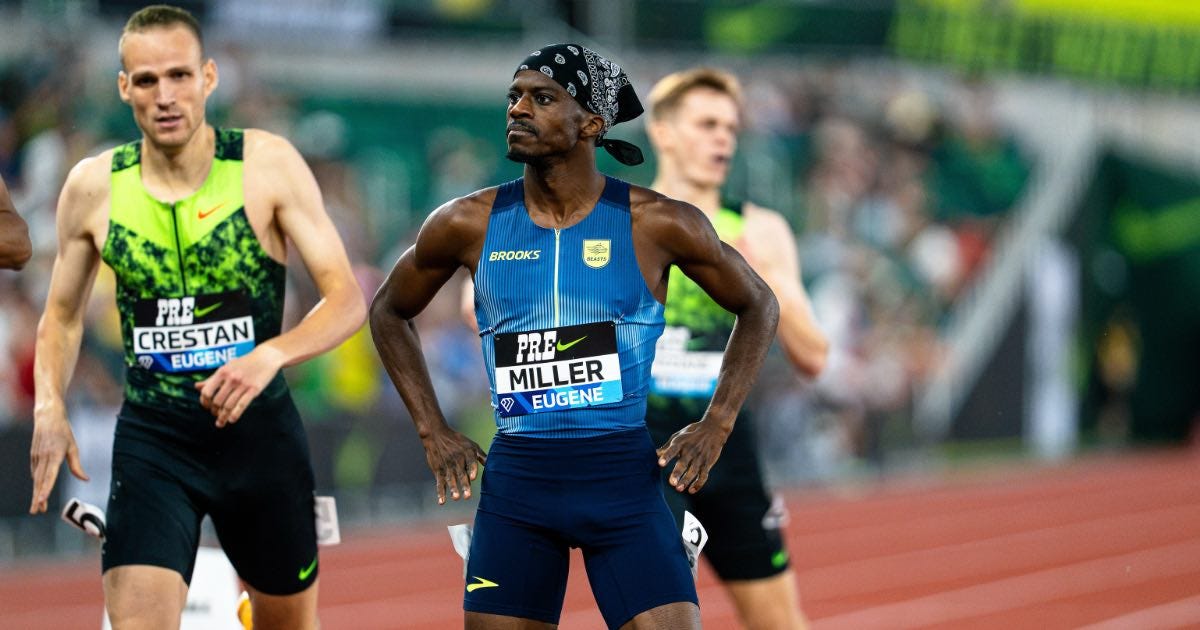
And while some athletes who excel as tweens do develop into stars (Jonathan Simms, Tia Jones, Brandon Miller, and Aleia Hobbs come to mind), it is not obligatory. In fact, many experienced coaches and physiologists would argue against starting a serious training regimen early.
David Epstein, the author of the #1 New York Times best-selling book, Range, contends that when it comes to developing athletes, the best approach is to encourage broad exposure to many sports so as to not specialize in anything early on. He praises the Norwegian model for youth sports, which is one focused on participation. Giving every kid a trophy and not keeping score until they are 13 years old is not some gentle parenting agenda—it’s an effective developmental strategy! By minimizing pressure and maximizing fun, kids stay involved and it allows them much needed time and space to advance their skills and overall athleticism.
For American running fans, the goal should be to start scooping up the talent left behind by other sports. When they zig, we need to zag. As the fastest kids are being priced out of travel soccer or AAU basketball or Little League or whatever other endeavor costs as much as a car, that’s when track coaches ought to swoop in.
It sounds nice in concept, but what does that mean in practice?
It means professional teams like the Atlanta Track Club or Oregon Track Club having youth divisions that are affordable yet well-resourced. It means having the New York Road Runners or USATF going into schools to host clinics. It means the Armory making its track accessible for the neighborhood. It means having a free kids’ fun runs at the local 5K, and all-comers meets that cost a few bucks. It means Recovered Running donating equipment and gear to schools that don’t have any. It means the USATF Foundation giving grants to youth clubs. It means Girls on the Run implementing after school programs for grades 3-8 with volunteer coaches.
But most importantly, it means that the current culture of inclusivity that the sport has cultivated must continue. Track and field is not soccer. It’s impossible to know if a seven-year-old may one day break world records. For that reason—among countless others!—we shouldn’t create barriers to entry just because their parents can’t afford to find out.
More News From The Track And Field World 📰
– At the Gyulai István Memorial, Ethan Katzberg threw a season’s best in the hammer, 83.64; Ja’Kobe Tharp beat Jamal Britt in the 110m hurdles, 12.85 to 13.01; Julian Alfred won the 100m in 10.87; Gabby Thomas took the 200m in 21.83; and Masai Russell won the 100m hurdles (again), in 12.33.
– If somebody runs the second-fastest 800m on North American soil and only a few hundred Albertans turn out to see it, does it still garner a bullet point in this newsletter? Turns out, the answer is yes. Marco Arop went 1:42.13 at the Edmonton Athletics Invitational on Sunday, winning by over two seconds. In the prelims of the 100m, Sade McCreath broke the Canadian record, going 10.86, but was beaten by Audrey Leduc in the final.
– At the Sunset Tour, in-demand rabbit Abe Alvarado proved he’s also good at finishing races, winning the men’s 800m in 1:44.07 for an 0.01-second margin of victory, and Makayla Paige took the women’s 800m title in 1:58.14 in another squeaker—second place was just 0.03 seconds back.
– Emily Venters continued her solid string of 2026 racing at the U.S. Women’s USATF 6km Champs, winning in 18:08 and holding off a late challenge from Elise Cranny. Annie Rodenfels rounded out the podium in Canton, Ohio. Incoming Indiana University freshman Katy Zang finished 11th, splitting 15:45 through the 5k.
– This being an even numbered year, this past weekend’s Hardrock 100 was run in a clockwise direction, and both the clockwise course records fell despite the occasional presence of wildfire smoke. Courtney Dauwalter won the women’s race by over four hours in 26:03:10, finishing fifth overall. 50-year-old Frenchman Ludovic Pommeret won outright in 21:11:36.
– At a blustery Ed Murphey Classic, Jamaica’s Kadrian Goldson snuck in a wind-legal 9.89 (+1.9) 100m, while two Americans notched global top-five marks: Jordan Geist heaved the shot 22.44m and Russell Robinson went 17.54m (+1.6) in the triple jump.
– Jemma Reekie won the 800m at the British Milers Club Grand Prix in 1:58.41, winning by 1.6 seconds.
– TLC favorite Sam Prakel scored the win in the mile at the Morton Games, going 3:50.97.
– Congratulations to Sydney McLaughlin-Levrone, who gave birth to her first child!
– And additional congratulations to Emma Bates, who also welcomed her first child to the world!
Interested in reaching 20,000+ dedicated runners and track and field fans? Advertise with us here.