

STICK!!!! ⏱️
Lap 271: Sponsored by VELOUS
Sponsored by VELOUS
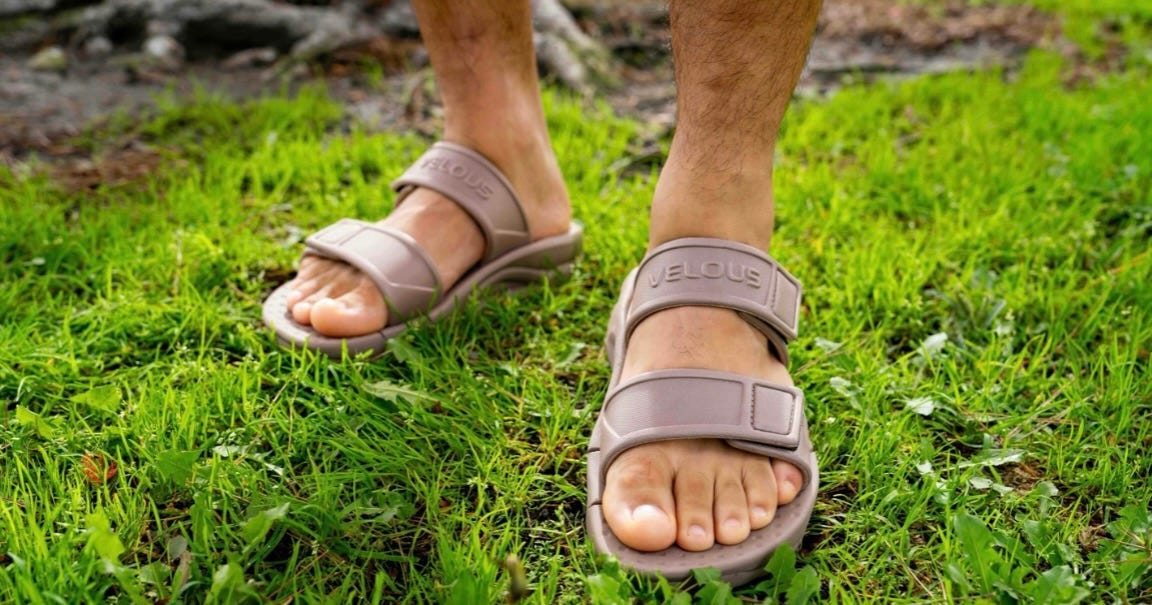
Recover Smarter with VELOUS! Whether you just finished an intense track workout, a long run, or a weekend race, your feet have earned some recovery time.
VELOUS makes recovery footwear designed to help runners bounce back faster between sessions. Their sandals feature Tri-Motion™ Technology: a technical three-density foam system and contoured footbed engineered to cushion impact, support your arches, and help your toes stretch and relax on every step. They keep your feet and legs properly aligned after you put in all of those weekly miles.
Fan favorite Hoya Adjustable Slides are built for easy post-run comfort but even better for all day comfort. This season, VELOUS introduces the Active Two Strap: a new adjustable style designed for a more dialed-in fit and all-day recovery. Plus, fresh spring colorways just dropped in all of their most popular styles. From the track to the coffee shop, VELOUS helps runners recover better so you’re ready for your next run or workout.
Run. Recover. Repeat. with VELOUS! Get 20% off your VELOUS order with code CITIUSMAG20 at checkout, including FREE Shipping!
Compiled by David Melly, Paul Snyder, & Kyle Merber
World Relays Is Still A Diamond In The Rough 💎
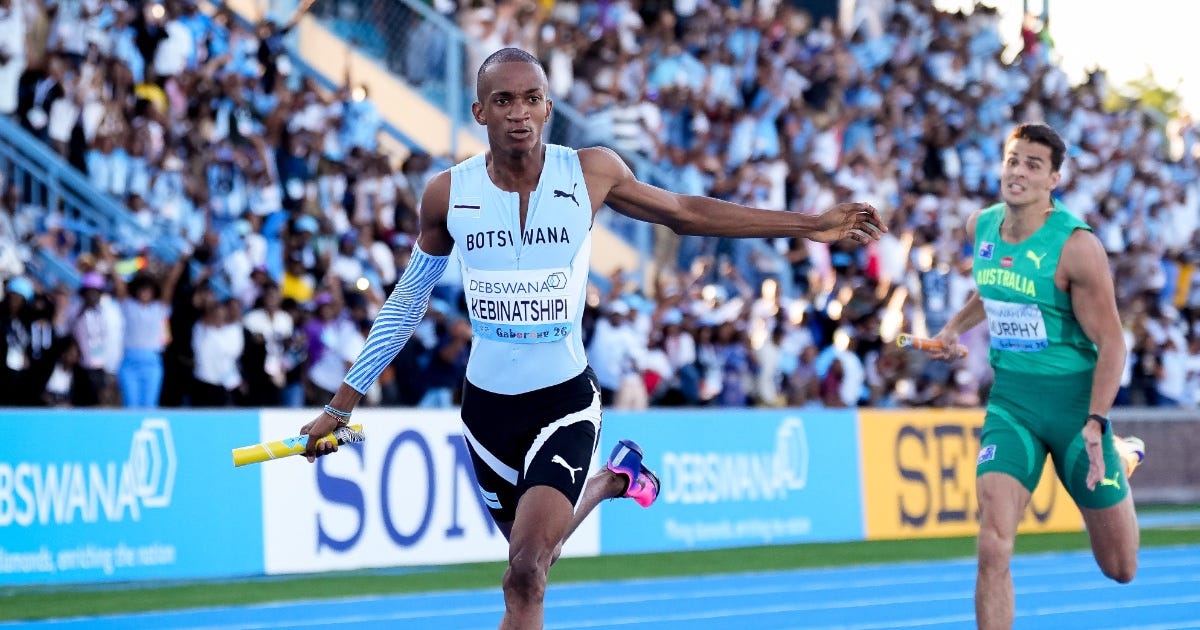
It’s not every day that you see a packed stadium going absolutely out-of-its-mind bananas for track and field. But at last weekend’s World Relays, held for the first time in Gaborone, seemingly every fan in the 25,000-seat stadium was on their feet screaming and clapping every time a single Botswana athlete so much as set foot on the track to walk to the start line.
Let’s start by giving World Athletics some serious credit. The organization’s commitment to putting the “World” in “World Athletics” pays off in situations like these, where countries that have historically not been hot spots for professional track and field are given the opportunity to host big meets and celebrate the sport. Much like 2023 Worlds in Budapest or 2017 World XC in Kampala, the palpable excitement of the first-time host nation made the crowd a major character in the track and field narrative, lending some much-needed verve to an event that has become a bit of an afterthought on the global calendar in recent years.
The biggest payoff for the home team came at the very end of the meet, of course, with the all-star Batswana quartet of Lee Eppie, Letsile Tebogo, Bayapo Ndori, and Collen Kebinatshipi winning a thriller of a 4x400m. (Editor’s note: That wasn’t a typo in the preceding sentence. “Botswanan” is an incorrect term for citizens of Botswana; the correct demonym is “Motswana” for individuals and “Batswana” for groups.) Questions about proper start lines and 3,000-odd feet of elevation aside, the results were nevertheless stunning: Botswana took the win in 2:54.47 ahead of South Africa (2:55.07) and Australia (2:55.20), the third, fifth, and sixth fastest marks ever run.
Pause: let’s consider that for a moment. Of all the all-star Team USA squads assembled over the years, only two—the 1993 team featuring Quincy Watts and Michael Johnson, and the 2024 Olympic team—have run faster than Australia did in Gaborone. Sure, there might be some weird altitude-acknowledging asterisks around the marks, but even still, it helps support the notion that carving out a little time for athletes to focus solely on relays is a worthwhile endeavor. Australia in general deserves a lot of credit for sending a team of 30 athletes halfway around the world, including stars like Torrie Lewis and Lachie Kennedy, and they were rewarded by making the final in three out of six events. Not too bad for a nation generally not considered a sprint powerhouse.
The Jamaicans weren’t messing around either, bringing in their big guns and coming home with two golds and a silver. With all due respect to the Team USA athletes who made the trip, no one on that roster was as big a name as Elaine Thompson-Herah or Ackeem Blake. Kishane Thompson and Oblique Seville, the top two finishers in last year’s World 100m final, were also initially named to the team, but withdrew before the meet. ETH continued to build hype around her triumphant return to the track in the women’s 4x100m with a virtuosic anchor leg, getting the baton well behind Canada and overhauling poor Donna Ntambue in a matter of steps before cruising to a 42.00 victory.
The strange experiment known as the “mixed 4x100m” continued to be… strange, with the rapid pace changes between legs causing all sorts of handoff issues. Nevertheless, Blake and the Clayton sisters powered Jamaica to sub-40 seconds in both the prelims and the final, becoming the first world record holders in the brand-new event. Unlike the mixed 4x400m, where handoffs are less critical to smooth execution and smaller countries have the chance to shine, this one feels like perhaps it’s just simply more trouble than it’s worth.
Overall, there was a bit of a reversal of fate in the American-Jamaican sprint rivalry. In recent years, the American women have been wildly successful on the world stage, but the men have struggled. This time in Gaborone, it was the opposite: the U.S. men won the 4x100m ahead of a hard-charging Akane Simbine of South Africa, but the Jamaicans failed to make the final entirely after finishing fourth in their heat on day 1. They returned to the repechage to book a spot in next year’s World Championships (more on that shortly), but didn’t have the chance to contend for medals. In the women’s race, however, the U.S. team didn’t even contest the repechage after finishing fourth in the heats, which means that the 3x defending champs will need to qualify for Beijing ‘27 some other way. Not a great look, particularly with 14 of the 15 fastest 100m American runners of 2025 sitting at home.
Before you scroll back up, you read that right: the meet being held in May 2026 is serving as a qualifier for the World Championship set for September 2027. In what world does that make sense? Particularly given the fact that participating countries are under no obligation to run the same athletes at both events, there isn’t the faintest logical argument for why 12 of the 16 spots should be determined 16 months in advance.
If World Athletics really wants to use their championship to entice teams to show up for World Relays, they actually haven’t gone far enough. The current setup is laughably illogical and does little to motivate the big nations to bring the big guns. Instead, they should hold the two events the same year, but require participating countries to declare and enter the same six athletes for both. You want a bonus gold medal, Noah or Sydney? Then you’re going to have to pick up a baton at least twice a year.
The meet broadcast itself also had its ups and downs. Compressing the finals into the last hour of the program made for a very exciting hour, but it also made the rest of the event feel like background noise. Relays are short, high-stakes, and exciting by nature, but with only six finals slated, it doesn’t quite feel like a full meet. The return of a DMR, 4x200m, or even—gasp!—a 4x800m could help pad out the program a bit.
All in all, this year’s World Relays did feel a bit like the unique medals themselves. Embedded at the center of this event is the spirit of something interesting, and perhaps truly special, but you’ve really gotta squint to see it. The challenge we haven’t quite figured out yet is the right placement and presentation to make this little gem really shine.
This Week’s Results You May Have Missed But Shouldn’t Sleep On 👀
With all eyes on the World Relays, it was apparently a relatively quiet weekend on the professional circuit for athletes who didn’t want to fly to Botswana or run farther than 400 meters. That is, until you dig in a little deeper into the couch cushions of the results pages.
It’s been a long-held stance of this newsletter that professionals shouldn’t run in college meets, but because we are not in charge, it does still happen. One of the main reasons for that opinion is that when the best runners in the world step onto the track, they deserve their due attention. An Olympic champion running the world-leading time ought to be appreciated in real time and celebrated after! But alas, that’s not the present world we live in.
So to make sure that none of the standout performances from the week are overlooked, here are some under-the-radar results that have us excited for various reasons:
Masai Russell: The 2024 Olympic champion quietly dipped below 12.50 seconds twice at her training grounds at the University of Kentucky this weekend. Russell’s 12.40 (+0.5) established a new world leading time and gave peace of mind to anyone who may have been concerned over the fact that she did not compete at all indoors for the first time in her pro career. She looks eager and sharp enough to prove that last year’s fourth place finish at the World Championships was a fluke.
Josh Izewski: Ask someone on the street what the American record for 10 miles is and you’ll get 10 different answers (or more likely, 10 blank stares). Two weeks after winning the Jersey City Half Marathon (62:09), the former ZAP athlete who now runs for Asics won the Broad Street 10 Miler as he cruised the Philly street(s) in a course record of 45:09. The point-to-point race is not eligible for official records, but Izewski ran the fastest an American has ever run for the distance. After the race he’s rumored to have shouted, “Tell Chris Chavez I’m coming for his marathon power rankings!”
Jonathan Simms and Samuel Ogazi: The pair of 19-year-olds had good excuses as to why they couldn’t make the trip to Gaborone—they had class. But Simms, the University of Georgia freshman originally from Allen, Texas, set a world lead of 44.02 in the 400m to confirm what we already knew… UGA’s new facility isn’t just pretty; it’s fast! And Ogazi was not far behind; the two-time NCAA champion for Alabama also ran 44.02. It’s hard to believe that it’s been two years since he finished seventh for Nigeria in the Olympic final, and he’s still not old enough to legally enjoy a warm Natty Light.
Jenna Prandini: Speaking of, while you should never ask a woman her age, it has been 11 years since Prandini won the NCAA 100m title for the Ducks in front of the (original!) Hayward Field faithful. Well, for the first time since 2018, the now-On-sponsored sprinter is back under the 11-second barrier after she dropped a 10.97 (+0.4) at the Desert Heat Classic. While Team USA may not have fielded a 4x100m team in Botswana, may we offer a suggestion for a third leg if they do end up at Worlds in 2027?
Julien Alfred: If anyone had a good excuse to skip the World Relays it’s the 2024 Olympic champion. With a population of ~185,000, the island nation of Saint Lucia has zero recorded 4x100m’s in the World Athletics database (although Wikipedia notes a NR of 46.78 from 1999). If only Julien had a twin like Tia Clayton. Alfred opened her season on home turf in Austin with a double of 10.93 (+1.8) and world leading 21.86 (+0.5). And if you’re rooting for a Saint Lucia relay resurgence, keep an eye on the nation’s young talent like Naomi London, who is following a familiar trajectory by competing for Texas.
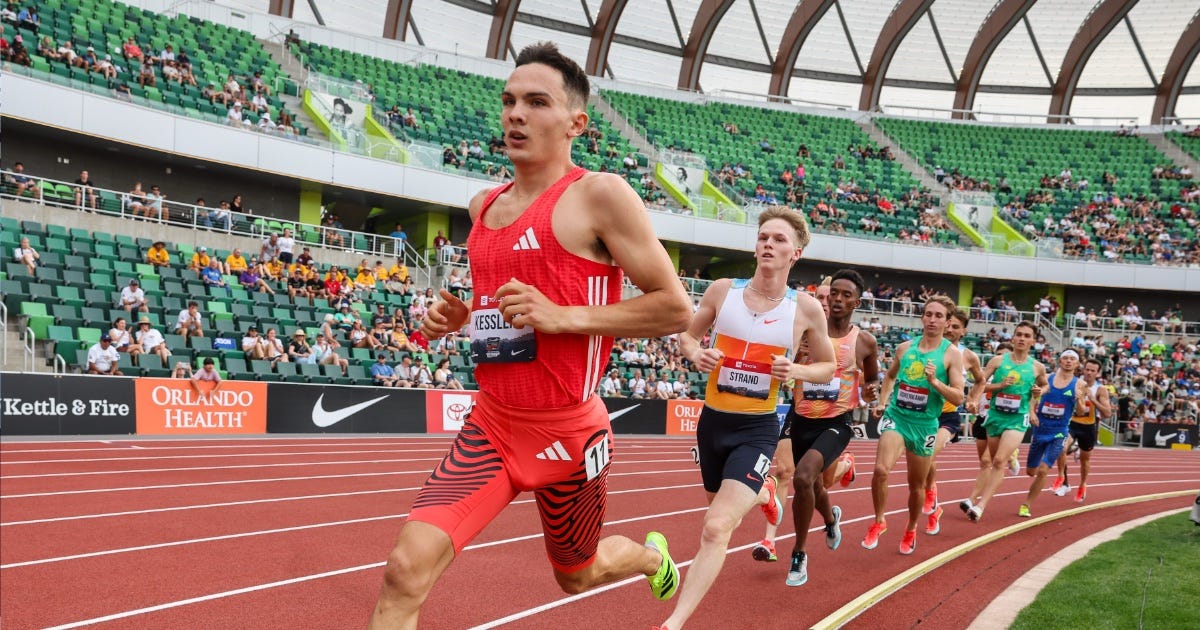
Hobbs Kessler: It probably won’t be enough to convince him to switch events, but it was cool to see the indoor world record holder at 2000m make his 5000m debut in Palo Alto. Kessler’s 13:13 was only good enough for sixth place in his race, but for a guy who rarely runs more than an hour at a time, it was proof that rock climbing ability converts. (Liam Murphy won the race in 13:12 despite likely possessing comparatively poor grip strength.) Until someone proves otherwise, it’s our belief that this is the fastest-ever 5000m debut by an American.
Jake Heyward: Now that’s a name we haven’t heard in a long time. The Welshman is back in action for the first time since 2022, winning the 1500m at Payton Jordan in 3:37.75. During his last competitive season he finished second at both Europeans and 5th Avenue. The 3:31.0 PB he set at the time was good enough to rank tenth in the world back then. But times change and that would’ve landed him 27th in 2025. It’s also worth noting, however, that entering 2020 his PB was 3:36.90, and in 2021 he cut it down to 3:32.82. Maybe he’ll take another big jump with healthy legs back underneath him.
Ko Ochiai: The Japanese 19-year-old popped off a 1:43.90 800m at the 41st Shizuoka International Athletics Meet in Fukuroi—the fifth fastest mark in the world this year. He’s the only other teen in the top ten so far, the other being Cooper Lutkenhaus, but if you expand your definition of “wunderkind” out to include “kids under 20 who are also ranked within the top 20 in the world in the men’s 800m,” you also get Australia’s Daniel Williams (who sports a very Gen Z haircut in his World Athletics profile photo). So it looks like the event is in capable hands well into 2040.
With the first Diamond League meet of the season now just nine days away, these performances add up to something of an intriguing appetizer to what will hopefully be a sumptuous meal of elite track and field. And more importantly, you’ll know who to keep an eye on the next time you see Kessler next to Heyward or Prandini next to Alfred on a starting line, thanks to the tantalizing hints of fitness and potential they dropped before the lights got bright. Stay tuned!
What The New NCAA Rules Mean For Track And Field 🖐️
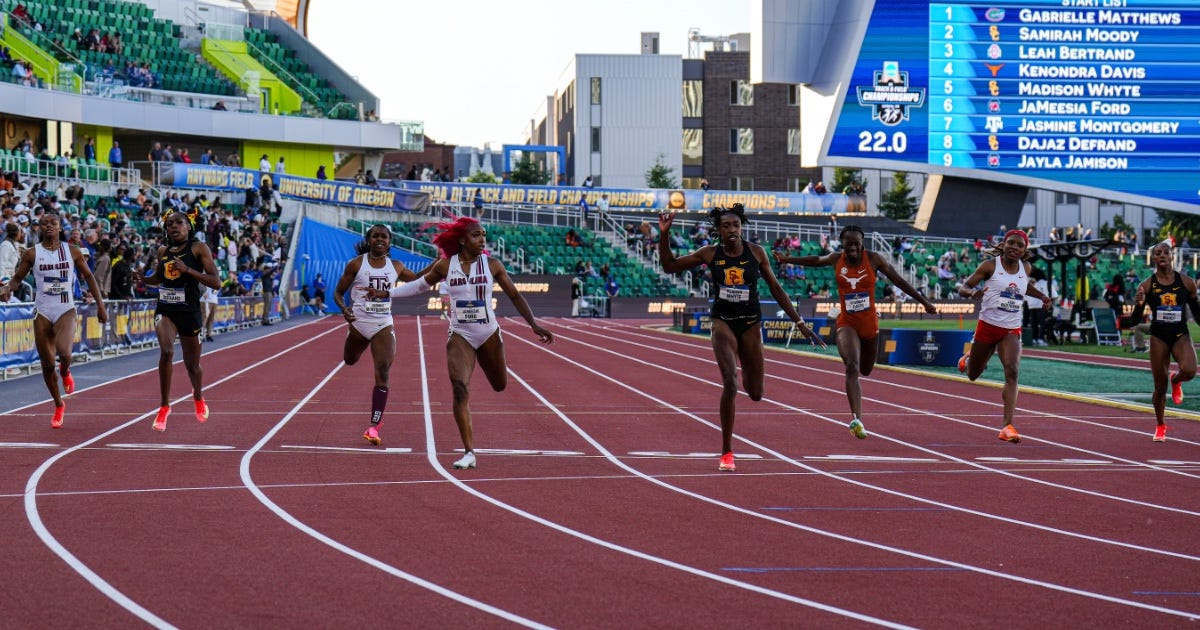
When it comes to the NCAA these days, Bob Dylan said it best: the rules, they are a-changing.
The proliferation of NIL deals and revenue sharing, heavily shaped by the historic House v. NCAA settlement, has injected an unprecedented flow of cash into college sports. Next year’s men’s basketball landscape is expected to feature 20-25 teams with $20 million rosters. Seemingly every legacy rule about “amateur” athletics, earnings, and eligibility has been overturned in court, and the lack of subsequent Congressional action has created a wild west of an intercollegiate athletics landscape. The result in big-money sports is that the COVID-impacted seventh-year seniors era has seamlessly transitioned into the five-schools-in-five-years transfer portal era.
The consolidation of conferences into the “Power Four” has widened the gap between the haves and have-nots in some ways, but the ability to buy yourself a competitive team has evened the playing field in others. Generally speaking, the little corner of the college sports landscape occupied by track and field hasn’t actually changed nearly as much as it has for sports like basketball, in large part because we weren’t exactly a money-maker in the first place. Conference competition means very little in this highly-individualized sport and the few NIL deals that have cropped up are much closer to the spirit of “name, image, likeness” endorsements rather than simply paying a donor-supported salary to athletes.
But the next switch-up on the horizon could have much more direct impacts on our sport, and the new rules are likely to go into effect as soon as this fall. Last week, the NCAA Board of Directors directed its rulemaking body to advance a proposal that would fundamentally change how eligibility works for college athletes. The general sentiment is that this edict will not be nearly as vulnerable to endless litigation.
The new rules channel another classic musician, Dave Brubeck: when it comes to eligibility and time signatures, take five. The simple version is that Division I athletes will now be limited to five years of eligibility, regardless of medical status, and—with few exceptions—they’ll have five years to use it. For U.S.-originating athletes, the clock starts with high school graduation; international students would have five years from the time they turn 19.
Two phenomena that have dominated NCAA track and field—and cross country even moreso— would suddenly change dramatically.
There would be no more mucking around with redshirts, questionable injury waivers, and other career-extending strategies: you simply have to do your best to stay healthy for your five year window of eligibility and maximize your potential within that time.
It would also spell the end of 28-year-old freshmen arriving in the U.S. via international recruiting. (That being said, age manipulation is not exactly unprecedented in this sport, so we very well may also see an influx of “19-year-old” Millennials.)
Military service and religious missions would still be exempt from the new rules, so BYU’s cross country roster could very well still have a few 26-year-old fathers of two on it here and there. But the net result of all these changes is that cross country competition should, in theory, be levelized a bit more. Managing rosters and career development would be a much simpler task, as coaches will not have to make eligibility-related decisions based on what’s best for the team and, hopefully, will instead choose to race or not race athletes based on what’s best for them.
Generally speaking, this could be the largest and most impactful change of the last decade for our sports specifically. And generally speaking, it’ll probably move things in a positive direction. The age factor aside, it should create a system where expectations are clear and the best coaches will be operating on a series of five-year plans to get the best out of the athletes. Getting really injured for long periods of time will still be a bummer (when has that not been a bummer?) but a more defined timeline creates an incentive structure for runners to prioritize staying healthy in the time allotted over pushing the limits knowing they have the fallback of a medical redshirt.
No single rule change will “fix” NCAA track and field, and some would probably argue that track and field is a lot less broken than other college sports. But every action will have an equal and opposite reaction, and with the prospect of a brave new world of eligibility looking more likely by the day, coaches, teams, and athletes better be ready and plan accordingly.
More News From The Track And Field World 📰
– At the U.S. 5k road championships in Indianapolis, Drew Hunter (13:28) and Dylan Jacobs (13:29) punched their tickets to the World Road Running Championships. Karissa Schweizer (14:59) did as well, while second-place finisher Emma Grace Hurley (15:01) had already qualified for Team USA in the half marathon. She could run both events, but may forego one. In that case, next up was Gracie Hyde (15:04), who also already made the team, in the mile in her case. Should both Hurley and Hyde opt for the first events in which they secured spots, it could be Courtney Frerichs (15:07) who gets the nod.
– Up at 4,600-odd feet of altitude, Riley Chamberlain beat out Jane Hedengren in a mile at the BYU Robison Invitational, running 4:25.27 to Hedengren’s 4:31.10. In the men’s race, Tayvon Kitchen took the win in 3:59.17
– Sabastian Sawe’s haul for breaking the marathon world record continues to grow. Upon arriving back home in Kenya, president William Samoei Ruto awarded him the equivalent of about $62,000, a new car, and best of all: a vanity license plate reading “01 59 30.”
– Shelly-Ann Fraser-Pryce posted “and just like that…🚀” to her Instagram, indicating she is either teasing a return to the track or she just found out about the HBO reboot of Sex and the City.
– He sure knows his way around a runway: Mondo Duplantis continued his quest to become a multi-hyphenate, adding “fashion icon” to “world record holder” and “up-and-coming pop star” with his appearance at the 2026 Met Gala.
– And in the interest of encouraging more historical powerhouse college teams to partake in dual meets, UCLA won the men’s competition and USC won the women’s battle at the 92nd installment of the grudge match between the two Los Angeles schools.
Interested in reaching 20,000+ dedicated runners and track and field fans? Advertise with us here.
DMR for the win! This was a great post. I wish I could comment on the NCAA rule changes but alas, cannot. But it was such an interesting read!
William Theriault from Billerica Massachusetts and I love what you do and keep it up. I WAS THE MASCOT FOR THE 1984 OLYMPICS SAM THE AMERICAN EAGLE AND THE HEAD WEIGHT 65 LBS.