

Here, There, Everywhere ⏱️
Lap 260: Sponsored by USATF & COROS
Sponsored by USATF

Get your tickets for the 2026 USATF Indoor Championships presented by Prevagen.
Use promo code CITIUS10 to save on tickets to the USATF Indoor Championships, where the stakes are high as athletes compete for the chance to represent Team USATF at the World Indoor Championships in Poland.
Feel the energy of the crowd, the speed on the track, and the pride of watching the nation’s best compete head-to-head at Ocean Breeze Athletic Complex in NYC.
The action takes place February 28 to March 1 as athletes battle for national titles. Tickets are on sale now. Grab yours before they’re gone!
Compiled by David Melly, Paul Snyder, & Kyle Merber
Matchups Still Beat Time Trials Every Time 🥊
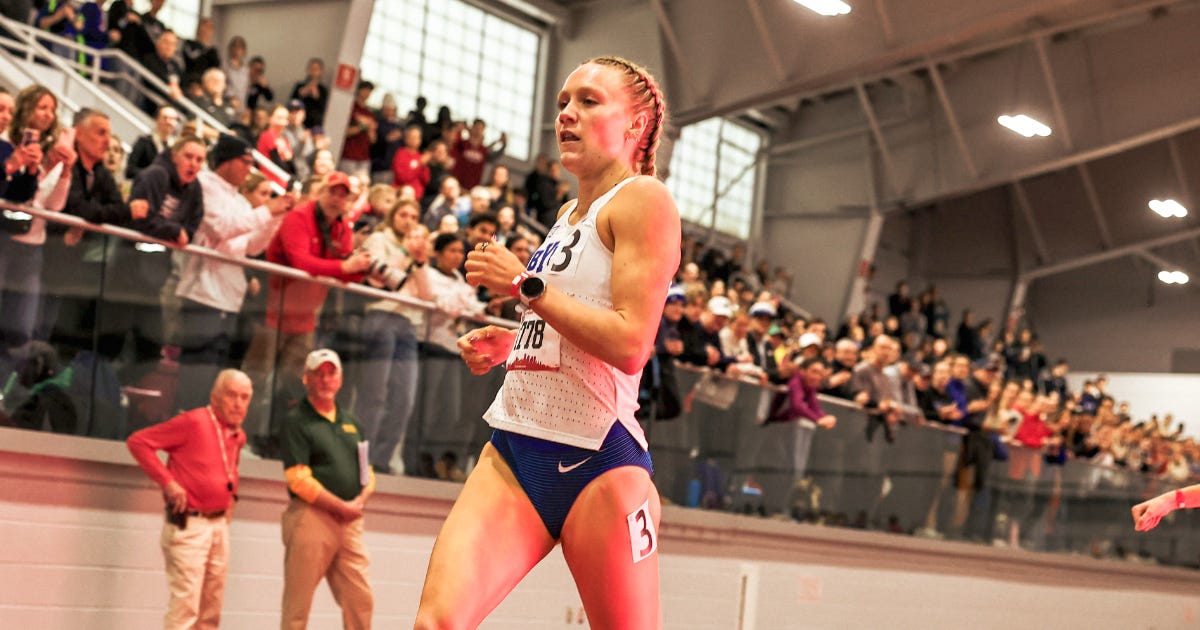
Did anybody else feel like there were a lot of track meets this weekend? From Boston to Birmingham, Fayetteville to the Fast Track, it seemed like every indoor oval in the Northern Hemisphere was booked and busy. If you weren’t able to convince your Valentine that a trip to the “short track” is the perfect date, you were forced to sit on your phone, constantly refreshing a menagerie of live results tabs for hours on end—an equally romantic way to spend the weekend.
Where to start… Cole Hocker’s American record? Keely Hodgkinson’s 1:56? Elle St. Pierre and her parade of record-breaking collegians?
Here’s the thing: the plethora of racing options this weekend offered a rich bounty of storylines, but that’s also kind of the problem. Let’s take the UK Indoor Championships, for example. Birmingham played host once again to the British national meet, and in theory, that should’ve been the highlight of the whole weekend. Josh Kerr! Georgia Hunter Bell! Matthew Hudson-Smith! …were all not there. In the first two cases, both Kerr and Hunter Bell were slated to compete, but granted last-minute medical exemptions by UK Athletics.
Because the British governing body doesn’t have a hard-and-fast World trials system, big stars facing small setbacks in training are able to still secure their spots at World Indoors without showing up and racing domestically. We don’t know the extent of their injuries, and we would never begrudge athletes’ desire to get and stay healthy… but it’s going to be a little annoying if Hunter Bell shows up in Lievin tomorrow, five days after the national championship, and crushes a sub-four 1500m.
Hunter Bell’s training partner, Keely Hodgkinson, did show up and race. Hodgkinson, who’s seemingly never once in her career needed to bust the rust, opened up her 2026 season by shattering her own national record in the 800m in the heats, clocking a solo 1:56.33 effort to land at #3 all-time indoors. Jolanda Ceplak’s 1:55.82 world indoor record from 2002 is officially living on borrowed time… but it’ll live at least a little longer, because Hodgkinson skipped out on the final, presumably to prepare for Lievin as well. That means that she’s still yet to face the #2 Brit this year, Isabelle Boffey, and paradoxically is the fastest 800m runner on the weekend but not the national champ. Shoutout to Boffey for actually starting—and winning—the final.
Let’s not dwell on the negative. Many of the biggest British athletics stars did show up and run through the rounds. Huge kudos in particular to Dina Asher-Smith, who, despite being based in Texas for training, made the trip to take on Amy Hunt in the 60m and come out victorious, 7.05 to 7.15. Asher-Smith’s now won New Balance, Millrose, and her national championships all in the last month, exactly the sort of schedule you’d expect of a top sprinter, but somehow more the exception than the rule. Thanks Dina!
Major not-kudos, on the other hand, to the second-fastest Brit of all time over 60 meters, Daryll Neita, who opted to run at the Tyson Invitational in Fayetteville, Arkansas instead of racing Asher-Smith and Hunt head-to-head in Birmingham. There’s no other way to say it—that’s lame!
The UK champs’ loss was the Tyson Invitational’s gain, however: those chicken-mongers know how to put on a rockin’ meet. Arkansas alum Jordan Anthony, last year’s NCAA champ over 60 meters, took down Trayvon Bromell and a pair of speedy Tennessee Volunteers with a blazing 6.43 victory, the T-10th fastest mark in history. Noah Lyles, who doesn’t often run a long indoor season, clocked his first indoor 200m in five years and got the win and an indoor PB of 20.56. Another beloved Arkansas alum, Britton Wilson, showed she’s back fully healthy and fit with a 50.66 victory over training partner and fellow former Razorback Nickisha Pryce. A bunch of pros taking over a collegiate home meet isn’t exactly ideal, but it’s still great to see them racing hard, and racing good competition.
The collegians themselves are fully in the thick of it, with Tyson and the BU Valentine Invite representing, for many, the last big opportunity to drop a fast time before shifting into the championship phase of the season. Behind Elle St. Pierre’s 4:17.83 mile in Boston was an epic NCAA battle, as three women got under the old collegiate record. Riley Chamberlain came damn close to clocking the first ever sub-4:20 in the NCAA, but Oregon’s Wilma Nielsen deserves a lot of credit for trying to go with St. Pierre and paying the price (to the tune of a 35-second final lap… oof. But ultimately Chamberlain timed her kick just right to put the new collegiate record in BYU hands. Behind them, Jane Hedengren became the fastest college freshman ever at 4:22.22, which also would’ve been a collegiate record had she not finished fourth.
The one stud that was missing was NC State’s Sadie Engelhardt, who opted to race closer to campus at the JDL Fast Track in Winston-Salem, and ran a 4:23.84. That would’ve been good for “fastest freshman ever” status if she’d only run it a few hours earlier! You can hardly accuse Sadie of dodging, however, as she was stepping up to race pros like Emily MacKay and Maggi Congdon without leaving the state, a totally understandable meet to put on the calendar.
Speaking of fast middle-distance runners with poor timing, you’ve gotta feel for Penn State’s Handal Roban, who’s putting together an 800m campaign for the ages but keeps getting overshadowed. He ran 1:44.73 at JDL, which would’ve broken Paul Ereng’s collegiate record had Colin Sahlman not done so earlier this month at Millrose. And he had to further suffer the indignity of losing to a high schooler! To be fair, he’s the fastest high schooler of all time in 17-year-old Cooper Lutkenhaus, who blitzed an astonishing 1:44.03 to set the world junior record and land at #6 all-time on the SENIOR indoor list. A totally honorable L for Roban to take, because Lutkenhaus is proving over and over that he’s more of a generational talent than a flash in the pan.
Of course, that wasn’t even the best intergenerational battle of the afternoon. Three weeks ago, it would seem absurd to imagine that Cole Hocker’s biggest threat at JDL would be a 16-year-old Kiwi, but Sam Ruthe’s 3:48 in Boston put him firmly in the conversation against Old Man Hocker, age: 24. But while Ruthe is undoubtedly a prodigy with boundless potential, he’s not yet a world-beater, whereas and more it’s seeming like Hocker-plus-healthy-training is a pretty invincible combo. Hocker didn’t just run 3:45.94 to break Yared Nuguse’s American record one week after its first birthday; he did so by winding up the field from the front and tearing it apart, closing his last 400m in 54.82 to expand his lead from 0.2 seconds to 4.5 seconds.
(Speaking of Nuguse and lethal kicks, Nico Young continues to show serious mid-distance wheels by beating Nuguse in the 3000m, 7:33.32 to 7:33.78. Young is going to be a problem in the 5000m this year.)
In years past, Hocker has intermittently caught flak for prioritizing small time trials over big races during the regular season. He’s also been viewed as a guy who will win you a medal in August but won’t be a factor in February. All that seems to be changing, and fast, with Hocker on his fourth straight win of 2026, running fast times with real competition. In 2025, the 1500m felt very in flux with the likes of Josh Kerr and Jakob Ingebrigtsen battling injuries, opening the door for guys like Isaac Nader. But if this version of Hocker is what we’ll get outdoors, the “no repeat champs” streak in the 1500m could come to an end quite soon.
Unless you’re a real freak who just loves paying streaming services, last weekend probably felt a little too diffuse. The common theme, however, was that the best races tended to be the ones where the biggest names toed the same starting line. This isn’t a new issue. In fact, it’s arguably one of the longest-running themes in the five-year history of this newsletter. There’s no one solution; fixing the track and field calendar would require a lot of different parties working together to make some tough decisions, and would likely make a few enemies. At the very least, we as fans can be discerning consumers, cheering loudest for the races with the best stakes and the athletes least afraid to take them on.
Black Canyon Is The London Marathon Of Ultras 🏃♀️
Every April, the annual running of the London Marathon pretty much guarantees two main things: the largest participation race in the world, and the best women’s elite field ever assembled. In 2025, the three fastest women in history (who have not been busted for doping) claimed the podium spots, in Tigst Assefa, Joyciline Jepkosgei, and Sifan Hassan. Back in fifth was 42-year-old Vivian Cheruiyot, a five-time global champion on the track. Eilish McColgan placed eighth in her long-awaited marathon debut in front of an adoring home crowd. And that’s pretty much what we’ve come to expect each time out!
This year figures to be just as great, with all three podium finishers returning to face off against World champ Peres Jepchirchir and NYC champ Hellen Obiri. But the race is still over two months away, so why are we talking about it now?
It’s probably a safe bet that most of our readers recognize most, if not all the names on the London list for their historic marathon accomplishments and generational talent. Jennifer Lichter, however, is probably not a household name… unless your household is really into trail running. Lichter is a 29-year-old based in Missoula, Montana. She was a walk-on at the University of Toledo and finished out her college career with 16:48 5000m and 34:22 10,000m PBs. Oh, yeah, she’s also the 2023 JFK 50 Miler champ, the Speedgoat 50K course record holder, and now the Black Canyon 100K champ.
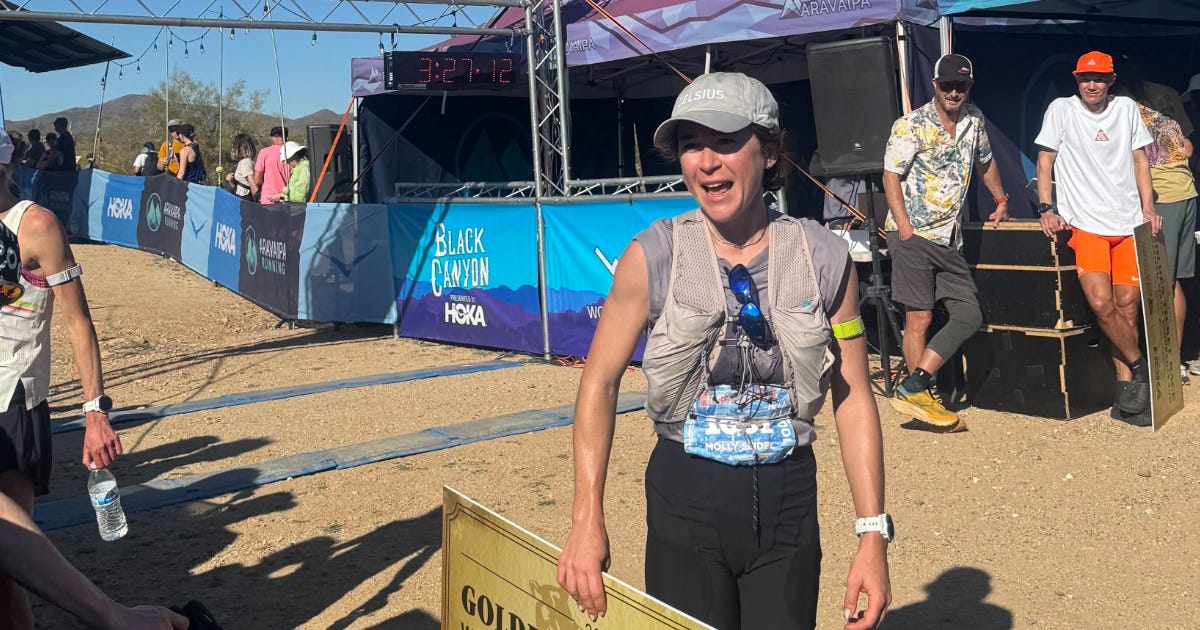
The Black Canyon Ultras were held last weekend about an hour north of Phoenix, Arizona, where Lichter took a decisive—but ultimately pretty narrow, by 100K standards—win in 7:57:05 Anne Flower, the 50-mile world record holder, finished just 70 seconds behind her. 12 minutes behind Flower was Tara Dower, whose claim to fame is that she holds the overall record—male or female—for fastest southbound hike of the Appalachian Trail. She also broke the course record at last year’s Javelina Jundred, which was previously held by another ultrarunning legend, Camille Herron (you can read her Wikipedia article to learn more!).
Rounding out the top five were Molly Seidel—yes, that Molly Seidel—and Abby Hall, the surprise winner at last year’s Western States 100-miler. (Seidel wasn’t even the only Olympic marathoner on the course, as Des Linden finished 13th in the 50K the next day as a training run for April’s Marathon des Sables in Morocco.) Until just before halfway, Seidel held the lead in the women’s race, but the combination of the brutal desert heat and the step up in distance got the better of her. She still hung on for fourth, securing a golden ticket to this year’s Western States. Should she compete, it would set up another huge clash between the 2021 Olympic bronze medalist and the best pure trail runners in the country.
Molly Seidel running Black Canyons felt a bit like a glitch-in-the-Matrix moment. Technically, everything from 100 meters to 100 miles falls under the umbrella of “running,” but ultras and especially trail races really feel like a totally different sport, with their own culture, circuits, and celebrities. So it might be helpful to frame things in road-running terms to realize what a bonkers race this was.
This year’s Black Canyon, featuring the Appalachian Trial FKT holder, the Western States champ, the 50 mile WR holder, and the Speedgoat course record holder all going head-to-head with a 2:23 marathoner really is the equivalent, in terms of field quality, of a London elite field. And the results delivered, just like London’s do, as three women finished underneath the old course record. Thanks to the pressure of their tight battle all the way to the finish, Lichter and Flower became the first and second sub-eight hour finishers in the race. And Seidel, to her great credit, ventured WAY outside her comfort zone and still proved she belonged.
There was a men’s race too! And Black Canyon champ Hans Troyer is, in some ways, the Sabastian Sawe of trail running: a preternaturally talented up-and-comer who pretty much emerged onto the scene a star and is only getting better. Just like London, however, the best narratives from the race came from assembling a field of internationally-renowned greats, all with different skill sets but meeting on the starting line of a high-stakes test. And like any world marathon major, the prestige of winning becomes more about the field you beat than the records you set along the way.
Comparing any race to the London Marathon makes for a high bar, but this year’s Black Canyon women cleared it. Now the standard is set. If Black Canyon can retain its newfound reputation as the place to be for every top female ultra runner, it could easily become the kind of race that escapes from niche status to broader recognition.
Sponsored by COROS
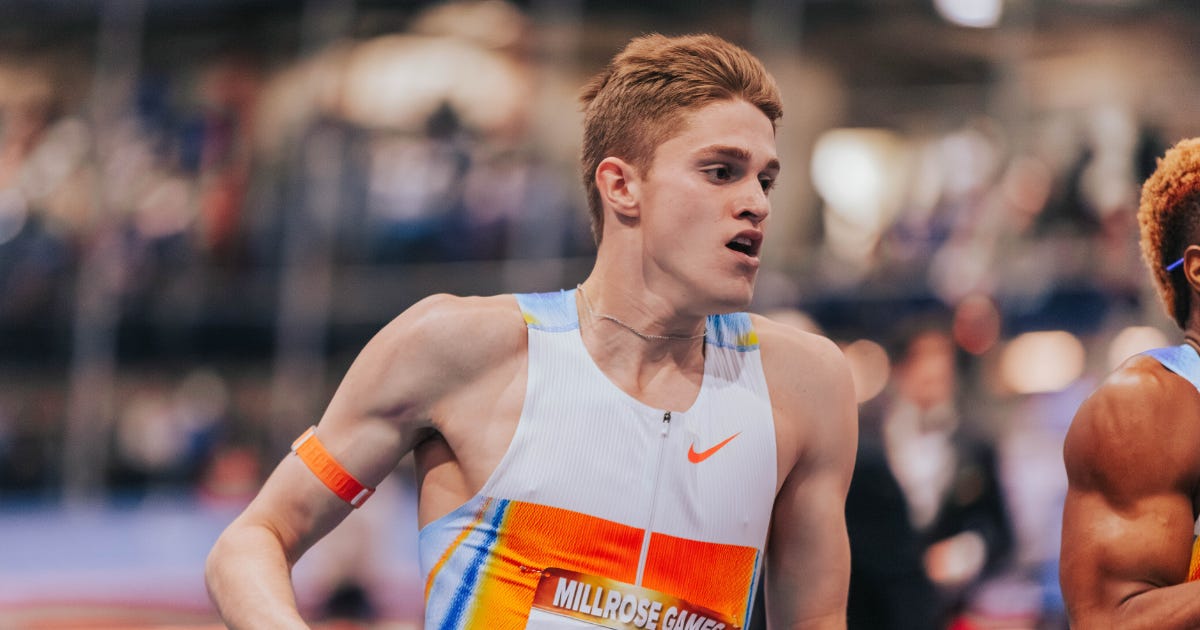
“I love to look at the heart rate. If that’s workouts or just easy runs. I’ve always been interested on, you know, if I feel really bad, is the heart rate going to be really high? Or if I feel really good, what’s the difference?…And then during workouts, something that I try to do is see how low I can get it in between reps.”
Cooper Lutkenhaus is the latest star to join COROS’ pro roster. After a historic 2025 season that included a jaw-dropping 1:42.27 800m to shatter the high school record and U18 World record, Cooper has carried that momentum into his first professional season by capturing wins at the Dr. Sander Scorcher, the Millrose Games and breaking the U20 800m word record again at the ASICS Sound Invite this past weekend with another victory in 1:44.03.
Guided by a data-driven approach, Cooper relies on the COROS PACE 4, Heart Rate Monitor, and POD 2 to track effort, optimize recovery, and refine every detail of training.
Learn more about how Cooper using COROS technology to unlock his full potential here.
Are We Approaching The Flat, Fast Marathon Singularity? 💫
Kyle Merber dives into the stats behind elite marathoning.
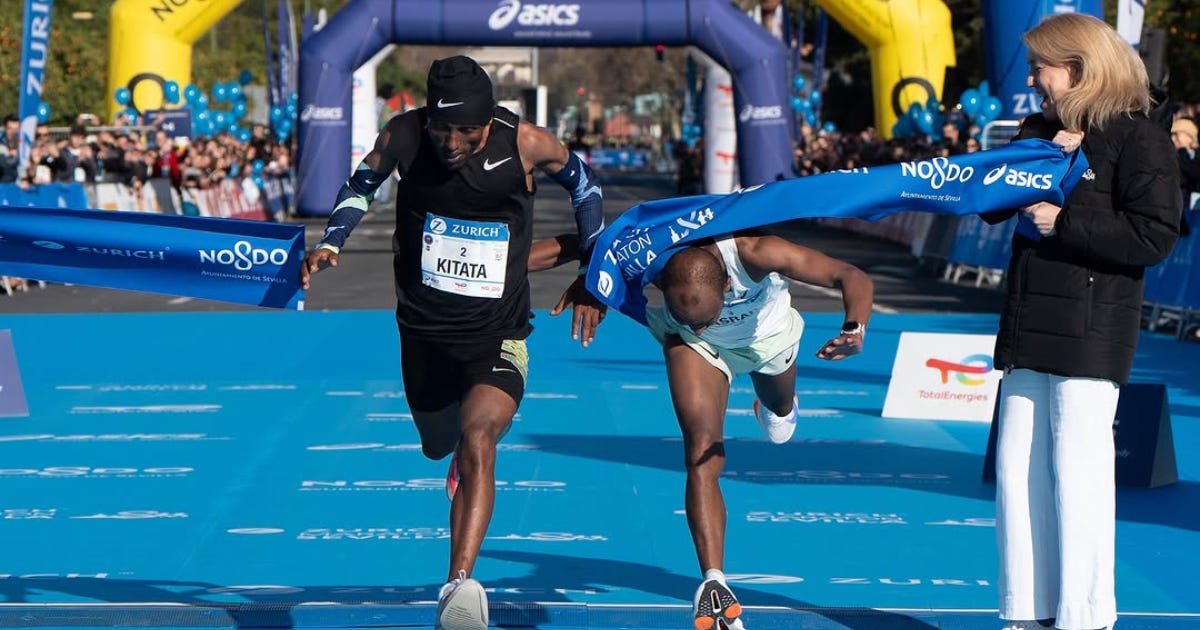
It was a wild ending to the Seville Marathon with Shura Kitata Tola and Asrar Hiyrden Abderehman diving (re: falling) across the line a second under 2:04 in an almost collar bone shattering finish. Further down the results, it was a good day for the Americans, too: Daniel Mesfun (2:08:24), Andrew Colley (2:09:33), and Reed Fischer (2:09:47) all PB’d and dipped below 2:10, and Frank Lara wound up just on the other side. And Finland’s Alisa Vainio shaved nine seconds off her national record en route to victory, going 2:20:39.
But despite the excellent performances, my heart filled with shame as I digested the results—I had no idea Seville was this past weekend. But is that really my fault? To be a road racing fan in 2026 not only requires a good VPN and Internet sleuthing skills, but also a well organized and basically empty weekend calendar.
With the marathon enjoying an explosion of interest from lost millennial souls looking for a purpose, races are gaining larger fields and deeper pockets. It seems like every marathon has enough cash to draw in at least a few 2:05 guys and 2:20 gals now, which has seemingly made it more difficult to track when the next race worth following should be on our radar. Of course the World Marathon Majors remain appointment viewing, but how does the distribution of top performances compare to a generation ago? Are there actually more races producing world class times now than there used to be?
Now for a bit of inside baseball. The way I normally write an article for The Lap Count is that something happens over the weekend, which leads to a kneejerk hypothesis, followed by a deep dive into the data to see if my theory holds water. Well, this week I supposed that top marathon performances twenty years ago would have been more concentrated than the wide range of fast races we see today. Surely in 2005, everyone either ran Chicago or London, and it was not only easier to be a fan, but fields were deeper and the top athletes couldn’t avoid one another, right?
Right?!
Wrong.
The numbers tell the opposite story. I took a look at the top 500 performances in 2025, 2015, and 2005, on both the men’s and women’s sides, for record-eligible courses. On prestige alone, a 2:42 in 2005 is worth a sub-2:30 today.
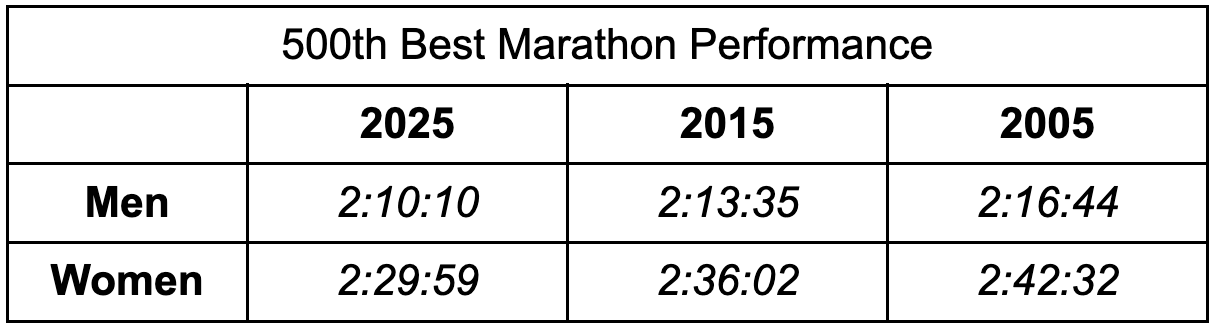
But what I was interested in is how many different races played host to each of these results. Last year, the men responsible for the top 500 marks ran them at 78 different events, and that figure was 96 for women.
In 2015 there was a distribution across 95 and 107 races, respectively, for the men and women. And in 2005 those performances were run across 96 races for the men, and 106 for the women.
Of last year’s 78 events, six races made up 36% of the top 500. If you are a dude looking to run under 2:10 in the marathon, then your best bet is to line up at Osaka, Valencia, Seville, Tokyo, Amsterdam, or Chicago. The women’s performances are not nearly as focused, perhaps because elite women are likely to have packs of men to run with if they venture outside the most conventionally fast courses.
Okay, enough numbers! What does this all mean?
Big picture, this is all net-positive—we want the top marathoners showing up to race each other as often as possible. That’s not their motivation though; time is. In 2024 the men’s Olympic standard was 2:08:10, and in the current 2028 cycle there’s speculation that the cutoff could be a minute faster. If the average elite marathoner’s schedule has room for two big efforts a year to hit that time, or chase absurdly fast shoe contract bonuses, then those swings can’t be wasted. An athlete needs to optimize to set themselves up for success, and a solo 2:09 on a hilly course doesn’t really do anything for anyone.
In the next few years, it’s reasonable to expect an even higher percentage of athletes will exclusively compete on those same few courses. This trend of flat, fast, bottle-heavy loops like the Marathon Project or the McKirdy Micro could become an increasingly popular destination for standard chasers if the economics make sense.
And that’s probably a good thing. We need consolidation. Times across the sport are broken, and comparing marathon results across time zones and topography is meaningless. Therefore head-to-head battles are the only barometer by which two athletes can fairly be compared. And when only three athletes per country, maximum, are selected for the Olympics, is the 20th place finisher really the 20th best marathoner in the world?
Of last year’s 500 fastest men and 500 fastest women, 676 hail from Kenya, Ethiopia, or Japan. We’ll never see all of them on the same starting line, but the fewer races they spread out across, the more we’ll understand about who’s actually the best over 26.2
More News From The Track And Field World 📰
– Death, taxes, and Spanish half marathons resulting in speedy performances: at the Barcelona Half, Ethiopia’s Hagos Gebriwhet (58:05) and Kenya’s Loice Chemnung (1:04:01) notched the world leads en route to the wins.
– Also… death, taxes, Spanish half marathons resulting in speedy performances, and Weini Kelati lowering her own U.S. and North American records in the half marathon: the recent Nike signee placed second behind Chemnung in Barcelona, going 1:06:04.
– At the Monaco Run—a run in Monaco—Faith Kipyegon ripped the longer-distance band-aid off and made her 10k debut, winning in 29:47. Dutchwoman Diane Van Es won the 5k in 14:33.
– At the Ras Al Khaimah Half in the United Arab Emirates, Geoffrey Kamworor of Kenya broke the tape in 58:14, a whopping 13 years after his first win on the same course.
– Another entry into the women’s 800m being a wildly competitive event category: Switzerland’s Audrey Werro took home the ‘W’ at the Belgrade Indoor Meeting in 1:57.27, the second fastest time posted in the world thus far in 2026.
– Summah down undah update: Peter Bol went 1:43.89 to win the 800m at the Perth Track Classic, the fastest outdoor time run this year and the third fastest time overall.
– At the Sirikwa Classic Cross Country meet in Eldoret, Kenya, local studs John Korir (29:44) and Agnes Ngetich (32:28) took home victories to the delight of the hometown fans.
– Five-time Olympic gold medalist Elaine Thompson-Herah competed for the first time since May of 2024, placing third in an outdoor 60m (7.24, into a 1.7m/s headwind) in Kingston, Jamaica. Interestingly, she appears to not have a shoe sponsor at the moment.
– Also in “long road back to the top” news, world record holder Yulimar Rojas of Venezuela triple-jumped a world-leading 14.95m at the Spanish Indoor Clubs Championships.
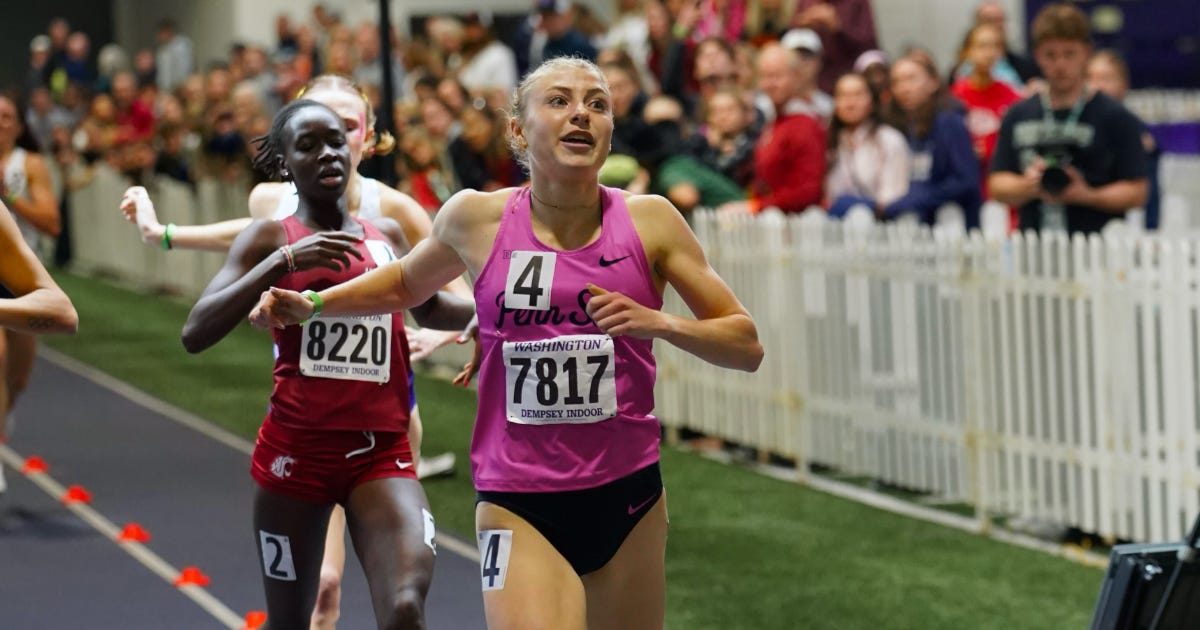
– In oversized short track (medium track?) action, Seattle’s Dempsey Indoor saw four collegians dip under two-minutes in the 800m: Australia’s/Penn State’s Hayley Kitching (1:59.22), Kenya’s/WSU’s Rosemary Longisa (1:59.71), Stanford’s Juliette Whittaker (1:59.76), and UW’s Chloe Foerster (1:59.91).
– For the second year in a row, the frankly horrible-sounding Barkley Marathons saw zero finishers of the full five-lap course. Hearty Frenchman Sébastien Raichon was the sole entrant to muster three loops in really crappy conditions, even by this race’s standards.
– Favour Ashe, formerly of Nigeria, has applied to switch allegiances to Qatar. Between him and Favour Ofili, it’s clear that the Nigerian athletics federation is doing themselves no favours [hold for groans]. No word on whether or not he’ll update his Instagram handle.
– And finally, in track-events-being-mentioned-in-pop-culture news, indie rocker and runner Kevin Morby released a jauntry new single called “Javelin.” The video stars comedian Caleb Hearon and Katie Crutchfield (of Waxahatchee fame), and is sure to hit the spot if you’re a fan of any of these people.
Interested in reaching 20,000+ dedicated runners and track and field fans? Advertise with us here.