

Running Up That Mill ⏱️
Lap 258: Sponsored by USATF
Sponsored by USATF

Get your tickets for the 2026 USATF Indoor Championships presented by Prevagen.
Use promo code CITIUS10 to save on tickets to the USATF Indoor Championships, where the stakes are high as athletes compete for the chance to represent Team USATF at the World Indoor Championships in Poland.
Feel the energy of the crowd, the speed on the track, and the pride of watching the nation’s best compete head-to-head at Ocean Breeze Athletic Complex in NYC.
The action takes place February 28 to March 1 as athletes battle for national titles. Tickets are on sale now. Grab yours before they’re gone!
Compiled by David Melly, Paul Snyder, & Kyle Merber
How A Prodigy Becomes A World-Beater 🔮
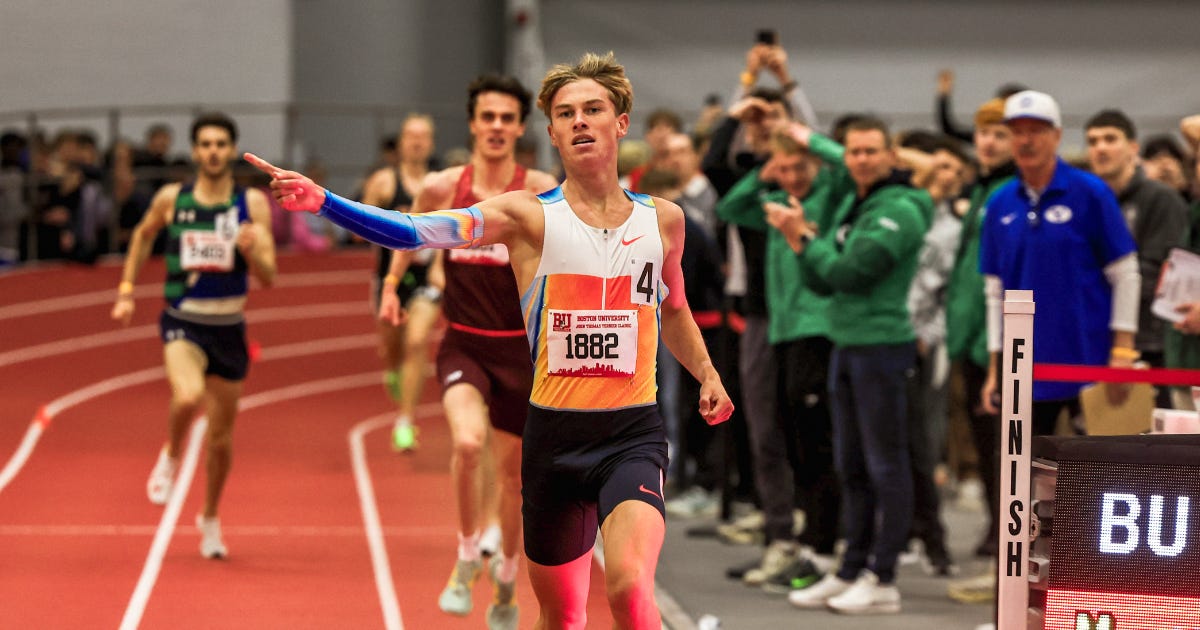
To discuss the latest preposterously fast performance by a teenager, we turn things over to Kyle Merber.
There are few performances in history that hit so hard that you’ll never forget where you were when they happened. My brain is still processing Sam Ruthe’s run in Boston the way your parents or grandparents remain in awe over the moon landing.
3:48.88 at 16 years old.
How can we even begin to make sense of that?
We can start with the stats: Ruthe’s performance lowers the age group record by every metric imaginable. It’s the 11th fastest indoor mile in history, and 54th overall. The next fastest 16 year old ever is some guy named Jakob Ingebrigtsen, who could only muster up a 3:56. And we all know how that turned out…
For Kiwis, the best way to contextualize the performance might be all the people Ruthe ran faster than to set this new national record: John Walker, George Beamish, Nick Willis, Rod Dixon, Peter Snell.
If I may… I think an interesting comparison might be against myself! When I was 16 years old, I was receiving letters and calls from nearly every college program in the NCAA. My ego knew no bounds, and my Olympic gold medal aspirations felt fully justified. With a mile time of 4:15, the world was my oyster!
We can rationalize this teenage 3:48 with a long list of reasons as to why Ruthe is so much quicker than everyone who came before him. Back in OUR DAY, we didn’t have super shoes, bi-carb, double threshold, the BU track, YouTube, or rabbits. We quadrupled at dual meets on Tuesday afternoons and we liked it! But deep in your gut, does it really feel like these factors all add up to this level of breakthrough?
Prodigious performances like Ruthe’s aren’t just impressive for the potential they reveal. They’re just plain impressive. But while it’s fun—and more healthy— to enjoy the show, it’s natural to speculate about the future of every prodigy. Not every great teenage athlete will go on to rack up Olympic medals, and those expectations can be daunting or even detrimental. So how can we identify the type of talent with staying power?
A generation ago, college coaches were all searching for that ideal recruit, the preternaturally talented diamond in the rough who won states after accidentally running 30 miles one week. Bonus points if they still played competitive soccer, and hailed from a “tough” state, like Michigan.
Now with athletes like Sam Ruthe (16), Cam Myers (19), Quincy Wilson (18), Marta Alemayo (17), Cooper Lutkenhaus (17), Gout Gout (18), Jane Hedengren (19), Biniam Mehary (19), and others running world class times before their 20th birthday, it’s safe to say the game has changed. They’ve all trained hard at a young age—you can’t run as fast as they are without doing so—but don’t appear to be on anyone’s radar as a burnout risk.
It’s worth asking: what factors should fans be looking for to help us make our best predictions about who will still be relevant in their mid-20s?
It’s helpful to look at the precedent and characteristics of previous generations’ wunderkinds. Allyson Felix was a World champion at 200m while still a teenager. Sydney McLaughlin-Levrone made the Olympics at 16. Galen Rupp and Jakob Ingebrigtsen should dispel any notions that training hard, like really hard, as a high schooler will shorten your peak long-term.
The first thing to consider is the support system around a young athlete. Is there space in their lives to be a phenom and also, y’know, a person? Cooper Lutkenhaus is still making it to practice every day. Quincy Wilson is staying in his home state for college.
We often see burnout among athletes whose parents are overly involved. There is a difference between being proud, and being invasive. What we want to see is parents whose love is not contingent on their children winning. That allows an athlete to cultivate the necessary intrinsic motivation that will guide them to keep chasing barriers, and to rebound from the inevitable disappointments that are part of the sport.
One perk of being precocious is that fans take a vested interest in every step along the way. Unfortunately there is a population of jealous psychopaths who also love to watch successful kids struggle.
And that’s the next factor to consider: how do young athletes handle loss? It’s Earth-shattering to go from universal praise and God-like invincibility to a reality check. When they can manage their emotions and zoom out to see the big picture, it’s a great sign of resilience. Consider this quote from Cam Myers in his recent interview on the Citius Mag Podcast:
“I am more focused on improving in training, whether that be improving just based on my threshold going up, or my mileage over time is going up, my speed is getting quicker, stuff like that… times aren’t always the best reflection of how well you’re tracking and the progress that you’re making.”
That’s a Wanamaker champion who isn’t consumed by a single data point on the clock.
Lastly, I want to see a young star with obvious areas for improvement. A sprinter with great top-end speed, but a terrible start… that’s okay, you can learn that! A miler who always gets caught on the inside and closes like a maniac to make up the difference. Tactics can be perfected by coaching or experience. It can seem like a red flag, but inconsistency is a sign of a high ceiling.
Ultimately, there is too long of a timeline and too many variables to pinpoint the perfect formula that will ensure the fastest kid today will become the fastest adult tomorrow. But the consistent threads among those who were able to make the transition are poise, persistence, and the ability to roll with the punches.
And what we have seen from this current crop of young talent is that they’re incredibly well-prepared thanks to those who were in their shoes before them.
Wanamaking Things Interesting 😈
There’s been a lot of talk around the track scene recently around the benefits of [legal] supplements like bicarb, ketones, and heck, even prebiotic sodas. But you know what we should be pushing on top pros? Vitamin C! B12! Zinc! Homemade chicken noodle soup!
Clearly, the immune systems of the world’s top athletes are fighting an uphill battle during this cold, dreary winter, because all the news leading up to the 2026 Millrose Games seemed to descend into hourly announcements of which athletes had withdrawn with sickness. Grant Fisher, Quincy Wilson, and Elle St. Pierre all fell victim to illness in the days leading up to New York’s best indoor meet, as well as Josh Hoey (who gave no specific reason for his DNS) and Cian McPhillips (dental issue…?), two more athletes who’d picked up wins at the New Balance Indoor Grand Prix the week prior.
While we’d generally prefer to see all the fit, fast people show up and race each other, there’s a silver lining to the randomness of the cold and flu season: it mixes up the fields and their dynamics at the last minute, throwing all our carefully-concocted analysis and predictions into disarray. In the men’s two mile and women’s Wanamaker in particular, that meant that two noted pace-pushers who were among the favorites for the win wouldn’t be around for the kickers to key off.
The close proximity of the two biggest U.S.-based pro indoor meets meant that most of the people who were fit on January 24th were—unsurprisingly—still fit eight days later. Dina Asher-Smith and Ackeem Blake made quick work of their respective 60-meter fields for the second week in a row, and Roisin Willis didn’t let a drop down in distance (or an American-record detour to BU) stop her from taking the 600m. In the hurdles, Danielle Williams doubled up on titles, while Cordell Tinch improved on his fifth-place showing in Boston with a Millrose win.
It’s unfair to call the first 30 or so minutes of the Millrose program boring, because we still got some damn good races, but it was the most predictable segment of Sunday’s festivities. That sentiment didn’t last long, however, because the distance races were intriguingly drawn. The women’s 3000m gave everyone the pre-NCAAs matchup of Jane Hedengren vs. Doris Lemngole we wanted. Though Lemngole beat her rival handily in cross country, it was nevertheless wild to see the Alabama superstar so handily dispatch a 14:44 5000m runner en route to a new collegiate record of 8:31.39.
And that was just the beginning. The men’s two mile may have lost some of its “Greatest Field Ever Assembled” shine with the loss of Fisher, but the indoor 3000m world record holder not running meant that there wasn’t a guy in the race who would probably have hit the front in the last 1k, squeezed the pace, and tried to hold off the kickers. Maybe Fisher’s untimely cold cost us a true shot at the world record, as the whole field had sagged off 8:00 pace by 1200 meters and no one looked particularly eager to step up and keep things honest.
Instead, it was Graham Blanks who decided to enter the mix, moving up six places to the front with five laps to go and injecting a little pace and intrigue. The last lap came down to a trio of kicks, but instead of Fisher, Josh Kerr, and Cole Hocker, it was U.S. XC champ Parker Wolfe mixing it up with the big dogs. Clearly having to go fast-twitch-for-fast-twitch with Ethan Strand every day in practice is pretty good prep, because Wolfe, who’s historically known as a bit more of a strength runner, gave two of the best championship milers in the world a true run for their money.
In the end, the finish order was still 1. Hocker, 2. Kerr—a fairly expected outcome for the two most decorated runners in the field. Hocker may have two global golds, but he finished second, third, and third in his previous Millrose appearances behind three guys that were in the race (Kerr, George Beamish, and Cooper Teare), so this result was actually a bit of table-turning that seemed to have left Cole in need of a nap.
Before we could even get to the main events, the surprises kept coming. The men’s 800m featured the first- and third-fastest Americans of all time in Bryce Hoppel and Donavan Brazier taking on 1:42 man Mohamed Attaoui… so you probably could’ve cashed out pretty big by betting on Colin Sahlman, who entered the race with a 1:47.49 indoor PB. Indeed, it was Sahlman, the 22-year-old NAU senior, who kicked his way to a shiny new lifetime best of 1:44.70 and broke Paul Ereng’s 36-year-old NCAA record. Two months ago, Sahlman was finishing 16th in the 10k at NCAA XC, and now he’s closing in 26.3 to show up the best middle-distance pros in the world. Must’ve been a productive winter break!
Last, but certainly not least, the Wanamaker Miles. (And lest you sprinter and field eventers get mad at us calling them the “main events,” take it up with the Armory, which literally waited until three-quarters of the way through the meet to have someone sing the national anthem.) The withdrawal of Elle St. Pierre meant that no one would break the all-time women’s victory record, and the absence of any other former champ on the start line meant that the race would end with a new victor.
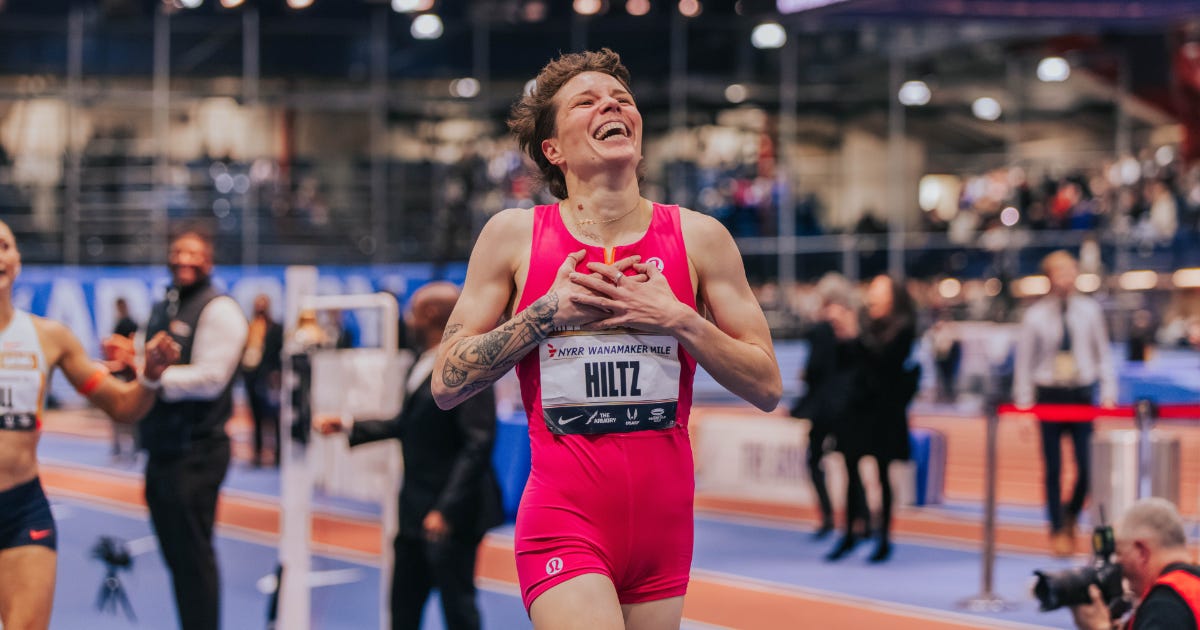
For anyone who’s watched any of the last six USAs, it wasn’t a surprise to see Nikki Hiltz kicking their way to a 4:19.64 victory, but they still had to beat out Jess Hull, the #6 all-time miler outdoors at 4:13.68, to do it. In third was an athlete we’ve got to start paying more attention to as she enters her first full year as a pro: Klaudia Kazimierska of Poland and formerly Oregon. For the second week in a row, Kazimierska set a new PB and national record in a top-three finish, picking up where she left off in 2025, a season where she only finished fifth at NCAAs but ended up seventh in the World final.
The men’s mile saw Yared Nuguse make a brilliant effort at four straight, but the boundless talent of 19-year-old Aussie Cam Myers won out, as last year’s Wanamaker third-placer got to hoist the trophy this time around. Nuguse still ended up second in 3:48.31, doing a bang-up job of holding off Hobbs Kessler in third. But perhaps the biggest surprise was Nico Young—yes, U.S. 10,000m champ Nico Young—finishing fourth in 3:48.72. You don’t win a U.S. title over any distance without some serious wheels, but given that Young was slogging it out in Tallahassee just three weeks ago, it’s seriously impressive to see him ahead of more traditional milers like Andrew Coscoran and Ollie Hoare. When you think about the long-term potential of an athlete like Nico Young, who’ll just be entering his distance-running prime when LA rolls around in a few years, this is one of those races where we may just be seeing the early flashes of global podium potential.
For a meet with a long and storied history that featured and promoted a lot of past winners in its 2026 program, it was refreshing to see so many unexpected outcomes. Yet the races didn’t feel shallow or deflated, even with a few big names missing. Instead, they were full of kinetic energy and restless tactics, generating electric finishes and introducing the broader NBC audience to fresh faces. It’s a fitting blend of old and new for a race in its 118th edition on a track that means so much to New York’s high school runners. It’s also hopefully a sign that the international pecking order is far from set and that this pro season will be full of surprises.
We’re Using The 600m Wrong 🙃
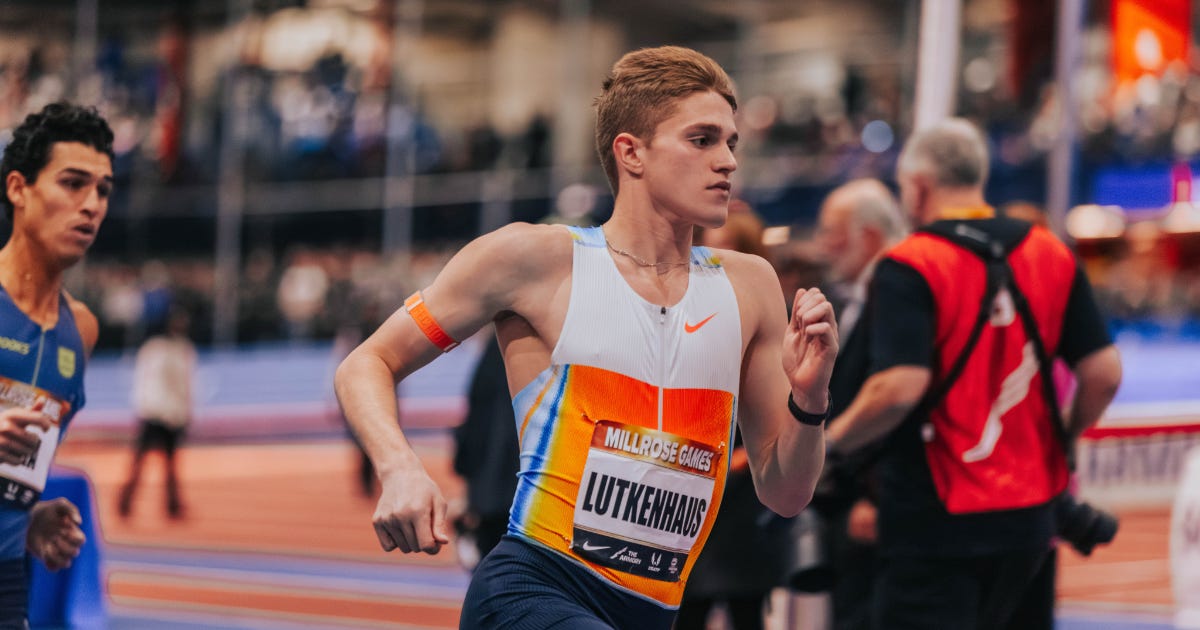
Two of America’s most promising young middle-distance stars took home decisive victories at Millrose, but though Roisin Willis and Cooper Lutkenhaus both factor greatly into the broader track and field conversation at the moment, the distance they competed in sure doesn’t.
Willis took down a respectable domestic field and posted the seventh-fastest indoor 600m in American history (1:24.87). And in the men’s field, 17-year-old Luthkenhaus took some time off from being a high school junior and posted the fifth fastest time in U.S. history (1:14.15).
Both youthful 800m specialists posted comparatively even splits in their one-lap-shorter-than-usual outings, and in doing so, hawked down the bell lap-leader over the final 75 meters to cruise to victory. Tactically speaking, they both demonstrated poise and patience beyond their years, and both gave us another reason to believe that Team USA just might be bringing home some hardware in the 800m at the next handful of global championships.
But also… like… what else was going to happen? By and large, the fields assembled for the 600m races at Millrose were comprised of 800m specialists. It makes sense they would play out like 800m races, and that the best 800m runners in the field would win. As much of a treat as it is to watch Roisin Willis and Cooper Luthkenhaus compete at any distance as they enter their prime racing years, we wanted something a bit more unpredictable from a scarcely contested event that in theory should serve as a mad science experiment, pitting legitimate mid-D studs against 400m and 400mH stalwarts.
Take a look at the all-time U.S. list for the women and men.
Ranked within both top 10s you see a bunch of names synonymous with the 800m—Mu-Nikolayev, Wilson, and Rogers for the women, Hoey, Brazier, and now Luthkenhaus for the men. But scattered throughout both are a handful of athletes who came at the event like sprinters, and even some whose highest scored career performance was the 600m.
Britton Wilson, Courtney Okolo, Shamier Little: all 400m/400mH stars who managed to hang on for an additional indoor lap. And then there’s the curious case of Alysia Montaño, a global 800m medalist whose best individual career performance—if you believe the WA scoring tables—was actually an indoor 600m.
The men’s list doesn’t include as many pure 400m/400mH types, but is instead heavily skewed toward the sort of tragic athlete whose best event was likely one that is rarely contested: Will Sumner, Erik Sowinski, Cas Loxsom… and in the Montaño spot, Brandon Miller, a globally competitive 800m man who would likely have a larger trophy shelf if the outdoor races stopped a little shorter.
Now envision a world where space and time have collapsed on themselves, in which Millrose’s 600m lineups were simply the U.S. all-time top-ten lists with everyone in their prime. It’s difficult to imagine how those races would go, isn’t it? Does somebody like Little or Sumner dare the rest of the field to enter the Gray Zone, and succeed in running the legs out of the 800m stars who likely were hoping for a slightly more evenly paced affair? Is a Brazier or Mu-Nikolayev simply too good and too speedy for that to work? Does a Montaño or Miller prove that sometimes you need a precise tool to accomplish a specific task?
Who’s to say? Not you, unless you’ve got a time machine. Instead, we get to think more about Sunday’s 600m races which did not play out in any of these ways.
The women’s race owed its early pace to Michaela Rose. Though notoriously a risk-it-all front runner adept at overriding her internal pacing governor, she is ultimately not a 400m runner. She is going to race a 600m like a front-running 800m runner, which she did, resulting in a race that felt more like a condensed half-mile than something wholly unique. We’d seen this before—Rose jumping to an early lead, pushing from the gun, and hoping the pieces stayed in place long enough to hold off late challenges; Willis sitting just far enough back to not cook herself, then striking when Rose began to falter. It was just the sub-90-second edit of the usual two-minute version.
The men’s race benefitted from the presence of eventual second-place finisher Jenoah McKiver, who is carving out a solid professional niche for himself as a 4 x 400m relay depth piece. Him leading most of the race wasn’t shocking, but we hadn’t seen before how he’d react to a field of mid-D guys, nor how they’d respond to McKiver. Because of this, he was a bit of an unknown in terms of how he might handle the last lap, but he acquitted himself nicely, and made Luthkenhaus sweat through the final curve before it became apparent that the kid’s 800m strength would be too much for him.
Hard-closing long sprinters, take note: per World Athletics, McKiver’s top-scoring career mark came at Millrose. He might be a 600m specialist in a world where no such thing exists. That’s something we wouldn’t know about the 2025 mixed relay gold medalist without him being included in this field. And his presence delivered something the women’s race didn’t: two athletes who don’t normally share a starting line going head-to-head.
We need more Jenoahs! Whenever a tweener event like the 600m is given center stage, we really need to make sure the players come from a range of disciplines. It keeps the racing more interesting. Developmentally, it gives star athletes a different tactical look to respond to. And in a world where the indoor season can sometimes feel like a collective hibernation while we wait for the summer to roll around, it gives us an opportunity for the “short track” to deliver something distinct and unique.
More News From The Track And Field World 📰
– After last month’s announcements detailing the loaded Boston fields, you could be excused if you expected London to come up empty-handed. Luckily, however, you’d be wrong as hell. The women’s field for London includes all three medalists from Paris—Sifan Hassan, Tigst Assefa, Hellen Obiri—plus the Tokyo Worlds champ, Peres Jepchirchir. The men, meanwhile, are headlined by Sabastian Sawe and Jacob Kiplimo, plus debutants Yomif Kejelcha and Hagos Gebrhiwet.
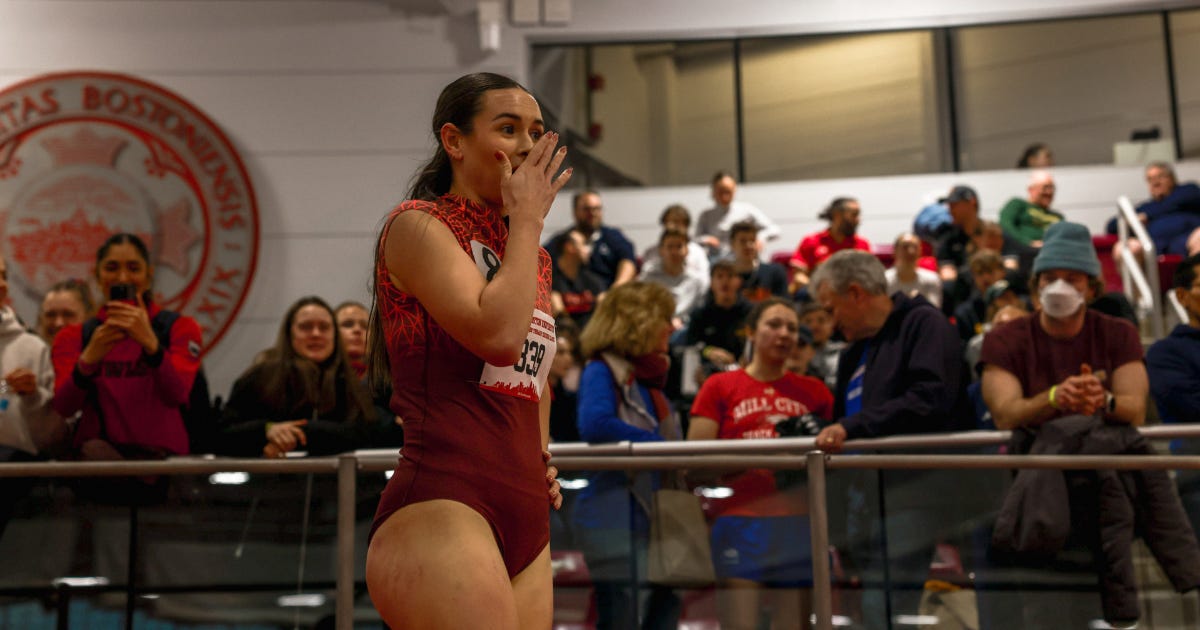
– Great Britain has itself yet another 800m stud: Isabelle Boffey, who had previously never broken two minutes indoors, knocked out a 1:57.43 performance at BU Terrier, which puts her in the global all-time top-ten.
– The Dempsey, BU, and the Armory tend to get nearly all of the domestic indoor attention, but down at the Razorback Invitational, plenty of fast times were posted: Florida’s Wanya McCoy went 20.50 in the 200m, Silan Ayyildiz of Oregon went 4:25.11 and Michigan’s Trent McFarland went 3:52.73 to each win the mile; Shenese Walker of FSU took the 60m in 7.09, and South Carolina’s JaMeesia Ford stepped up to 300m and won in 36.12. Pros Christopher Morales Williams (44.87 to win the 400m) and Trey Cunningham (7.42 to win the 60mH) were on hand as well.
– And before you hand the NCAA indoor title to Sahlman, at the Penn State National meet, Handal Roban (first in 1:44.91), Tinoda Matsatsa (second in 1:45.12), and Allon Clay (1:45.17 for third) put on a hell of a show in the men’s 800m.
– Across the pond, the Czech Indoor Gala in Ostrava featured the first-ever indoor race where four men broke 1:45 at the same time, led by Belgium’s Eliott Crestan in 1:43.83. In the 60m hurdles, Polish star (and every copywriter’s worst nightmare) Pia Skrzyszowska ran a world-leading 7.78 in the prelims and then backed it up with a 7.80 in the final.
– You know how world records are always reported as “pending ratification?” Well… once in a blue moon, that asterisk ends up mattering. It turns out Jacob Kiplimo’s 56:42 run from the Barcelona Half Marathon in 2025 won’t end up ratified as the half marathon WR because it was determined he received a little too much wind-breaking assistance from the race’s lead vehicle.
– Another significant barrier is reportedly in place if Grand Slam Track wishes to return for a second season—being licensed by the sport’s governing body. World Athletics is withholding its blessing unless GST pays back the roughly $30m debt it owes to athletes and contractors.
– File it under “bad things to see in your sport that you could also argue put it in the same company as the NFL, MLB, and NBA.” We’ve got ourselves a small betting scandal! (No athletes named in the disciplinary action wagered on their own performance, but per World Athletics, tracksters betting on trackers is still a no-no.)
Interested in reaching 20,000+ dedicated runners and track and field fans? Advertise with us here.
Excellent breakdown of what separates flash-in-the-pan prodigies from sustained excellence. The emphasis on support systems over raw talent feels underappreciated in distance running coverage. I've seen too many high schoolers peak at 17 becuase parents or coaches treated early success as validation rather than a starting point. The point about resileincy after losses is spot on tbh.
Will Kyle Merber ever stop talking about himself? "If I may… I think an interesting comparison might be against myself! When I was 16 years old, I was receiving letters and calls from nearly every college program in the NCAA. My ego knew no bounds, and my Olympic gold medal aspirations felt fully justified. With a mile time of 4:15, the world was my oyster!"
When Kyle previously wrote for the Lap Count (before his tenure at Grand Slam) he requested feedback on his posts. My feedback was for him to stop talking about himself in every post but rather talk about the subject itself. Here we are, several years later, and nothing has changed.
Please stop this Kyle. I don't want to read about you. Narcissism is not a good look.