

Strength, Speed, Or Both? ⏱️
Lap 243: Sponsored by Olipop
Sponsored by Olipop
Kian Tajadod isn’t having it with traditional soda. Working construction in the heat, all he wanted was something refreshing without being overly sweet. So he tried everything: teas, seltzers, you name it. Nothing hit the spot. Then one day, he cracked open an OLIPOP… and it was game on.
His go-to: Cherry Cola. One sip takes him back to childhood, surrounded by cousins and grandparents. Now, as a construction company owner? It’s safe to say his job site coolers are fully stocked with OLIPOP.
Give that flavor and all the rest a try at DrinkOlipop.com and use code CITIUS25 for 25% off all orders. The best Olipop deal on the internet!
Compiled by David Melly, Paul Snyder, Audrey Allen & Jasmine Fehr
Picking An Athlete Of The Year Has Never Been Tougher 😩
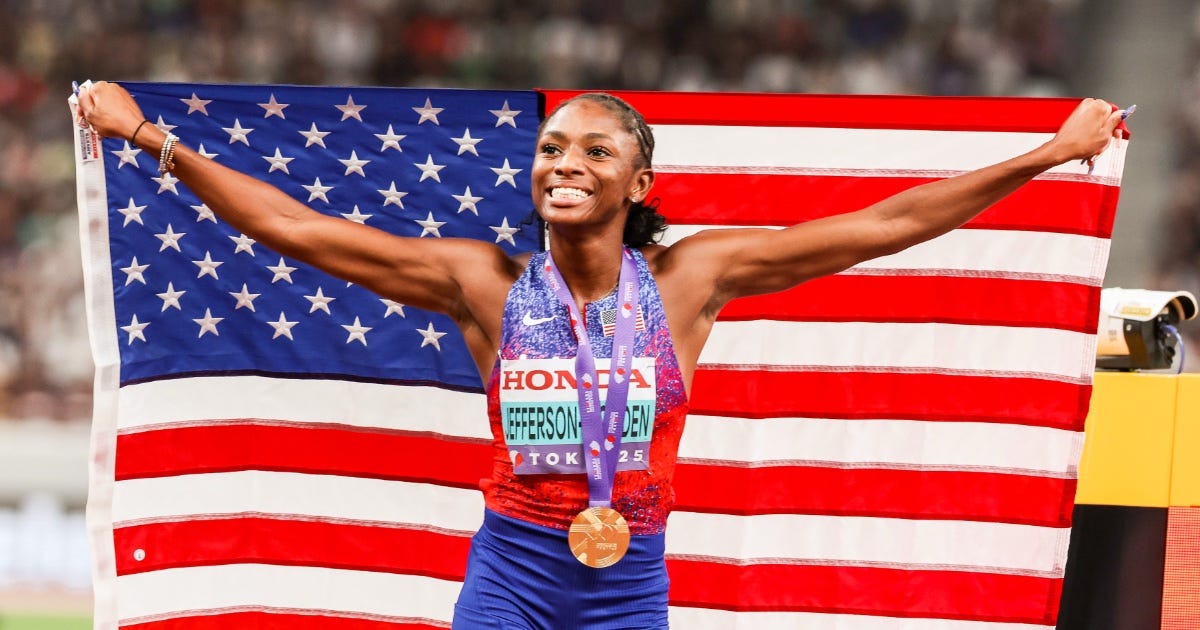
With the book closed on the 2025 track and field season at last, it’s time to start looking back on the year as a whole. Sure, it’s still October, but with any December time trial meets really counting toward the start of the 2026 indoor season, it feels like an appropriate time for some reflection.
We’re not the only ones getting a jump on navel-gazing, either. World Athletics has begun rolling out its nominees for its end-of-year awards, beginning with the finalists for Track Athlete of the Year and Field Athlete of the Year. At least one of those awards won’t be much of a competition at all. (Where does Mondo even put the trophies at this point? And Valarie Allman has a pretty strong case that she’s been more dominant over the discus than ever before.)
The men’s track nominees are particularly interesting because no one has really had an unblemished campaign. Four of the five nominees got beat a few times in their primary event, even if the year ended with a World title. Noah Lyles probably has the best shot at reclaiming this award after losing out to Letsile Tebogo last year as he’s unquestionably the best 200m runner this season. But Lyles didn’t pull off the same triple he did to claim the crown in 2023. Weirdly—although perhaps suitably for a 2025 season that could be very hard to predict at times—this race feels wide open because nobody has been truly extraordinary.
The women’s competition has the exact opposite problem. The athlete with the most memorable performance from this year’s World Championships, Sydney McLaughlin-Levrone (ever heard of her?), has arguably the fourth most compelling resume among the five nominees. Sure, you became the first athlete in 40 years under 48 seconds in the 400m, but that’s simply not good enough, kid. Even Faith Kipyegon’s seventh global 1500m gold and third world record probably won’t be enough to land her atop the voting.
That’s because two athletes—Beatrice Chebet and Melissa Jefferson-Wooden—have run fast and won repeatedly this year. Both women were untouchable from start to finish in 2025. In addition to coming home from Tokyo with a hefty medal haul, they raced early and often, something the folks in charge of organizing all those races presumably appreciate.
The challenge in narrowing things down from finalists to winners (which is a combination of World Athletics voting and popular voting) is comparing speedy apples to distance-y oranges. Chebet and Jefferson-Wooden were dominant at opposite ends of the track spectrum… so how do you decide who’s better? As a voter—which, as a member of the social media-having public, you are—you’ve gotta choose one.
First, a quick resume refresher:
Beatrice Chebet: World 5000m and 10,000m champion; 13:58.06 5000m world record; 8:11.56 #3 all-time 3000m; 3:54.73 1500m; beat reigning World 5000m champ Faith Kipyegon and World 10,000m champ Gudaf Tsegay head-to-head.
Melissa Jefferson-Wooden: World 100m, 200m, 4x100m champ; season’s bests of 10.61 (#4 all-time) and 21.68 (#8 all-time); undefeated in 100m and 13 for 14 in individual races overall; beat Olympic 100m champ Julien Alfred head-to-head twice.
Aren’t we lucky to be living in a time with both these women on the track? Talk about an embarrassment of riches.
In some ways, the question could come down to whether you weigh Chebet’s barrier-breaking sub-14 run heavier than MJW’s relay gold. But there are other factors to consider as well: Chebet has been fantastic, but also relatively consistent to her 2024 form, whereas Jefferson-Wooden has noticeably stepped up her game this season. Chebet hasn’t won this award yet despite being a two-time World XC and double Olympic champ, so arguably she’s due. And opinions vary on how much to consider distance times in the trackflation world, particularly when Jefferson-Wooden is being measured against mythical 1980s FloJo marks.
There’s also the question of who will win vs. who should win.
Historically, the Athlete of the Year award has skewed toward sprinters, like in 2013, when Shelly-Ann Fraser-Pryce won for the same triple-feat Melissa just pulled off. The 2023 revamp of the awards system to consider track, field, and “out of stadium” performances in three separate categories helps expand the shine a little, but that still ends with 10,000m runners going head-to-head with indoor 60m specialists. The last comparable long-distance winner was Almaz Ayana, whose world-record setting 10,000m at the Rio Olympics was a mind-boggling performance at the time (Faith Kipyegon and Eliud Kipchoge have also won in recent years but aren’t purely long distance track specialists).
The popular vote and the “World Athletics Family” vote (a group of current and former pro athletes and other influential figures) each count for 25 percent of the overall voting, each of which could lead to regional bases of support from the U.S. and East Africa. But each could end up with a split vote of her own as there are two American nominees and two Kenyan nominees, so it may be a bit of a wash. Ultimately, the shadowy entity known as the “World Athletics Council” will likely get the final say—and who knows what they value most?
For us here at the Lap Count, the decision comes down to ~vibes~. Chebet’s two-year run atop the distance ranks has truly been remarkable, particularly as she’s repeatedly beaten a just-as-lethal Kipyegon two championships in a row. But 2025 really was the Year of Melissa, and there’s something to be said for recognizing not just accomplishment, but ascendence. Nobody likes a tie—least of all track and field fans—but this year’s Athlete of the Year is absolutely a photo finish, and it may come down to the thousandth on the metaphorical FAT photo to crown a victor.
Jane Hedengren Has Every College Athlete Racing For Second (And More XC Thoughts) 💃
It’s an interesting time in the NCAA cross country calendar. It’s not early in the season by any means, but some athletes are just opening up. It’s not championship season, and yet NCAAs is only a month away. Right now, everyone is just trying to make it through in one piece, keep their cards close to their chest, but still somehow show everyone they’re not to be trifled with.
These themes manifested themselves on Columbia, Missouri’s premier cross country course for Pre-Nats, and at the “post-nats” grass of Madison, Wisconsin, for Nuttycombe. But the dominant storyline this week is one of the most highly anticipated debuts in NCAA cross country history.
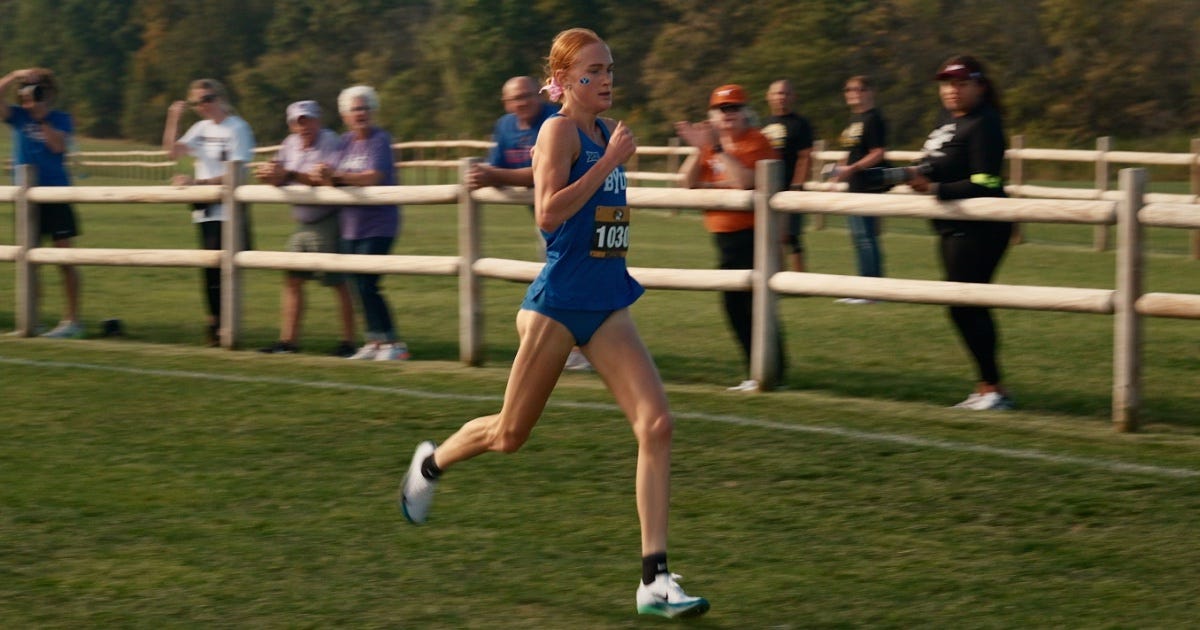
BYU’s star freshman Jane Hedengren finally raced in a Cougar kit at Pre-Nats, and the high school phenom—who shattered three national records last track season—made her college debut in spectacular fashion. She ran 18:42.3 to win by 23 seconds and set a massive course record. With a performance like that, the question now becomes: can she win the NCAA Championship as a true freshman?!
It’s more than possible, but to do so, she’ll have to face and beat world-class competition. Defending champion Doris Lemngole and runner-up Pamela Kosgei are back, along with five more top ten finishers from last year: Hilda Olemomoi (3rd), Amy Bunnage (4th), Grace Hartman (5th), Paityn Noe (7th), and Hannah Gapes (8th). Bunnage and Noe have yet to open their seasons, but other experienced runners across the NCAA are ready to step into top-10 territory if there’s an opening.
So how do you make your individual title predictions? Do you bet on experience, on talent, or on momentum?
Lemngole and Kosgei have proven time and again that they belong at the top. In addition to their first and second place finishes at last year’s cross country championship, Lemngole won the NCAA steeplechase title (in a barrier-breaking collegiate record, of course) and Kosgei won both the 5000m and 10,000m. Someone like NC State’s Hartman has both experience and momentum on her side too, after winning the Nuttycombe Invite in 19:30.1. She was followed closely by her teammate (and World Championship finalist) Angelina Napoleon in 19:34.6, who could be another favorite for the individual title.
But even without NCAA championship experience (or global experience like Lemngole and Napoleon possess), Hedengren has made it clear that she’s in the title conversation. Let’s not forget that, before she even got to college, she ran 4:23.50 for one mile and 14:57.93 for 5000m, which would rank her #2 and #6 on the NCAA all-time lists had she run them a few months later. Kosgei and Lemngole both have 5000m PBs of 14:52, so it’s not like Hedengren was way behind them even before this latest performance.
After a summer of uninterrupted training, she may be fresher and more finely tuned for November than those who extended their track seasons into September. And let’s not downplay the dominance she displayed at her first-ever college race! Winning Pre-Nats by 23 seconds against some of the best runners in the country isn’t something you can just shrug off.
She also has one of the best support systems in the country. Being coached by Diljeet Taylor and training alongside her BYU teammates, Hedengren is in an environment built for sustainable success and peaking at the right time. Aside from a 14th place team finish in 2023, Taylor’s squads are known for stepping up when it matters most. Only one true freshman has ever won the NCAA cross country title on the women’s side: NC State’s Suzie Tuffey in 1985. Jane Hedengren might just be the second. We’ll find out in about a month!
But Hedegren wasn’t the only runner to make a statement this weekend, and the championship picture is taking clearer shape, as more harriers started firing on all cylinders and geared up for a run at a conference title.
It’s raining cats and dogs, just not at the same meet: The growing storyline between No. 1 BYU and No. 2 NC State women’s squads can’t get much better than this. You might be inclined to think the defending champs are miles ahead of their next challenger, especially after a weekend where BYU placed all their scorers and a plus-one inside the top 10, their seventh in 18th, their ninth in 23rd, and 12 inside the top 100. (Plus, they still haven’t raced Jenna Hutchins, a 15:16 5000m girlie and 10,000m All-American two seasons ago.) But a 25-point win at Pre-Nats might not be worth as much as a 41-point win for NC State at a more competitive Nuttycombe in Wisconsin. With 18 of 30 ranked teams racing: Grace Hartman and Angelina Napoleon marked themselves as reliable ultra-low sticks, and ninth-placer Bethany Michalak has clearly leveled up since a 160th-place finish at NCAAs last year, running under 20 minutes. Given that the two are in different conferences and different regions, we won’t see the head-to-head we’ve been waiting for until NCAAs. The Cougars’ depth sure seems untouchable, and they have more room for people to have bad days or injuries. But if the Wolfpack can land two or more runners in the single digits in late November, it could be an epic battle.
And the solo breakout award goes to… Florida’s Kelvin Cheruiyot or Notre Dame’s Mary Bonner Dalton. The Gator was 16th in his NCAA debut at Gans Creek three weeks ago, but went out super conservatively (92nd at 2K, to be precise). This time around, a more aggressive run rewarded him with the Pre-Nats title. At the ‘Combe, Bonner Dalton continued her quiet run to the top ranks this fall with a fourth place finish. She won on home turfgrass at Joe Piane Invitational, and while her track season was respectable but not exactly head-turning, here’s a friendly reminder that she got 4th at the late Foot Locker Cross Country Championships as a high school junior. So maybe she’s just now finding her footing at collegiate level as the leader of a No. 5 Fighting Irish squad that’s improved every meet so far this season.
It’s spooky szn and conference wknd: So what’s next? After essentially a bye this week, all eyes will turn back to “local” racing at conference championships (for Stanford or Cal heading to Louisville for ACCs, maybe not so much). We recommend keeping tabs on the aforementioned NC State vs. aforementioned Notre Dame women at that one. On the men’s side, do we think No. 4 Virginia can hold off No. 6 Syracuse, No. 12 Wake Forest and No. 16 Notre Dame. Over in Kansas, BYU’s likely to keep their undefeated Big 12 status the same, but it will be interesting to see the Nos. 6, 7 and 11 in Iowa State, West Virginia, and Oklahoma State women duke it out for second. And good news—the men’s race at Big 12s is essentially another pre-Nats, with top-ranked Iowa State vs. defending conference champs BYU vs. No. 2 OSU vs. No 5 Colorado. And these are only two of the “Power 4.”
Better pencil in the course records at Gans Creek: To date, the highest-stakes race to hit Mizzou’s home course was SECs in 2021, where Alabama’s Mercy Chelangat and late Eliud Kipsang swept the individual titles, while a freshman Parker Valby finished fourth. It’s a relatively young course that debuted in 2019, and its records entering this year were 19:50 and 23:07 (both from the 2024 Gans Creek Classic). Just like a newcomer to the sport sees an exponential improvement before facing more incremental gains, it makes sense that this course has already seen the women’s time drop a whopping 1:08 (thanks, Jane!), with a staggering 31 women running below the old record this year, alone. In comparison, the men’s mark has fallen a full 0:43, with the current high-water mark belonging to Washington State’s Solomon Kipchoge at 22:24, and been bested 34 times.
So get your race-day Halloween costumes prepped, get your picks in the openers of big names we haven’t seen on the grass yet, and say your goodbyes to the 8K… because it’s almost the postseason, baby!
Making A Marathoner: When Is Best To Answer The Siren Song? 🎙️
On the evening of January 14th, 2012, in front of a live Studio 8H audience and millions of viewers around the globe, Lana Del Rey made her national television debut and bombed spectacularly. Though not yet a household name, the artist originally known as Lizzie Grant was well on her way to becoming one, and her SNL debut was met with excitement and curiosity.
But she stunk the place up! She sounded awful and looked lifeless, and her performance was panned across the media landscape, even getting parodied by Kristin Wiig in subsequent SNL episodes. However, the album she was promoting, Born to Die, debuted a couple of weeks later to huge critical and commercial success.
Lana Del Rey is an enigmatic pop star, not a pro distance runner, but her story has a lot of lessons for today’s aspiring marathoners. When to make one’s debut on the Big Stage is one of the most challenging decisions any performer or athlete will make in their career… but also, if that debut is an abject flop, it’s not necessarily bound to define said career. In running, when it comes to a breakout performance with a potentially-big payday, there’s no bigger stage than the marathon.
There are basically three distinct schools of thought when it comes to professional distance runners racing their first marathons: make the jump as soon as you ink that first shoe deal; try to straddle both road and track simultaneously, hoping success in one feeds success in the other; or wait until you feel you’ve squeezed every bit of track juice out of your track potential before taking your talents to the tarmac.
The first camp is populated by your Kelvin Kiptums and your Brigid Kosgeis… your Conner Mantzes and your Des Lindens. Sure, this archetype might occasionally hop on the track, but it’s very clearly not the primary focus. Many of the top dogs globally—like this year’s Toronto Marathon champion, Shure Demise, who still holds the world junior record set back in 2015—leaned into their professional specialization at an early age and never looked back. More and more, plenty of the top Americans have looked to the asphalt as soon as their last NCAA race was uploaded to TFRRS. The benefits of this approach are three-fold: you start stacking specific fitness bricks way earlier, you learn how to race the marathon well before you reach your physical prime, and you shoulder lower expectations when you debut if you haven’t attracted attention by putting up crazy fast track times.
The second approach is perhaps the most pragmatic. Use a 10,000m block as a springboard for a half marathon, or vice versa—the training isn’t that fundamentally different, and you continue to gauge your potential on the track while giving the roads a taste. Wherever breakthroughs in training or racing take you, you can follow and remain flexible. Plus, if you flub up, you can always dismiss it as “not a goal race” then plow ahead to the next track/road effort. More and more athletes, from Sifan Hassan to Calli Hauger-Thackery, have managed to carve a path of simultaneous successes.
The third approach to marathon specialization is by far the trickiest, in a handful of ways. For one, if your debut is attracting any attention at all, it’s because you’ve got an established body of work on the track that indicates you’re going to be really good at the marathon. The weight of projected performance can be crushing. Then there’s the ticking clock element; the marathon can take a few cracks to get right, but if you’re only beginning to work out that particular puzzle in the second half of your career, you simply don’t get as many attempts. If it takes most elite marathoners three or so tries to figure the distance out, and an injury or two could knock a whole year’s worth of races off your menu.
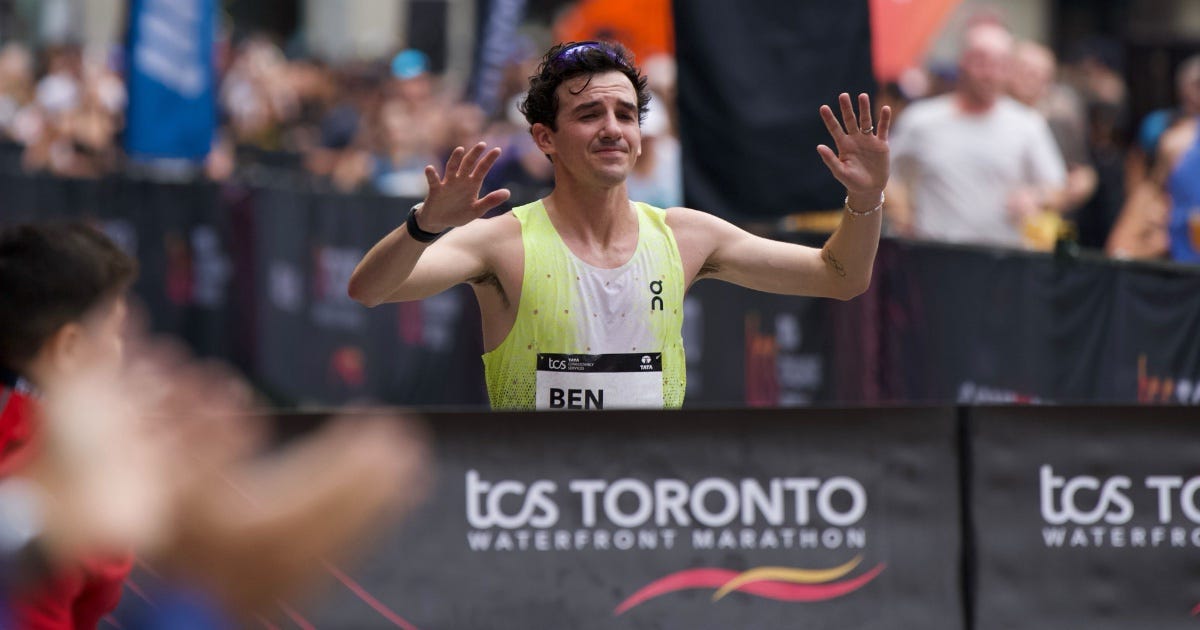
On paper, Canadian marathon debutant and 1:01:00 half man Ben Flanagan falls into that third camp. And his run at this past weekend’s Toronto Marathon was enough to deliver a national championship, but the time—2:15:39—won’t turn many heads. The good news moving forward, however, is that at 30 years old, Flanagan appears to now be all in on the roads. His 2024 season saw him go 13:04.62 at BU and compete in the 5000m at the Olympics, and since then, he’s been a road warrior through and through. Running 61 in the half twice this season meant that the hopes were high for Flanagan’s marathon debut–would he join Cam Levins or Rory Linkletter in boosting Canada’s presence at any upcoming World or Olympic marathons? A less-than-perfect build and a 66:49-68:50 positive split suggests that the jury is still out.
Instead, we’ll have to remain patient and see what his next few attempts at 26.2 look like. There was another apt lesson to be learned on this front in Amsterdam last weekend, in the form of Joshua Cheptegei’s fifth-place, 2:04:52 clocking. Not since Mo Farah or Kenenisa Bekele have expectations been higher for a trackster-turned-marathoner. Cheptegei is the current 5000m and 10,000m world record holder, after all! But what we’ve seen so far is a 2:08:59 debut (37th place), a 2:05:59 follow up (9th place), and now another improvement in both time and position. Certainly a respectable resume by even the highest standards, but perhaps not the sub-2:01 world domination that some were hoping for.
Is he lining up and hitting home runs each time out? No. But is he steadily chipping away at things as he learns the marathon? Yes. Don’t close the book on Cheptegei, Flanagan, or anyone else making the switch after just the first few chapters. Just because we have a sense of an athlete’s ceiling doesn’t mean they’ll hit it quickly—and just because they log a few clunkers early on doesn’t mean they never will. And the lessons learned along the way could end up being the secrets to success when it all finally clicks.
More News From The Track And Field World 📰
– Of course we can’t mention the Amsterdam Marathon and Cheptegei without addressing who won the race: that distinction belongs to Kenya’s Geoffrey Toroitich, who broke the tape in 2:03:30, and Aynalem Desta (2:17:37) of Ethiopia.
– And back to the Toronto Marathon as well… Kenya’s Leonard Langat (2:08:04) and Ethiopia’s Shure Demise (2:21:03) won the race outright, while Flanagan and Rachel Hannah (2:33:47) won the Canadian Championship portion of the production.
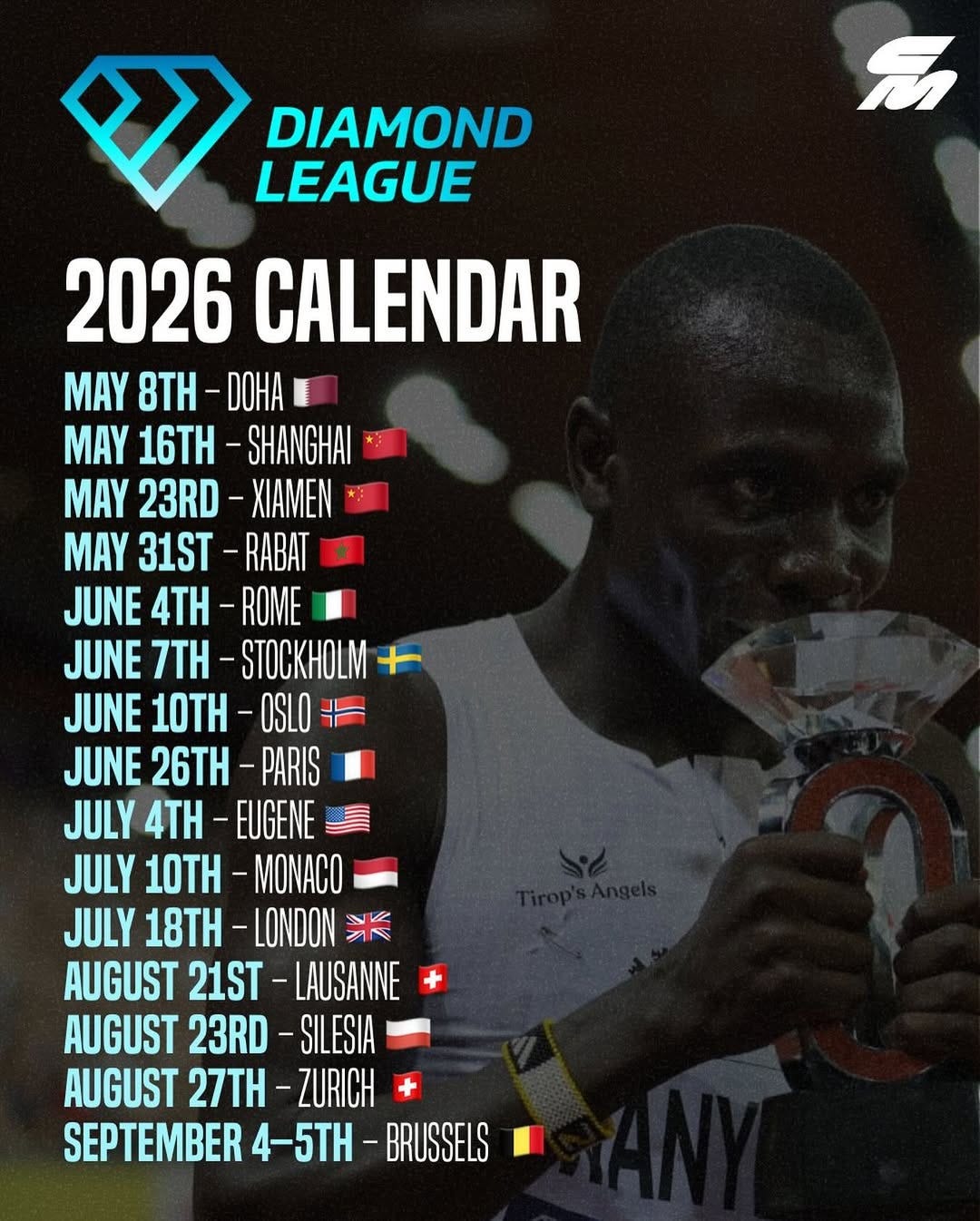
– The 2026 Diamond League schedule has been announced, and as expected, the entire series will once again precede the year’s global championship, the World Mega Super Duper Ultimate Championship.
– In more announcement news, USATF has unveiled its plans for the 2026 USATF Tour, which appears to be an effort to bring certain larger meets back under a unified promotional and budgeting umbrella.
– It’s proven to be a big week for announcements in general, as NYRR has shared the pro fields for its Dash to the Finish 5k, set for the day before the New York City Marathon. Notable entrants include Parker Valby and Abdi Nur.
– There’s a new Irish national marathon record in town, thanks to Fearghal Curtin’s winning effort at the Gyeongju International Marathon in South Korea. His 2:07:54 showing wipes Peter Lynch’s 2:09:36 mark off the board after a little over a year at the top.
– Great Britain’s Sarah Webster established a new 24-hour run world record, covering 173.127 miles in one day at the 24-Hour World Championship in France. Ukraine’s Andrii Tkachuk won the men’s race with a 182.898 mile showing.
– Soft, or smart? Organizers of the Cape Town Marathon – which has aspirations of joining the World Marathon Major circuit one day – cancelled the event just 90 minutes before it was scheduled to start, citing dangerous winds.
– As you read this, Big’s Backyard Ultra—another unpleasant race hatched from the dangerous mind of Gary “Lazarus Lake” Cantrell, founder of the Barkley Marathons—has been underway for nearly four days. Every hour, on the hour, runners have to complete a 4.167 mile loop until the last person standing, and if the last handful of runners made it through the night after this newsletter was finalized, you can watch live here.
Interested in reaching 20,000+ dedicated runners and track and field fans? Advertise with us here.