

Sponsored by Olipop

If you grew up making art like this, it’s time to up your fiber intake. Get 25% off your orders at DrinkOlipop.com using code CITIUS25 at checkout.
Compiled by David Melly, Paul Snyder, & Kyle Merber
When There’s A Werro, There’s A Way 🇨🇭
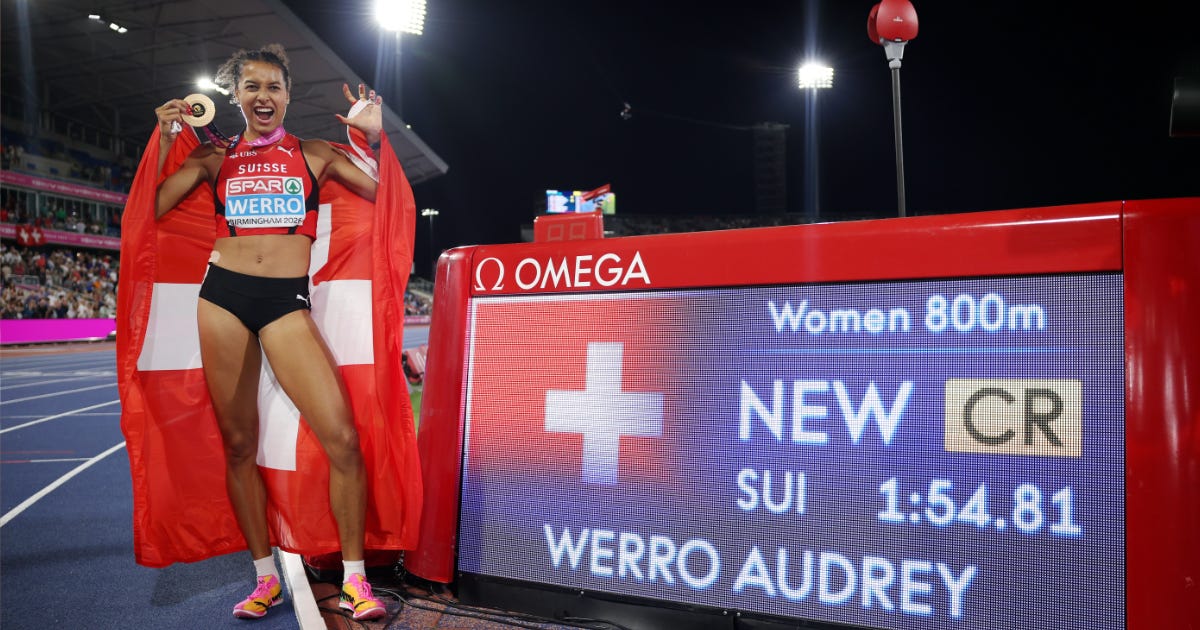
The most exciting and most controversial races of last week’s European Championships, held in Birmingham, UK, happened to be the semis and the final of the same event, held 24 hours apart.
It was clear from the jump that the women’s 800m would be the marquee race of the entire competition—heck, it’s been clear since June 7th, when Audrey Werro beat Keely Hodgkinson and cracked the 1:54 barrier in Stockholm, and even more so since June 16th, when Werro again ran sub-1:55 in Ostrava and Femke Broeders-Bol took second in 1:57.
The trio have been on a much-hyped collision course all summer, as Werro again lowered her Diamond League record to 1:53.80 in Paris and Broeders-Bol made the jump to 1:55.60. After Hodgkinson had to pull out of the 400m final at the UK Championships, some worried that injury woes would deprive us of the head-to-head-to-head matchup we all wanted, but the two-time defending European champ bounced back with a pair of 1:56 victories in Eugene and London. Since finishing second behind Hodgkinson at World Indoors, Werro hasn’t lost a race, but Hodgkinson is a fierce competitor who would be competing in front of a home crowd. Their rematch truly felt like an unstoppable force meeting an immovable object.
From the moment they stepped on the track in the first round of racing, it was clear the two favorites, both bold front-runners, meant business. Hodgkinson set the tone in the first heat of the first round, dropping a ridiculous 1:57.28 prelim, and 10 minutes later, Werro showed she wasn’t messing around either, practically even-splitting a 1:57.83.
But when the semis rolled around on Thursday, the certainty of a two-woman battle for gold was called into question. Disaster struck in the first section, with Werro getting tangled up and tumbling to the ground on the final turn, finishing last in 2:35.35 (more on that below). Then, more positively, Hodgkinson again cruised through in 1:57.38, but this time, she had Broeder-Bol stuck to her shoulder with a smile on her face, looking like she was out for a warm-up jog while running 1:57.46. Perhaps it would be a two-way duel after all—but with the Dutch hurdler taking Werro’s place.
Protests and appeals were filed, and replays flooded both the television and the internet. From one angle, it appeared that Werro had simply stumbled over her own legs, tripping up Gabija Galvydyte as well, who was swiftly advanced. From another, it looked like Anaïs Bourgoin had clipped Werro’s heel with her hand and knocked her just off-balance enough to disrupt her stride. Ultimately, the race officials ruled that Werro had been sufficiently impeded and placed both her and Galvydyte in lane 9, making the final a 10-athlete affair.
The decision made sense on many levels, but of course, a vocal minority (many of whom seemed to be British fans hoping for an unobstructed path to a Keely threepeat) protested that the reinstatement was unfair. There’s an argument to be made that the decision was justified even if the evidence was murky: Werro had done nothing intentionally wrong—certainly nothing to gain an advantage as she ended up with a faceful of track—and fans of the sport, whether buying tickets in Birmingham or tuning in from around the world, benefited from her presence in the final.
Track and field, candidly, could benefit from more discretion at times. The correct decision is not always the right one… although in this case it was both. Had Werro’s untimely fall kept her out of the medal hunt, or worse yet, caused a longer-lasting injury that derailed her summer, we’d all lose. Two of the greatest middle-distance athletes of all time going head-to-head in their primes in meaningful races is a rare thing, and in a year where we’re starving for narratives about why this season matters, the rise of Werro and Broeders-Bol to challenge Hodgkinson’s hegemony has been a welcome thrill.
Friday’s final had all the makings of sporting greatness. Werro was coming in banged up with something to prove. Hodgkinson had the eyes of her home nation all around her. And Broeders-Bol had the benefit of underdog status and an unknown ceiling. More and more, it felt like the sneaky likely outcome was that Femke would steal the whole thing, completing the arc of the Great 800m Experiment that’s been percolating all year.
Hodgkinson held the inside lane all the way around, and by 200m, Werro found herself in the lead. Surely, the reigning champ was remembering how things played out back in June—when Werro got her breakthrough victory by using her rival as a de facto rabbit for 650 meters. Forcing the Swiss 22-year-old to take on the mantle of leading felt like a smart way to turn the tables.
In the end, however, Werro has just gotten too good. Running from the front, she laid down a pace that Hodgkinson simply couldn’t overhaul, even if both women were running pretty much the same speed in the second lap. Werro split 27.4-29.1-29.2-29.1, while Hodgkinson ran 27.4-29.3-29.1-29.2. Those are both incredible runs, decided by a tenth here and a tactical gamble there, and Werro is now the European champ in 1:54.81, with Hodgkinson settling for silver in 1:55.01.
Broeders-Bol didn’t quite have the juice this time to overtake the women she’s been running behind all year, but she did take another meaningful step forward: her bronze-medal run was sewn up in 1:55.54, exactly equalling the 32-year-old Dutch national record. Only a fool would bet that Ellen Van Langen’s mark from 1992 will live to see its 33rd birthday.
Last week proved two things beyond a doubt. Werro is a special, special talent, with the rare combination of front-running speed and back-end strength that makes it nearly impossible to consistently outfox her. Hodgkinson, frankly, did everything right from the first step of the first round, and it still simply wasn’t enough. And the sport benefits greatly when rivalries and racing are paramount—thank goodness track and field didn’t get in its own way this time. When there’s a race that captures our attention, gets people talking, and showcases the best athletes in the world doing their thing, athletics fandom becomes irresistibly exciting. The organizers and overlords of the sport should be very, very grateful Audrey Werro has made herself undeniable this season.
Diamond League’s Summer Break Is Ending. What Did We Learn (And What Still Don’t We Know)? 👩🏫
Our summer vacation from the Diamond League circuit comes to an end Friday, when action resumes in Lausanne, Switzerland. The sport’s biggest stars are going back to school after 34 days of rest and relaxation… oh, wait, that’s not true at all.
Track and field’s summer break wasn’t just about family vacations and new haircuts. It was a busy month “off,” with high-profile detours through Eugene, New York, Glasgow, and Birmingham, to name a few. A lot of that non-DL racing helped clear up some mid-season ambiguity about who was healthy, who was fit, and who was really taking 2026 seriously.
At the same time, it almost feels like we have more questions than answers as we head into the back half of the schedule. Particularly as the World Ultimate Championships in Budapest approach, the hard-core rankings nerds aren’t going to be the only ones refreshing the World Athletics website each week as athletes jockey for one of the coveted 12-16 spots on the line.
So what did the last five weeks teach us? And what does it say about the matchups we should expect—and crave—in Lausanne and beyond?
Will the young’uns hang with the uncs?
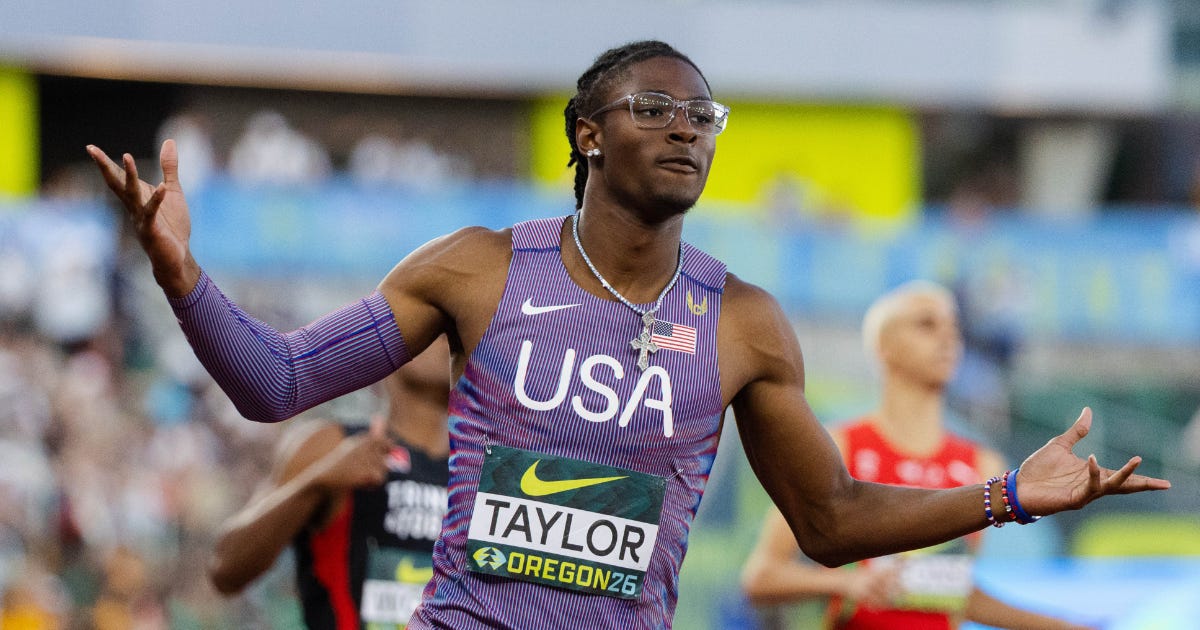
Literal summer break was good to some of the best sprinters in the U.S., namely Tate Taylor and Mia Maxwell, the double World U20 champs over 100m and 200m. Taylor, especially, has dropped times fast enough that he has to be considered a factor in any senior race, even if he was just recently only a high school senior. With bests of 9.94 and 19.75 set this summer, he’s the tenth fastest American over 100m and the second-fastest over 200m this year. Back in May, Taylor finished second behind U.S. champ Noah Lyles in a pro race in Japan—has the gap between the two closed since then?
Not so fast: Lyles himself had a productive July, winning the 100m at USAs in a personal best-equalling 9.79. He pulled up with a cramp in the 200m final, so we don’t know for sure what his current form over the longer sprint is right now, but the 29-year-old clearly hasn’t lost his fastball. Between Taylor and recent collegiate stars like Jelani Watkins of Arkansas and Garrett Kaalund of USC, the familiar faces of Lyles, Kenny Bednarek, Trayvon Bromell, and Christian Coleman may soon start to sweat as a new generation rises to crowd up the U.S. sprint scene.
Is Amy Hunt ready for prime time?
For an athlete that suddenly has four new European gold medals, Amy Hunt remains something of an athletic enigma. Her PBs in the 100m and 200m aren’t the flashiest—10.97 and 22.08—but she’s a compelling example of one of the sport’s most universal truths: races aren’t run on paper. Despite having turned in just the 49th and 37th fastest marks in the world this year in the 100m, and 200m, Hunt’s name carries the weight of athletes with sub-10.90 and sub-22 credentials because she tends to perform at major championships, having struck silver in the 200m at the most recent World Championships.
Now, coming off an all-time slate of races at Euros and surely buoyed by an appropriately elevated sense of confidence, Hunt still has a major point to prove: where does she stand when the Western Hemisphere gets added back into the mix? In Lausanne, she’s one of just three women in the field without a sub-22-second PB, yet in theory it shouldn’t be a shock to see her give Shericka Jackson—the fifth-fastest woman on the year—a legit fight to the line.
Hunt and Jackson will have their hands full, however, as Americans Brittany Brown, Anavia Battle, and Kayla White will all surely want to take down the Jamaican legend and Great Britain’s golden girl. Hunt’s results may take on greater significance as something of a referendum on the state of European sprints—which historically have not been the same quality of American and Caribbean fields. If she’s once again in the mix for the win (and potentially a big PB), that could be seen as something of a sea change in the event writ large.
Just how fast can the main sprint girlies go?
Just two days after Lausanne, the Diamond League circus will pop up its tent in Silesia, Poland, where the action is scheduled to reach a crescendo in the final event of the night: the women’s 100m. The field is, frankly, bonkers. Sha’Carri Richardson. Melissa Jefferson-Wooden. Julien Alfred. Just between those three, you’ve got the global champion in the event from the preceding three seasons. And that’s before even getting into the stellar crew of Jamaicans who would love nothing more than to play the part of spoiler: Shericka Jackson, along with Tia and Tina Clayton..
This ought to be the best women’s 100m race of the year thus far, and unless it’s run into a wind tunnel, the expectation will be that it’ll take a season’s best performance in order to break the tape. Times aside, the real intrigue here is that we get to see the top five finishers from Worlds last year race head-to-head. The winner here doesn’t just get confirmation that they’re wicked fast right now; they send a warning shot to their rivals that could sow a seed of doubt into their minds as they complete their end-of-season preparations.
Aside from Josh Kerr, WTF is going on with the male milers?
In addition to establishing a true pecking order among the fastest women in the world, Silesia also should help clear up the bizarrely murky state of the men’s 1500m. So far this year, we know what Josh Kerr is capable of, and that’s about it. Regrettably, we won’t see him in Poland, but an all-killer-no-filler 15ish-man field is currently slated to line up, and we will finally get data points from Jakob Ingebrigtsen and Cole Hocker, both of whom are making their debuts at their signature distance.
Ingebrigtsen looked strong in his season debut, a 5000m victory at Euros, and Hocker has raced sparingly outdoors—a sixth-place showing at the Bowerman Mile and low-stakes 3000m rust buster back in June. Despite being… well… Ingebrigtsen and Hocker, it’s hard to definitively call either the favorite as of right now.
The 1500m at Euros was, in a word, weird. The results almost look like you put every entrant’s name in a hat then began drawing them out at random. That’s not to say the winner, Stefan Nillessen, wasn’t deserving. It’s just that this was a deep field without a clear cut favorite, and as a result, the Dutchman was able to secure a statement victory. Reigning World champ Isaac Nader finished dead last, and the two fastest guys in the field by season’s best—Jake Wightman and Azeddine Habz—finished sixth and tenth, respectively.
Regardless of how this race actually plays out, it’s going to be the highest-quality field we’ve seen on the circuit this year. In addition to Hocker, Ingebrigtsen, Nillessen, and Nader, we’ve got Samuel Pihlström, Reynold Cheruiyot, Phanuel Koech, Jakes Wightman and Heyward, Nathan Green, Vince Ciattei, Hobbs Kessler, and Ethan Strand all in the mix, and all capable of leaving their mark on this race depending on how it shapes up. With Kerr not competing, the lack of a clear top dog and the plethora of guys who could be top dog at their best makes for an intriguing combo.
Does the men’s 800m get as crazy as the women’s?
This time last year, if you had to guess which 800m world record would fall, the smart money would’ve seemingly been on the men’s, with Emmanuel Wanyonyi coming within a quarter second of David Rudisha’s remarkable 1:40.91 in late 2024 and showing no signs of slowing down. Especially with Marco Arop around to keep things honest, finish times under 1:41 felt inevitable.
One year later, Arop and Wanyonyi are the first- and third-fastest men in the world, but the hype has cooled a little as Audrey Werro’s star has risen on the other side. Both athletes started their 2026 campaign by taking two Ls apiece, and in Oslo, both got embarrassed by 17-year-old Cooper Lutkenhaus. Lutkenhaus, in turn, had a clean racing card until he was outkicked by Brandon Miller at the Pre Classic. Miller then pulled out of USAs, citing injury concerns, but returned to form with a fast but lowkey 600m in Portland. There’s a huge amount of talent in the mix, but also some questions.
Arop and Wanyonyi are both trending in the right direction, with Arop clocking a 1:41.84 world lead in Paris and Wanyonyi breaking the 1000m world record. Lutkenhaus tore apart a Miller-less field in NYC, but he literally has to go back to school so the trip to Switzerland is not happening. Instead, Miller will face off with the two World champions, and if everyone shows up to the starting line 100%, we could find ourselves back in the low 1:41s in no time.
Not all of these questions will be definitively answered Friday… but fans won’t have to wait long for more. There are three Diamond Leagues coming up in the next week, and the two-day final in Brussels is not too far off, on September 4th and 5th. Vacation time is officially over.
What Bill Simmons Got Wrong About Cross-Country Parenting 🏃♂️
Dear Bill Simmons,
You had my vote to become Sports Czar, Podcast Mogul Category, before I heard your list of the “20 Best and Worst Youth Sports for Parents.” Unfortunately, I can no longer support you in such an important role given your egregious under-ranking of cross-country at #15.
From a parent’s perspective, cross-country is unquestionably a top-three sport. Let’s go through every point on your own rubric so we can highlight the overlooked benefits of your child deciding they’re going to spend an inordinate amount of time just running around.
How does the sport upend your life?
It basically doesn’t. This may be the strongest argument in favor of cross-country, because it is frictionless from a parenting perspective. There are only a handful of meets to attend throughout the entire fall season. Most teams compete fewer than 10 times, with the large majority of meets taking place at a local park or high school’s campus.
In terms of off-season workouts… that’s typically left up to the athlete. Imagine your teenager out of the house for an hour or so at a time, jogging. Not playing video games. Not being radicalized on the Internet. Not in possession of your credit card en route to rack up a devastating tab at Chipotle. Just jogging! Peace and quiet for you and a microdose of military school-worthy self discipline for them.
But the biggest selling point would be that there are no private teams—kids pretty much only run for their school. Competition-schedule-wise, what you see is what you get. You can write down the dates and locations of every planned meet on your calendar in pen, then, if you’re dramatic, throw that pen in the garbage.
What’s the parent culture?
There is no culture beyond telling runners from your child’s team “good job,” and nodding along in agreement when you’re within earshot of another parent saying “they’re such good kids.”
It’s just a bunch of parents who are happy their kids are doing something generally healthy after school with friends. With no prospect of a major league contract, parents’ investment tends to remain firmly in the “for the love of the game” camp, and unlike baseball, there is no arguing with umpires over balls and strikes.
Maybe shuffle jogging from point to point along a cross-country course with a bunch of other out-of-breath parents isn’t your idea of a perfect Saturday, but would you really rather spend your entire weekend driving to and from an all-day tournament in some middle-of-nowhere town that’s built its entire economy on the youth sports industrial complex?
How expensive is the sport?
How much do shoes cost? Multiply that maybe by two and that’s the maximum out of pocket cost for a season. It’s not nothin’, but it can be measured in three digits, which by most sports’ standards is an unbeatable bargain. Again, there are no travel teams and basically no private coaches. At some point your child may want a slightly fancier GPS watch that could be found on Facebook Marketplace for $50.
What’s the toll on physical and mental health?
The physical benefits of being able to run for a long time should be obvious. But studies have shown that running reduces depression risk by about 30%, and over 89% of club runners report an improvement in their happiness. Like any other sport, it is important to find (and help maintain!) a coach and a team with a healthy culture, particularly when it comes to nutrition and fueling. Plus, it’s a guaranteed hour that your kids won’t be on their phone, which has to count for something.
Is there scholarship potential?
Due to the low costs of operating a cross-country team, it’s the sport with the second-most participating NCAA programs behind only basketball. And when you consider that most kids would rather be playing basketball, soccer, football, lacrosse, golf, or literally anything else, then it is not nearly as competitive!
How much parent entertainment value is there?
Honestly, pretty minimal. To your point, watching most races requires standing around in a field and doing a light jog yourself to the next place that you could actually see the kids. But cross-country meets have set start times, and at the high school level each race maxes out at around 30 minutes.
Is it easy to understand?
It is hard to think of a sport with fewer rules than “who can run around this field the quickest?” The team scoring takes a little bit of effort to figure out, but gone are the days of popsicle sticks and back of the napkin math to figure out who won—we have computers now! And it’s easy to see how your child competed and placed in the field.
Bonus: Are adults happy they did it, and can you keep doing it as they grow up?
If you have never worked in a corporate office with a bunch of 30-year-olds who are tired of going out to the bars, then you may not understand the potential social capital here. The majority of water cooler talk these days is young professionals debating the merits of running New York or Boston this year. If you have a marathon time that starts with the number 3, let alone a 2, then executives will be swarming your desk asking for training advice.
I know cross-country isn’t the coolest sport to brag about your kid being good at. Most adults—present company very much included—never fully move past high school, so there’s objectively more clout to say your son is the starting quarterback. But by all metrics, and especially considering the categories you value most, there is no sport that is better for a kid’s short- and long-term health, while simultaneously enabling you to partake in the absolute bottom of the barrel, low-effort parenting.
Sincerely,
New York State’s 2007 Class A High School Champion (and Father to Two Eventual New York State Class B Participants)
More News From The Track And Field World 📰
– The women’s 800m at Euros may have—deservedly—attracted the most attention, but there were plenty of other fantastic performances. Norway’s Henriette Jæger won the women’s 400m (49.04) and mixed 4x400m relay; Nadia Battocletti of Italy showed both the 5000m and 10,000m fields a clean pair of heels as she kicked her way to two easy wins; Slovakia’s Emma Zapletalová won the 400m hurdles in 52.91—her fourth time under 53 this season; Dutchwomen Jessica Schilder (20.73m) and Jorinde van Klinken (67.67m) won the shot and discus, respectively; Great Britain’s Matthew Hudson-Smith took the 400m in 44.17; Karsten Warholm broke his own championship record, winning the 400m hurdles in 46.63; and Andy Díaz broke his own Italian national record in the triple jump, going 18.15m. Perhaps the most impressive effort of the meet, however, was Andreas Almgren’s push-from-the-front 27:23.44 10,000m victory, winning by 19 seconds and negative-splitting 14:05-13:18.
– At the Chinese Championships, 17-year-old Chen Yujie lowered the Asian area U20 record in the women’s 100m to 11.08 (+0.7), winning the event, and 19-year-old Zhang Jiale won the women’s hammer—in a senior area record—of 78.64m.
– Both Beach to Beacon champs doubled back successfully on the Cape. Habtom Samuel’s inaugural season as a road warrior continues to be a smashing success. He won the Falmouth Road Race in 30:53, a new course record and 11 seconds ahead of runner-up Edwin Kurgat. Samuel’s former New Mexico teammate, Pamela Kosgei, likewise, delivered another stellar road performance, winning the women’s race in a photo finish against Jess McClain in 35:25.
– Score one (or two?) for the Commonwealth! Your Falmouth Mile winners were Massachusetts native Heather MacLean (4:25.89) and Luke Houser (3:51.42), whose most obvious Bay State connection is far more tenuous, in that his college coach is from the Boston area.
– The Brooks Beasts showed out at Stumptown Twilight, with Brandon Miller making his return to action following a minor ankle injury. He won the 600m in 1:14.08; Brannon Kidder won the 1500m in 3:33.47, a new PB; and Valery Tobias broke the tape in the 800m in 1:59.83.
– Excellent news for fans of Eugene’s three Burrito Boy locations and their $5 bean and cheese burritos: the 2028 U.S. Olympic Track and Field Trials will be held at Hayward Field, with a new condensed, six-day schedule, and sans the multis and 10,000m races, which will take place earlier in the spring at TBA venues.
– 10 athletes from the European Championships were named “Gold Crown” winners, meaning they had the highest-scoring performances within their designated event groups, based on World Athletics tables. These winners received a literal gold crown, but also €50,000. Going through the list of prize recipients, they all make a lot of sense, until you get to the “roads, combined events, and relays” category, where race walkers took top honors for the men and women. Not to disparage walkers, but Finland’s Alisa Vainio really got shafted here: she won the women’s marathon in a commanding 2:22:26—by any non-WA-scoring-table metric the best performance from this sprawling classification at Euros.
– Kyle Merber, the man most recently known for penning one of three sections in this week’s Lap Count newsletter, will be competing in the Chicago Marathon, and is being coached by Galen Rupp. Listen to their kick-off conversation—the first installment in a CITIUS MAG Podcast mini-series here.
– Lessons learned: if you organize an underwhelming pro-doping mini-Olympics, align it with some of the world’s most loathsome public figures, all in the interest of hawking supplements to rubes, you are not, in fact, guaranteed to turn a tidy profit right off the bat. The Enhanced Games’ second-quarter 2026 results showed a net loss of over $60 million, and its stock is down nearly 80% from its debut.
Interested in reaching 20,000+ dedicated runners and track and field fans? Advertise with us here.
As the father of three sons who have or currently run HS XC, Kyle, your response is spot on.
Each of my sons has found his own passion in the sport and each has had success in his own way.
That's the beauty of XC. Success can be found in a number of forms.
Our oldest lived and breathed XC in HS and is entering his senior year in college where he has been a 4 year member of his school's XC team.
Our middle son dreamed of playing HS soccer, but got cut his freshman year. HS XC was never easy for him and it took everything for him to do to find success. He found his passion though and is now entering his sophomore year in college and is a member of his school's XC team and absolutely loves it, doing things he never thought possible.
Our youngest is entering junior year in HS and he's still finding his was with running. But I see what it does for him and the confidence it continues to build in him.