

Playing The Wild Card ⏱️
Lap 283: Sponsored by Bandit & Olipop
Presented by Bandit
The Unsponsored Project aims to solve a problem in professional running where athletes compete at elite levels, but receive no monetary compensation from the brands whose gear they wear on the track. To-date, 12 Unsponsored Project athletes have gone on to sign traditional footwear deals.
This past weekend, we were so proud and honored to play a small role in supporting 77 unsponsored athletes who bet on themselves against the best in the world at this USA Champs. They received 100% unbranded kits to represent themselves, cash for travel/lodging/anything else they may need, and a contract featuring an immediate opt-out clause if another brand comes along with a larger deal.
Congratulations to all the athletes who competed, including Alia Armstrong who came away with the national title in the 100m hurdles.
Compiled by David Melly, Paul Snyder, & Kyle Merber
Lessons Learned From An East Coast USAs 🇺🇸
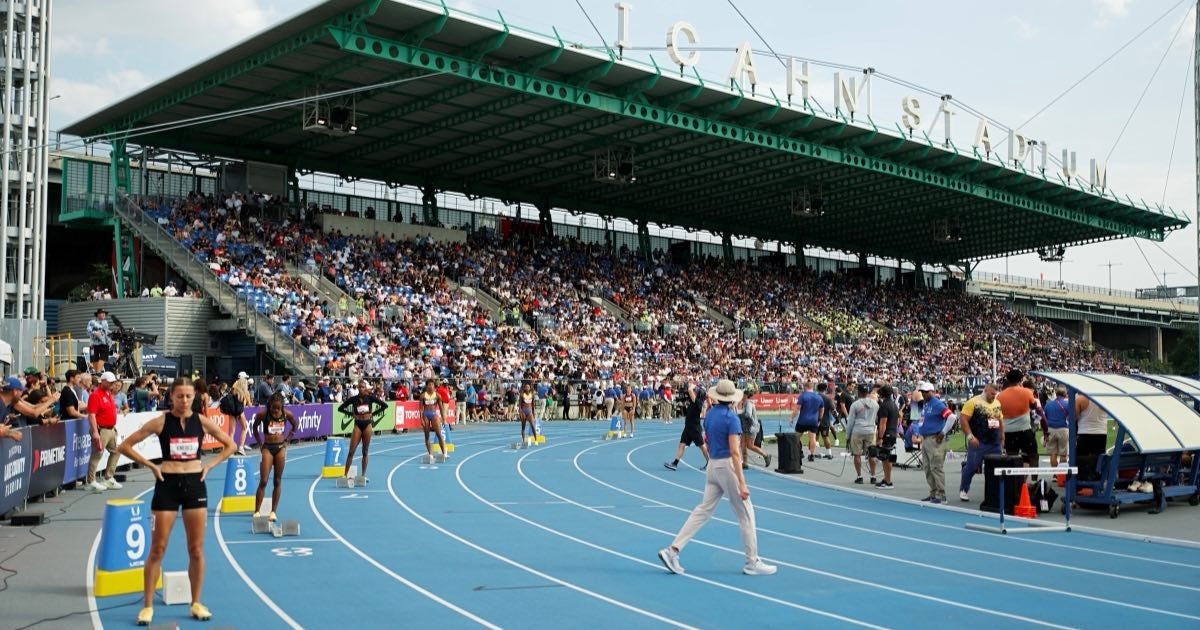
Like Odysseus returning to Ithaca, the team has made it back home from the long journey across the stormy seas of the East River to the remote island of Randall. And also like Odysseus, the trials (and finals) we faced along the way taught us a lot.
The first New York-based U.S. Championship in over three decades is in the books, and in so many ways, it was very different from the last five editions of USAs, all of which took place in Eugene, Oregon. Unlike an Olympic Trials, all the action was compressed into four days of action, and with no global championship teams being selected, more than a few stars opted to focus on their own personal Odysseys of the European summer circuit over domestic glory.
That isn’t to say the results were all that watered down, however. Look at the short sprints, where Noah Lyles and Sha’Carri Richardson took the 100m finals in 9.79 and 10.77, respectively. Throw in Melissa Jefferson-Wooden dropping a 21.69 in the 200m, Cooper Lutkenhaus negative-splitting a 1:43.48, and two men nearly tying for the victory at 13.00 in the 110m hurdles, and any worries that the Icahn Stadium times would pale in comparison to Hayward Field were put to rest.
The distance races were… another story. Whether it was the women’s 10,000m going out in 99 seconds or the men’s 1500m closing in 51, the overarching theme of the championships races this weekend were a whole bunch of athletes with infallible faith in their own kicks putting that (over)confidence to the test. That probably explains why the men’s and women’s 5000ms were both won by athletes who’d placed top-three in the 1500m the day before, giving Emily Mackay and Vince Ciattei the first U.S. outdoor titles of their respective careers.
So what did we learn from all this? There was a lot of talk heading into the meet over whether an off-year championship in a new city would produce a better or worse entertainment product, or if such conditions could even perform the coveted magic trick of bringing entirely new eyes to the sport.
The results were mixed.
There was a lot to like about the East Coast version of USAs, and a lot that could be improved upon. Ultimately, it’s probably helpful to have made the change, if for no other reason than to test out different variables in the pursuit of finding new best practices that can be made permanent rather than putting on the same show year in and year out. Neither Hayward Field nor Icahn Stadium is a perfect place to watch track; such a place doesn’t exist (at least not in the U.S.). So the next best thing is to be both open to new ideas and willing to invest in replicating those that prove successful.
When it comes to scheduling, density is the goal. There was a lot of chatter early on in the weekend about sparsely-populated stands and whether or not fans would actually show up. That’s not unique to NYC; it’s pretty much a perennial talking point for every major American meet. What was noticeable, however, was how different the crowds were on Saturday and Sunday versus Thursday and Friday. Some of that is that it’s easier to fill a stadium on the weekends when folks aren’t forced to take time off or commute after work, but a lot of it comes down to the fact that the bulk of the exciting competition happened on days three and four of the meet, with only two track finals apiece on the two opening days.
Heats are a necessary evil of most track and field schedules, and there is value to creating doable doubles so the biggest names can get in front of the crowd multiple times. But the reality is that, without a team to make, many of the biggest stars—like Grant Fisher and Woody Kincaid in the 10,000m and Parker Valby in the 5000m, along with Lyles, Richardson, and Jefferson-Wooden—only picked one event to focus on anyway. World Ultimates seems to be betting on the value of trading off some quantity for quality, and it would be worth USATF further exploring ways to compress the schedule in non-championship years, perhaps looking a bit more like indoor NCAAs in the future.
The actual scheduling of events within a day leaves something to be desired as well. The current programming format usually allows hefty cushions for post-race interviews, commercials, and setup, but the net result is that there’s a lot of time when nothing is actually happening on the track. Sometimes, that dead air hanging over the oval is filled by field events, but usually the timing of final throws is more of a happy accident than deliberate choice. Better “block scheduling,” where track and field can end up looking more like a basketball game with 15-20 minute periods of constant action broken up by longer advertising, bathroom, and concession breaks, would make the actual flow of the meet more energetic.
It should be as easy as possible to go to a track meet. For the majority of Americans, it’s way easier to fly, drive, or train to New York City than it is to get to Eugene. Once you’re in the Big Apple, however… getting to Randall’s Island is a whole other story. It’s inaccessible by subway, includes very limited CitiBike parking, and a battle to reach in rush hour traffic. Shuttle buses and other forms of piecemeal transit infrastructure can only go so far. Compare that to Madison Square Garden, located in the heart of Midtown, and it’s not exactly a fair fight for casual sports fans’ attention.
Finding a host location that has the trifecta of being affordable, accessible, and populated enough to attract a built-in local audience isn’t easy, but there’s one obvious choice: Franklin Field, located at the University of Pennsylvania in Philadelphia. Annoyingly, a strict read of the rulebook means Penn isn’t allowed to host USAs because the track does not have nine regulation lanes all the way around. But if there’s ever a reason to bend the rules, it’s this. Consider this our official call to action for USATF and World Athletics to cobble together whatever exemptions and waivers are needed to allow Franklin Field to host USAs, building on all the great things about Icahn with a whole bunch of other benefits to boot.
Make USAs a party from start to finish. Sports, at the end of the day, are supposed to be fun. And yes, a big part of that is sitting in your seat with your friends and family and cheering when Valarie Sion yeets a discus halfway across the island, but every part of the experience around that thrilling moment should be additive. Icahn Stadium did have food and drinks, both alcoholic and virgin, for sale, but only at one location. There were a limited number of fan activations outside the stadium, but plenty of unused space immediately adjacent to the athletic facilities.
Who doesn’t love a tailgate?! Allowing the area around the stadium to become part of the attraction both before and during the meet makes it easier for fans (especially those with rambunctious young future track and field stars) to make a whole afternoon of it, which in turn makes the in-stadium vibes more positive and exciting. Some of this is already happening—like having athletes throw T-shirts to the fans after their event, and situating the warmup area right near the entrance so fans get an extra look at their faves—but when it comes to atmosphere, more is generally more.
Many elite track and field events benefit from a well-timed mass participation event, like the BAA 5k before the Boston Marathon or the various road races that coincided with the Budapest World Championships. You’d never know it based on the advertising, but the New York Road Runners actually hosted its annual Team Championships 5-Miler Sunday morning in Central Park. It feels like a no-brainer to cross-promote and create a little synergy. Host the race—one that lures about 5,000 dedicated club runners out to the starting line—at Randall’s Island two hours before the meet! Give the winning team free drink tickets! Make Noah Lyles the official race starter! The possibilities are endless and largely mutually beneficial.
Complacency is the enemy of success, and USATF deserves a lot of credit for switching things up. Every sport, not just track and field, relies on a careful balance of tradition and innovation to keep its existing audience base happy and attract new viewers. No one in their right mind would argue that we’ve perfected the formula, and in a lot of ways, that’s a good thing: it creates demand for creative thinking, collaboration, and growth. If the national championship ends up back in Hayward next year, here’s hoping they bring some of the best parts of this year’s edition with them.
Who Should Seb Coe Give The “Seb Coe Entry” For World Ultimates? 💥
Still buzzing from the weekend and looking for your next track-cation? Look no further!
The inaugural World Athletics Ultimate Championship—or “Ultimates” as the kids are now calling it—will be hosted in Budapest September 11th-13th. While attending won’t necessarily be the same as having watched the first-ever Olympics in-person, it’s still an excellent chance to witness Olympic-quality racing, with vastly easier logistics, for a fraction of the price.
Ultimates is only three days long and every session tops out at three hours, which means you can explore the city while the sun is up then experience nonstop finals in the evenings. There are plenty of flights from New York for under $800. Nice hotels in Budapest cost $100 a night. And a three-day ticket package is $90. For the value of a single morning session ticket in Los Angeles, you can watch 10x the amount of track and pay for an entire vacation. Like Icahn, the stadium sells beer – but for roughly 1/4th the price.
“I’m listening… but what athletes will be there?” you ask. Well, it’s an exclusive event with only 16 qualifying for events with semi-finals, 12 athletes in straight finals, and only eight qualifiers for the field events. With the national championships behind us, our attention now turns to the Road to the Ultimate tool to see which of our favorites still have to close the gap.
As you sort through the current status of potential athletes in each event, you’ll notice some names missing, like Yared Nuguse.
Despite having a fantastic season that includes multiple Diamond League wins and a 3:45 mile, his name is not on the list, which is odd because he’s technically ranked second in the world at 1500m. That’s because in most events an athlete needs five performances to be ranked, and three of those have to come in the exact event. So while Nuguse has raced plenty this season, including multiple fast miles and a couple indoor 1500ms, he needs one more outdoor 1500m to be considered.
Aside from those who will be invited based on their rankings, reigning World and Olympic champions will receive bids. Additionally, the week before Ultimates at the Diamond League Final in Brussels, one more spot will be handed out per event. These go to whoever is the highest finisher that has not already qualified. Meaning an athlete could finish last, but if everyone who beat them was already in the quota, then they’ll still get invited.
But there is yet another way to get invited to the World Ultimate Championships and that’s through what will henceforth be known as the “Seb Coe Clause.” Buried at the bottom of the rule book is a little loophole for exceptional invitations:
World Athletics has the right to provide an entry to an athlete who for whatever reason has not qualified for the Championship. This athlete would be within the above defined Target Numbers. Such exceptional invitation is limited to one per event and, unless notified otherwise, the deadline to allocate them is Monday 17 August.
For you non-lawyers out there, that basically means at the end of the day, anyone can be invited if World Athletics deems their absence to be a problem. It would be quite the power move to leverage an invitation via the Seb Coe Clause since it would bump another already-qualified athlete, considering there are lane limitations. So just because it seems like a competitor is comfortably inside the quota today, they are only a Yared Nuguse outdoor 1500m, a Diamond League finalist, and a Seb Coe Clause invitation away from being bumped.
Now, given the potential for controversy and outcry, Lord Coe shouldn’t waste these spots on just anyone—they should be reserved for transcendent superstars, otherwise other athletes will rightly scream “KANGAROO COURT” and stop buying into the whole rankings thing.
While it’s in the best interest of TV ratings to extend an invitation to iShowSpeed for the men’s 100m, it’s probably a dangerous precedent. Instead, an athlete should have a body of work or standout performance this season that gives us reason to believe they’re in the sort of shape it’ll take to become the first ever World Ultimate champion in their event.
So it’s our opinion that as of July 29th, these are the only athletes that should be considered for a Seb Coe Clause invitation:
Josh Kerr: It’s like this rule was written just for him. Despite a mile world record and World Indoor title this year, Kerr is nowhere close to qualifying the old fashioned way. Given that the Commonwealth Games is running the mile rather than the 1500m for the first time since 1966, it seems unlikely that the Beast will run three outdoor 1500m races. Who knows if he’d even accept the invite, but Kerr should definitely be Seb’s first call.
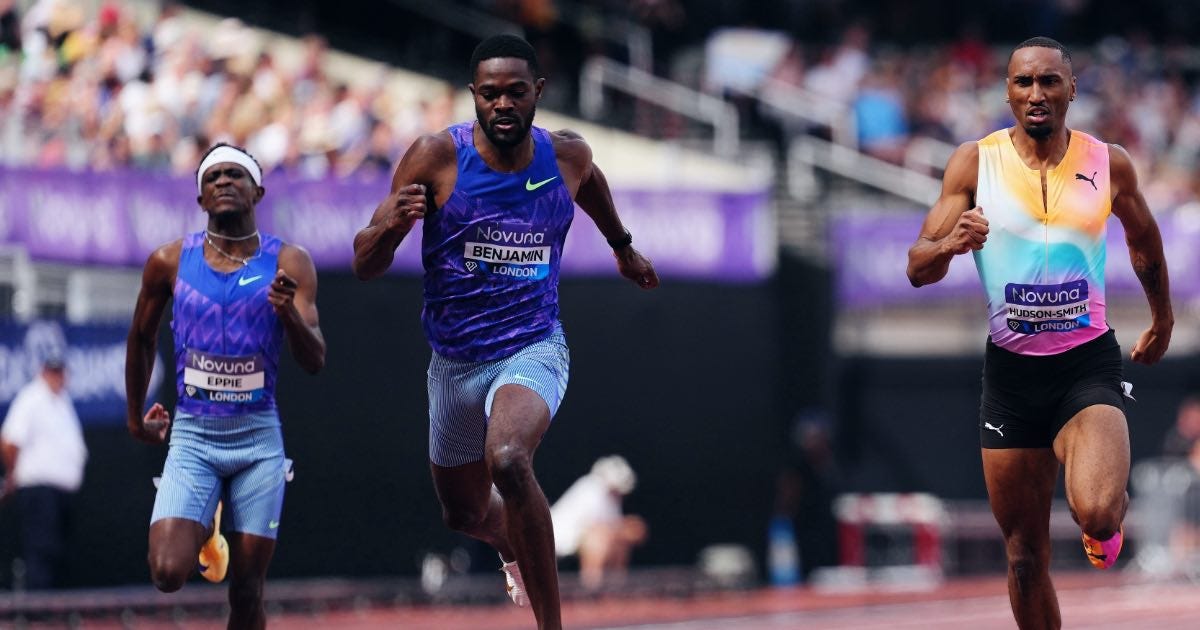
Rai Benjamin: Although he technically has invitations two ways to run the 400m hurdles, the Olympic and World Champion is not yet ranked in the flat 400m. Benjamin’s win in London and personal best of 44.05 proves that he’d be a contender. Fortunately, it will only take one more race to get him inside of the quota so this might not be necessary. (Of course, USAs could have been it, but Benjamin opted out.)
Elaine Thompson-Herah: Hot take – more people will want to see the five-time Olympic gold medalist run than whoever would otherwise get this spot. While it isn’t a popularity contest, ETH’s accolades and proven ability to show up at global championships warrants a bid. She is currently ranked 27th on the descending order list and just one or two solid showings at a Diamond League might get her over the hump. Regardless, the legend has run 10.91 this season and owns a personal best of 10.54 so there is merit.
Yomif Kejelcha: The only man ever to have run every marathon under two hours. Look, he’s probably not going to accept the invitation to run a 5000m, but he would have three months before Valencia. His range is a proven commodity and he only just recently stepped away from the track with a personal best of 12:38, in addition to two Diamond League wins last year. Kejelcha makes every race he is in more interesting, and given his newfound strength there is no doubt he’d be up front pushing the pace. At least ask him!
That’s it. Names like Mary Moraa, Isaac Kimeli, Sifan Hassan, and Gout Gout could be considered, but ultimately there was a stronger argument for keeping those fields in their present, organic forms. That said, if Jakob Ingebrigtsen wants to run the 1500m, Coe should obviously let him, if for no other reason than to ensure it’s an honest race from the gun.
Sponsored by Olipop

Get 25% off your orders at DrinkOlipop.com using code CITIUS25 at checkout!
Can You Be A G.O.A.T. Candidate But Not Your National Record Holder? 🇬🇷
At the Greek national championships this past weekend, Miltiádis Tentóglou posted the best jump of his life, launching himself 8.66 meters.
He’s among the greatest long jumpers in history, with a list of accolades that includes two Olympic golds, a World Championship gold and silver medal, the 2022 Diamond League Final crown, a pair of World Indoor titles, 11 wins on the Diamond League circuit, and three wins at the European Championships.
You might expect that an athlete of this caliber posting a PB would put him feet ahead of any of his compatriots. And yet, despite being tied at No. 13 all-time with that mark, Tentóglou only managed to tie the Greek national record.
The man with whom he shares that distinction, Louis Tsatoumas, was by no means a slouch. He jumped 8.66m after all! But he never medaled at the Olympics, never landed on the podium at a World Indoor championship, and the extent of his global medal haul was a single bronze medal, from the 2006 IAAF World Athletics Final.
By really any metric except—except a very notable one: PRs—Tentóglou is the superior jumper. And yet, in theoretical tavernas across Athens right now, long jump aficionados are embroiled in impassioned arguments over who is the Greek G.O.A.T., Tentóglou or Tsatoumas. Sure, one side has more ammunition than the other, but the shared national record at least gives the other side a bit of rhetorical room to operate. (That, and technically, Tsatoumas owns a 2–1 record in their head-to-head matchups.)
Crazily enough, Tentoglou might not even be the best athlete with this particular problem. For a variety of reasons, which could include the size of your country, a poorly-timed career ascension with a great rival, or a record book full of sketchy marks from the 1980s, there are more people than you’d think who’ve never held their country’s national record but have resumes worthy of the Hall of Fame. Such as:
Yohan Blake: We’ll start with one that’s simultaneously obvious but also criminally underappreciated. Blake is the second fastest man ever over 200m. His 19.26 is one of two performances ever under 19.30. In the 100m, he’s tied for second all-time with Tyson Gay at 9.69—that mark is tied for the third best in history. Of course, the only man unequivocally faster than Blake, Usain Bolt, isn’t just his compatriot… he was his contemporary.
That’s how perhaps the second greatest sprinter of all time is also the second greatest sprinter of all time from Jamaica, as well as just a one-time individual global champion. (Blake’s 2011 World title in the 100m happened to come in a race in which Bolt was disqualified for false starting.)
Asbel Kiprop: Kiprop sits at No. 3 on the all-time men’s 1500m rankings, thanks to his 3:26.69 showing at the 2015 Monaco Diamond League. With an Olympic gold medal to his name plus three World titles in his signature event, Kiprop is certainly in the conversation for the Mount Rushmore of men’s metric mile-dom.
And yet… he’s only the second-fastest Kenyan man ever behind Bernard Lagat—a man who is also (depending on who you ask) the fastest American man ever over the same distance, and who still clings onto the second spot on the all-time list. Though their competitive primes didn’t perfectly align, they still squared up in seven 1500m finals, with Kiprop beating Lagat in four of their battles.
Joe Kovacs: The 11 farthest shot put marks in history belong to Americans: The world record, along with the second, third, and fourth best throws all belong to Ryan Crouser. Then at number five is Joe Kovacs’s 2022 23.23m heave. The two next best heaves came courtesy of Crouser and Kovacs, respectively.
Much like the case of Blake and Bolt, Kovacs is more or less the unambiguous historical number two in his event. Totally great, yet totally unlucky to constantly trade blows with the unambiguous historical number one. Crouser won the last three Olympic games. Kovacs claimed silver every time. Unlike Bolt and Blake, both Kovacs and Crouser are still competing. Should Kovacs capture lightning in a bottle and throw one past Crouser’s current 23.56 WR, the G.O.A.T. conversation becomes a bit more interesting.
José Luíz Barbosa: When Joaquim Cruz ran 1:41.77 back in 1984, he was the second fastest man ever over 800m and along with Seb Coe, one of two men ever under 1:42. Cruz went on to win the 1984 Olympic gold medal after having finished third at Worlds the year before. He nabbed a silver medal in 1988 in Seoul, for good measure, rounding out his resume and claim to all-time legend status. Though Brazil isn’t necessarily known as an all-encompassing track and field powerhouse, Cruz isn’t the only 800m superstar it’s produced.
All of this is to say that had Barbosa been born anywhere except Brazil (and Kenya, and probably Switzerland), he’d have been the best 800m runner ever from his country. In the late 1980s and early 1990s, he nabbed silver and bronze at Worlds, won a World Indoor title, and finished just one spot off the podium in 1996 in Atlanta.
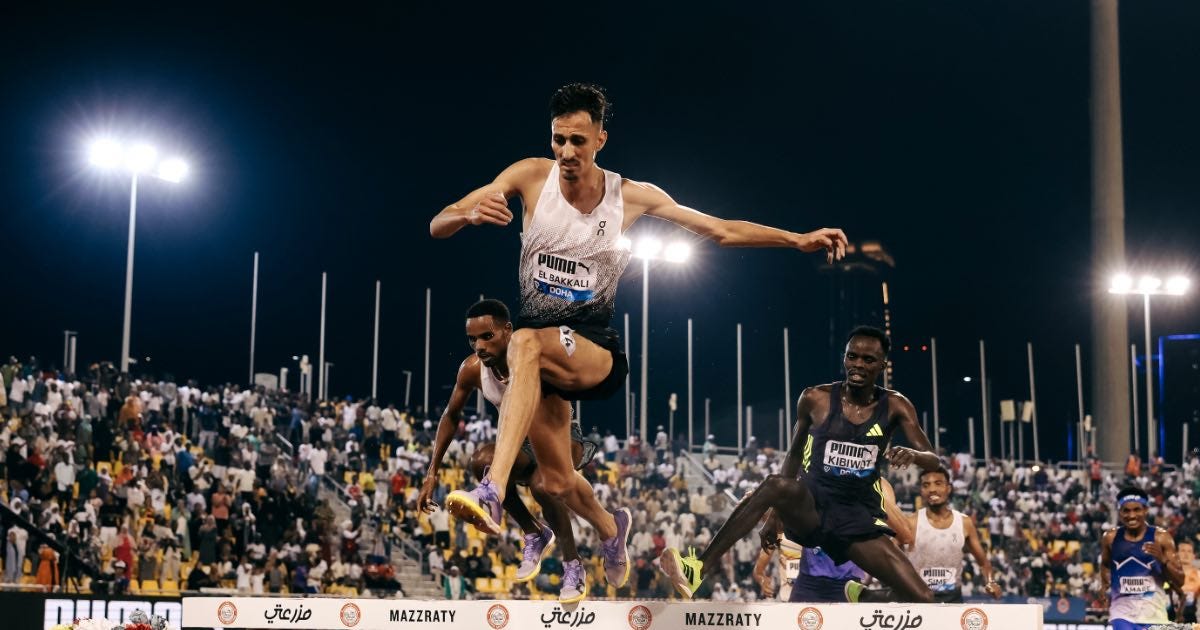
Soufiane El Bakkali: Younger steeplechase fans have only known a world in which El Bakkali is a dominant force. Since 2019, he’s placed no worse than third at a global championship—a streak that includes two Olympic victories, a pair of World titles, two World silver finishes, and a lone World bronze medal. He’s the ninth-fastest steeplechaser in history, and one of just 15 men to ever run under 8:00 in the event.
And yet… the Moroccan national record belongs to Brahim Boulami, who is credited with a 7:55.28 PB. Boulami ran even faster—7:53.17 in 2001—but that result was vacated the following year as the result of a positive doping test for EPO. His 7:55 was kept on the books.
If there’s any takeaway from this trip down memory lane, it’s that the adage that “records get broken, but medals stay golden” should probably have an addendum: sometimes, records don’t get broken even if the performances that follow are equally legendary. Time (and distance, in the case of Kovacs or other field eventers) is a weird thing in this sport; it feels like a universal and unbiased measure of accomplishments, and yet… it’s not. Athletes’ careers can be greater than the sum of their parts, and Tentoglou’s is a great reminder that personal bests are just one part of the whole story.
More News From The Track And Field World 📰
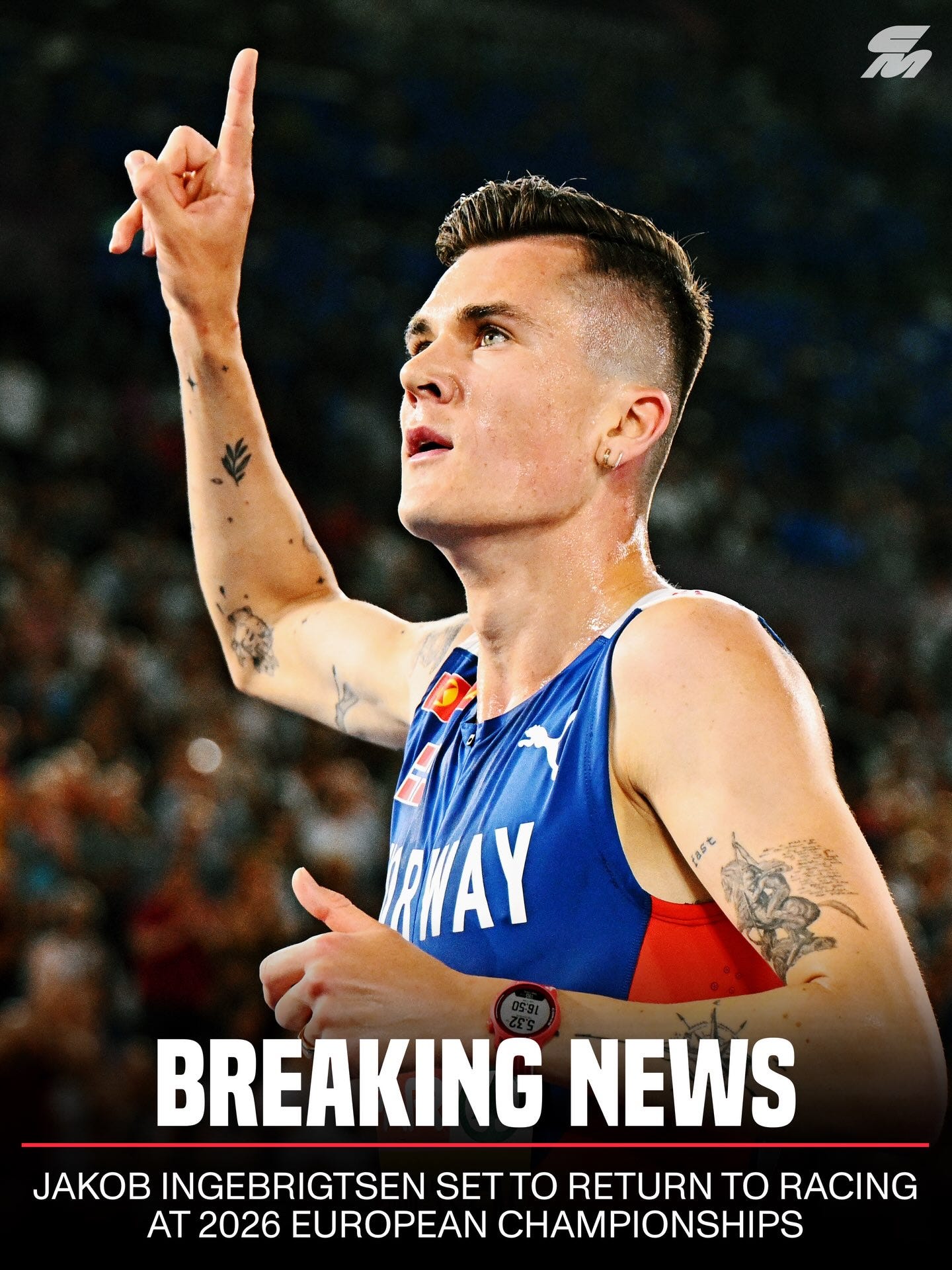
– He’s ba-a-ack! Jakob Ingebrigtsen has announced his intentions to return to competition in the European Championships 5000m in two weeks.
– At the Norwegian championships, Henriette Jæger lowered the national record in the 200m to 22.55 and also won the 400m, in 50.41; and Karsten Warholm won the 400m hurdles crown, given him a whopping 27 national titles thus far in his career between indoor and outdoor championships.
– And speaking of Warholm, Alison dos Santos reclaimed the 400m hurdles world lead from his Norwegian rival after winning the Brazilian title in 46.48.
– Slovakia’s star 400m hurdler, Emma Zapletalová, dropped the hurdles and some distance to contest the 200m at her national championship—she not only won, she set a new national record (22.67) in the process.
– Mykolos Alekna predictably claimed the Lithuanian discus title, launching for throws past the 70-meter mark. His best mark—72.65m—is the furthest he’s heaved the discus outside of Ramona.
– At his national championship, Andy Díaz extended the Italian triple jump record to 17.87m—also a world leading mark. But even then, Díaz had competition! Simone Biasuitti went 17.32m, which puts him at number 10 on the year.
– Rénelle Lamote edged out Clara Liberman, 1:58.70 to 1:58.82, to take the 800m at the French champs.
– We’re a couple of days into the Commonwealth Games, and we’ve got a handful of notable champions already: Kenya’s Edmund Serem won the men’s steeple; Jamaica’s Romaine Beckford won the men’s high jump (on count back) at 2.25m; Ethan Katzberg of Canada took the men’s hammer title; and Australia’s Rose Davies won the women’s 10,000m.
– Juliette Whittaker has joined the Brooks Beasts.
– The Boston Athletic Association has done it (it, being upsetting and/or confusing thousands) again, by announcing there will be an added, lottery-based layer to Boston qualifying.
Interested in reaching 20,000+ dedicated runners and track and field fans? Advertise with us here.
I call east coast bias on the idea Philadelphia is the perfect place. Sure it’s easier to get to than Eugene. But 9 lane tracks in places like Minnesota, Kansas would draw locals every day who’d be elated to host. And then there’s Long Beach State which is very easy to get to. No, I think the attendance issue isn’t solved by finding “yet another big eastern city full of people who don’t care.” Put that thing in Minnesota and you’ll see hundreds of kind people falling over themselves to bring casseroles to the athletes. Philadelphia, they’ll throw stuff at the runners.
Put the event back in Eugene where it belongs.