

We'll (Somehow) Always Have Paris ⏱️
Lap 279: Sponsored by CORE & Olipop
Sponsored by CORE

There’s a reason why the top cyclists and triathletes in the world are jumping in painter suits to do heat training blocks ahead of big races. The science is clear: heat training can induce performance-boosting adaptations like increased hemoglobin mass and VO2 max, which can match the same gains you get at altitude, minus the trip to the mountain. CORE’s thermal sensor streams your real-time core temp and other heat data straight to your watch, so you can safely and effectively conduct heat training without overcooking yourself.
Stop guessing what your body is telling you and try it today. Readers get 10% off the CORE 2 Thermal Sensor using code CITIUS10 at corebodytemp.com
The Lack Of Worlds Brings A Heat Wave To Paris 🔥
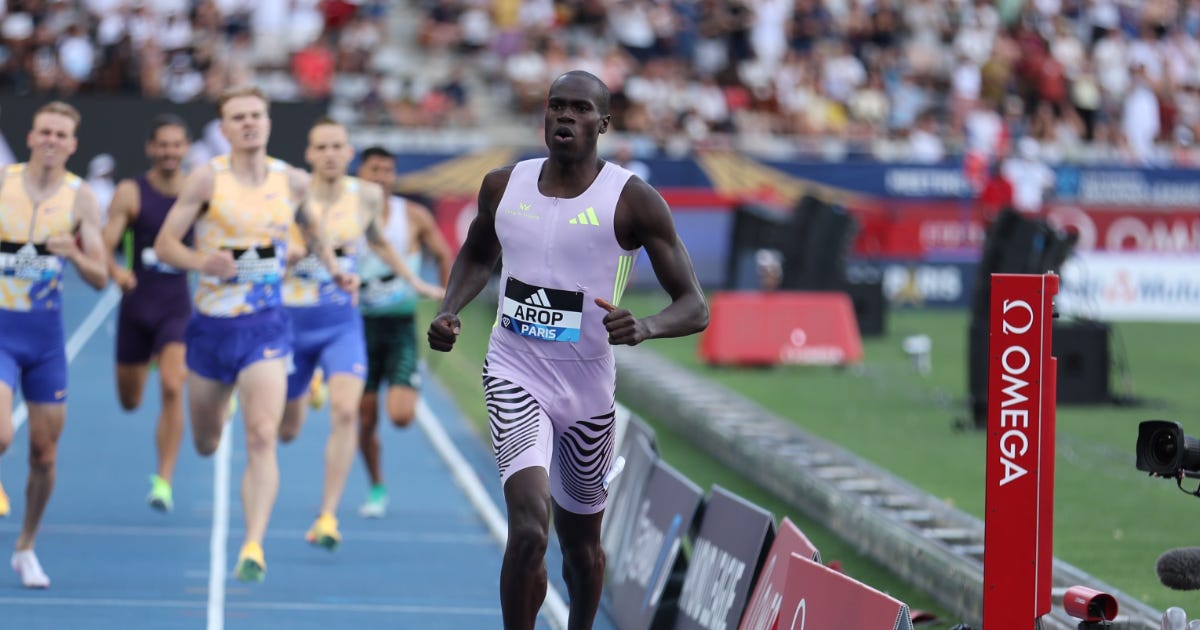
Heading into last Sunday’s Diamond League meet in Paris, the headlines were dominated by questions over whether the meet would even happen amidst France’s historic heat wave. After a few days of back and forth with city officials, the show did go on, with the distance races shifted to the end of the program and crowd-cooling efforts underway.
By the first commercial break, any weather-related concerns were a total afterthought as the real heat was happening down on the track. The first two events resulted in Diamond League records as Collen Kebinatshipi scorched a 43.54 400m and Audrey Werro clocked a 1:53.80 800m, her second league record in as many weeks.
Later in the program, Marileidy Paulino added her name to the DL record books with a 48.48 run in the 400m, winning by a country mile and clocking the fastest regular-season time of her illustrious career. Even in events where no record fell, we still got the first sub-1:42 of the year thanks to Marco Arop in the 800m and a world-leading 3:28.00 from Cam Myers in the 1500m.
After getting stuck at 13.07 for two years, Jamal Britt has now run sub-13 in three of his last four 110m hurdles races, the most impressive of which coming in Paris as he cracked the top-ten all-time list with a 12.89 personal best. The flat 100m wasn’t quite as impressive, timewise, but what did get a few folks talking, including Noah Lyles, was Trayvon Bromell’s 9.91 win out of lane eight.
The home crowd had plenty to cheer for, especially with middle-distance runners Anaïs Bourgoin (1:55.65) and Agathe Guillemot (3:56.24) setting national records in the 800m and 1500m, respectively. Guillemot held the record already, but in knocking over a second off her lifetime best at age 29, Bourgoin also took down a 31-year-old mark from Patricia Djaté-Taillard.
Their runs, combined with an impressive 5.93m showing from Baptiste Thiery in the pole vault (winning the non-Mondo division), probably made up for a slight disappointment from World 10,000m champ Jimmy Gressier, who finished a well-beaten seventh in the 5000m. Instead, the loudest cheers were from U.S. track fans (or maybe a few Franco-Americans from Maine or New Orleans with divided loyalties) when Grant Fisher finally earned his first career Diamond League victory after a handful of second- and third-place efforts. After his brief, mixed-bag dalliance with the half marathon, it was oddly comforting to see Fisher looking like himself, unleashing a perfectly-executed 54-second close to clock a 12:54.80, the ninth sub-13 of his career.
Diamond Leagues are fast—we get it. For better or worse, the nebulous points system and ranking implications for World Ultimate take a back seat when the fields are strong, the pacing is well-executed, and the Wavelights are humming. Everyone both competing and watching cares first and foremost about running a fast time, which is arguably a bad thing in the long run, but when fast times come, it sure is thrilling.
But this particular meet at this particular point in this particular season delivered flames top-to-bottom in a way that stuck out, and it’s pretty clear why. The lack of a World Championship (at least in the traditional, nine-day format) opens up the menu of racing options. If you’re the kind of top athlete who doesn’t care about indoor and doesn’t have to worry about actually winning your national championship (i.e. non-Americans, East Africans, and Jamaicans), you suddenly have a pretty boundless calendar in terms of when you want to peak and deliver your best stuff. For some athletes, that might be WUC, Europeans, or Commonwealth Games. But even then, there’s plenty of space to circle a line on the record book and focus on crossing it off.
Look at the way the middle-distance races played out. Days in advance, Werro was talking about following the pacer out at 55-second pace—and that’s exactly what she did, pulling Femke Broeders-Bol and the field along with her as seven of the top eight finishers set PBs. In the men’s 800m, Arop simply didn’t have the competition to push him without Emmanuel Wanyonyi or Cooper Lutkenhaus in the field (Editor’s note: it still sounds insane to put Lutkenhaus in that sentence), but he went for it nevertheless, putting a massive gap on the field around 500 meters that was never clawed back as he ended up winning by nearly two full seconds.
Despite the men’s 1500m not being an official DL event, Cam Myers was clearly rearing to go after finishing second and third in two more middling races earlier on the circuit. The 20-year-old Aussie stuck to the rabbit like glue and then ran the legs off runner-up Azeddine Habz in the final lap. That was the race of a man who knew he had a fast one in his legs and wasn’t content to take the win in a kick. As a result, while everyone else ran 3:29+, Myers knocked 1.8 seconds off his PB, took down Olli Hoare’s national record, and climbed to #12 all-time. Sub-3:30s are becoming increasingly commonplace in the mid-2020s, but only six men have run faster than Myers since 2020, and of those six, three are World/Olympic champions.
The freedom afforded by not scheduling your entire year around three rounds of racing in September has a leveling effect on the rest of the track and field calendar. Not everyone is at their peak fitness in June, but way more global-medalist-types are in 2026 than they would’ve been last year. Mid-summer has always been a somewhat fruitful time for time-trialing, particularly at the Parises, Romes, and Monacos of the world, but the shifted incentive structure of a “non-championship” year elevates those races much higher on the totem pole.
If rabbit-assisted record chasing is going to remain a part of the elite racing scene, we might as well watch our faves blow the doors off the place when they do. Paris showed that… and with the star-spangled Nike-funded megapalooza that is this year’s Prefontaine Classic, set for the Fourth of July in the U.S. on the country’s 250th anniversary, you can bet that this year’s onslaught on the history books is far from over.
2015 Nostalgia Comes To Croatia
Cam Myers ran a world leading 1500m in Paris. He’s just 20 years old. Isn’t that incredible? Ask Samuel Ogazi, the 20-year-old world leader at 400m. Or Ja’Kobe Tharp, who set a world record in the 110m hurdles at… you guessed it: just 20 years old. Then there is Adaejah Hodge who currently holds the world lead in the 100m and the 200m. She is of course 20 years old. And don’t forget about Birke Haylom, the world leader at 1500m, who is also 20 years old!
Maybe being young is an advantage?
Well, the Boris Hanžeković Memorial, held in Zagreb on Friday, would argue otherwise. Held since 1951, the Continental Tour Gold event is the oldest sporting event in Croatia. Last week it certainly felt that way.
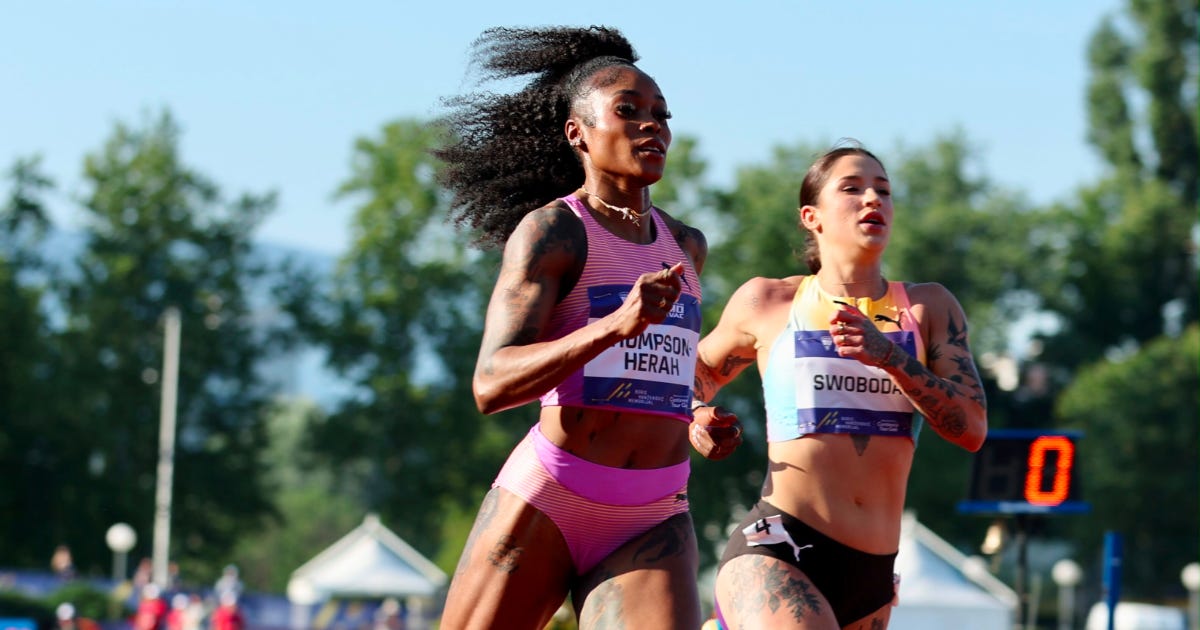
Elaine Thompson-Herah (34) won the women’s 100m in 10.91.
Shaunae Miller-Uibo (32) won the women’s 200m in 22.19.
And then Andre De Grasse (31) won the men’s 200m in 19.95.
What year is it… 2015?
At the 2015 World Championships in Beijing, the trio all earned their first of many outdoor global championship medals. In fairness, De Grasse did have to share his bronze medal with another young up-and-comer named Trayvon Bromell (30)—the same guy who just won the Paris Diamond League.
Today’s world leaders would have been finishing up elementary school in 2015! And in 2026, they’re competing against athletes that used to play snake on a Nokia while waiting for their call time.
As fans, we love the excitement of the prodigy. We’ve certainly written extensively in this newsletter about the wunderkinds suddenly at the helm of our sport. There is no limit to how high a 20 year old’s ceiling might be and that unknown potential is nothing if not captivating! If anyone is going to break a world record, it’ll likely be one of the kids at the top of sport, though it’d be great to see a tricenarian prove that prediction wrong.
The list of athletes who are 30+ and still posting top-10 marks in their event is a short one.
Across the track in 2026, there are only 17 women and 10 men who qualify for that accomplishment. The oldest athlete with a current top-ten time is 36-year-old Dalilah Muhammad. Track is not like baseball, where the average age of a major leaguer is 29 and there are currently four active roster players who have entered their fifth decade.
To still be active and winning some of the most prestigious races in track and field, these older athletes had to persevere. Andre came back from a torn hamstring, while Trayvon and Elaine both tore their Achilles. And in addition to knee surgery, Shaunae has had two kids.
At a certain point in every athlete’s career, the narrative flips from “what could they do at their best?” to “how long can they keep doing what they’re doing?” And that’s if they’re lucky— there are plenty of athletes whose legs don’t take them that far. Let’s not forget that Shelly-Ann Fraser-Pryce and Usain Bolt are the same age, but she made it two Olympics and four World Championships longer than him. And both of these Jamaican greats are two years older than David Rudisha, who, at 37, has never officially retired but hasn’t raced in nearly a decade. It goes to show just how special being great for a really long time is that even the best of the best rarely are.
So while most fans are understandably excited about the future and what records may someday fall, let’s also leave time for a little nostalgic appreciation of continued greatness. Being fast when you’re 20 is impressive, but building a decade-long career is the stuff of legend.
Sponsored by Olipop

Isn’t history so interesting? Get your fiber fix. Shop Olipop’s flavors at DrinkOlipop.com and use code CITIUS25 at checkout for 25% off.
What Can Western States Tell Us About The Future Of Ultrarunning?
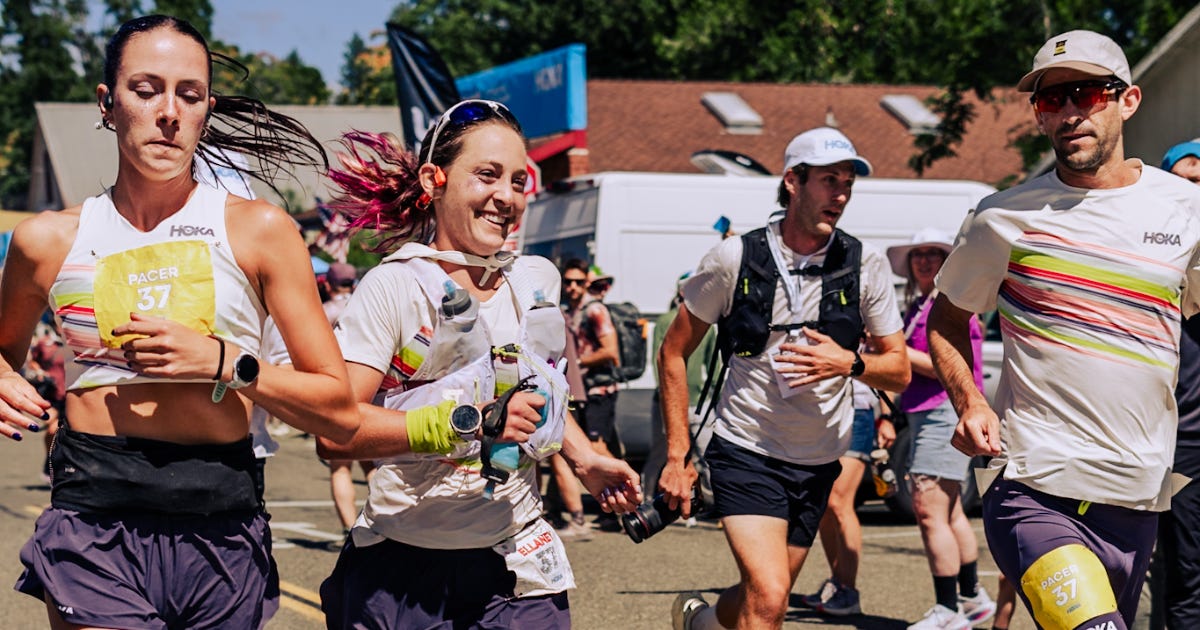
Coming into this past weekend, the course records at the Western States Endurance Run were held by Jim Walmsley (14:09:28 in 2019) and Courtney Dauwalter (15:29:33 in 2023). It was one of those statistics in sports that felt perfectly intuitive. LeBron James and Diana Taurasi are the all-time leading scorers in the NBA and WNBA… Walmsley and Dauwalter were the fastest ever over the 100.2 mile course at WSER.
But after this past weekend, both course records are considerably faster and held by different athletes. Winner Vincent Bouillard (13:46:15) was one of four men under Walmsley’s old record, and one of three to break the long-coveted 14-hour barrier—Francesco Puppi took second in 13:51:08, Ryan Montgomery came next in 13:53:55, and Thomas Cardin finished in 14:07:58. Jennifer Lichter won the women’s race in 15:28:05, placing 11th overall. Out of the 50 WSERs ever contested, Lichter’s time would have outright won 36 of them.
Results such as these surely merit a larger unpacking of the all-time pecking order at the most historic ultra in North America… right? To make sense of what we just witnessed on the switchbacks between Olympic Valley and the Auburn High School track, we checked in with Stephen Kersh, a two-time top-ten finisher at Western States, who was on site photographing and filming parts of the race.
To understand why what just transpired was even possible, let’s start with what Kersh himself was wearing during his long day out along the course: “I was in jeans all day and wasn’t ever very warm.”
This is what most ultra-followers pointed to in the post-race de-briefings—not Kersh’s pants, but the fact that the weather was as close to perfect as you’ll ever get for a race that covers this much varied terrain. “The conditions this year were an anomaly,” says Kersh. “There was no snow along the course due to low snow during the winter, and then the temperatures were some of the coolest in race history, topping out in the high 70s in Auburn (though it certainly was warmer than that in the canyons and along the river).”
Obviously this all contributed to the course records in both men’s and women’s races and the overall historically fast finishing times in the entire top ten. Kersh suggests that the weather provided a psychological boost as well as a physiological one, but he’s quick to wedge a big old caveat in there.
“I think it would be easy to say the weather was what made people really ‘go for it,’ and I’m sure that it played a part in the calculus, but these top athletes are now just complete professionals,” he explains. “They have the ability now to completely focus on this performance and put so many resources into having the perfect day.”
It’s easy to look at a race with as rich a history and surrounded by as much fanfare as Western States and assume that those striving to win it have always been type-A sickos following rigorous training plans, backed up by the latest in sports science. But if you’ve spent any time crewing for a friend at a trail race, you’ve undoubtedly met an old-timer bemoaning the sport’s ongoing transition from fringe activity for recluses, naturalists, and off-the-grid dirtbags, into something that is becoming optimized and that attracts increasingly talented athletes who both love the outdoors and want to kick your ass in terms of exploring it.
Take a look at what Boulliard was doing during his prep for WSER, as outlined by his coach, Mario Fraoli. Lots of aerobic volume, lots of threshold work, lots of heat acclimation, lots of course-specific prep.
The true professionalization of ultrarunning is still fairly new—it might even be fair to say that as a genuine high-end competitive endeavor, it’s a young sport. But given there are some structural similarities between ultrarunning and regularrunning—what we’ll call marathoning for the sake of this piece—we can expect it to reach competitive maturation quickly. And in regularrunning, we are seeing athletes go for it in previously unthinkable ways, and be rewarded. Take the two recent sub-two hour marathon performances, for instance. Kersh thinks that’s what happened to an extent this past weekend.
“The fear of blowing up certainly still exists in the sport, but the chance of lacing one is much higher now,” he unpacks. “The landscape has changed and the caliber of athlete at the pointy end of these races is a more elite, trained, and calculated one. The big swings used to look like someone running recklessly—now it’s just what you need to do.”
There is still an element of caution required in ultras that might now be a thing of the past on the roads. Just ask Hans Troyer, the pre-race favorite who led at a blistering course-record clip before slowing down and ultimately dropping out at mile 78. Other notable DNFs this year included Hayden Hawks, Kilian Jornet, and Walmsley himself. It might be an exaggeration to say anyone on course-record pace was running conservatively, but simply making it through all 100 miles of a 100-mile race remains a significant chunk of the battle.
A lot more can go wrong in a race that takes over half a day to complete than in one that might be completable in about two hours. That’s especially true when your 13+ hour day is spent on undulating and uneven terrain with the potential for tons of sun exposure and often long gaps between aid stations.
Boulliard didn’t hit the lead until he had about two hours of running left, and comfortably ran much of the race several minutes back from whoever was leading at the moment. Lichter likewise took an aggressive yet slightly cautious approach, running hard but still in 20th to 30th position overall for much of the first half of the race, then easing her way up toward the top-10 on the back half. About a third of the way through the race, she overtook early women’s leader Riley Brady and ended up beating Brady by 14 minutes.
So what does this all mean for our collective understanding of ultrarunning greatness? As we enter a new era of performance for the sport, do the legacies of past greats wind up tarnished as their once dominant times are gradually buried? Not quite. Because of the reasons outlined in the preceding paragraph, course records and times probably matter less in ultrarunning than in any other competitive wing of our sport. Its fans and athletes inherently understand that the course and conditions have an outsized impact come raceday, which means placing is the purest measure of greatness.
If anything, ultrarunning is uniquely well-positioned to weather the changes it’s going through for that very reason. Right now, Vincent Boulliard and Jennifer Lichter are the fastest athletes to ever traverse the Western States course. But are they the best champions the race has ever seen? That’s more open to debate, which is the sign of sport that’s navigating its growing pains in a healthy way.
More News From The Track And Field World 📰
– In positive news: Jenny Simpson has been discharged from Duke University Hospital and will continue her recovery in North Carolina.
– In “Gig ‘Em” news: after four years at the helm of Auburn’s track & field program, Leroy Burrell has been hired to take over at Texas A&M.
– In “about time” news: beginning retroactively for athletes who competed at this year’s Winter Olympics, the IOC will begin offering $10,000 grants to Olympic athletes—this is the first time direct financial support has been made available to Olympians.
– In “so long super seniors!” news: The NCAA has made it official—at the Division I level, athletes can only compete within a five-year competition window that begins at full-time enrollment or on their 19th birthday, whichever comes first. That means basically no more conventional redshirting, but exceptions can still be granted for religious missions, maternity leave, or active-duty military service. We talked about what this means for track and field already if if you missed it.
– In “not the same as the Pan Am Games” news: At the first ever Pan American Championships in Medellin, Colombia (elevation: 4,900 feet), the home team’s Ronal Longa won the men’s 100m in a South American record time of 9.85 and Puerto Rico’s José Figueroa won the 200m in 19.87. Daily Cooper of Cuba won the women’s 800m in a speedy 1:56.10.
– In World Athletics Combined Events Tour news: Annik Kälin broke the meet record while improving on her own world lead (now 6819) at the Stadtwerke Ratingen Mehrkampf-Meeting; reigning world champ and hometown hero Leo Neugebauer won the decathlon with 8573 points.
– In non-old-timers news: at Croatia’s Boris Hanzekovic Memorial, Dominica’s Thea Lafond notched a world lead in the triple jump (15.25m); Jamaica’s Rajindra Campbell heaved the shot 22.44m; and American Nathan Green continued his winning ways in the 1500m, going 3:32.46.
– In “you know you’ve made it when” news, Grenadian Olympic champion Kirani James will be honored with his face on the new Eastern Caribbean $5 note coming into circulation in 2027.
– And in “desperately keeping this joke structure alive” news: former elite sprinter and notable track and field online personality Monzavous “Rae” Edwards evidently learned from a CITIUS MAG Instagram post that he had been banned two years—not three, as he had originally believed to be the case—by USADA for his role in connecting Marvin Bracy-Williams to a testosterone supplier.
Interested in reaching 20,000+ dedicated runners and track and field fans? Advertise with us here.