

If These Lanes Could Talk ⏱️
Lap 273: Sponsored by New Balance
Sponsored by New Balance
New Balance is celebrating Grey Days 2026. It’s a tribute to the iconic shade that helped define the brand’s identity. Featuring rising sprint star Quincy Wilson alongside a roster of global athletes and ambassadors, the month-long campaign honors the evolution of grey from a practical runner’s choice to a symbol of timeless style, innovation, and independence. Check out the Grey Shop here.
Compiled by David Melly, Paul Snyder, Kyle Merber, & Paul Hof-Mahoney
The Weekend’s Big Losers Are Actually Winners 🙃
From Tokyo to Terre Haute and pretty much everywhere in between, there was a lot of track to process this weekend. As certified Time Doesn’t Matter guys here at the Lap Count, the temptation is to focus solely on the weekend’s victors at NCAA conference meets and Diamond League openers. But interestingly, one common theme this weekend was that many top runners who lost races all over the globe kinda ended up with the better narrative.
Maybe calling them “big losers” in this section’s header is overkill—we were just trying to capture your attention… These athletes only lost by a little, which makes them “regular losers,” but we wanted to give a moment of appreciation to six athletes for some great racing this past week that may have been overshadowed by their competitors who actually landed on the top of the podium.
Tate Taylor: The American U20 record holder made his first international business trip, foregoing the Texas state championship to instead compete at the Seiko Golden Grand Prix in Tokyo. The high school senior needed more than a permission slip to attend this meet; he needed a passport. Despite a substantial time zone difference and a few nights away from mom’s homecooking, the precocious star excelled, finishing second in the 100m and running 10.04 (+0.6). If ever there is a moral victory in defeat, it’s traveling to the other side of the world and only losing to the Olympic champion. Also making the trip was Taylor’s fellow high schooler and training partner Jake Odey-Jordan, who finished third in the final, although he actually beat Taylor and set a PB (10.07) in the prelims.
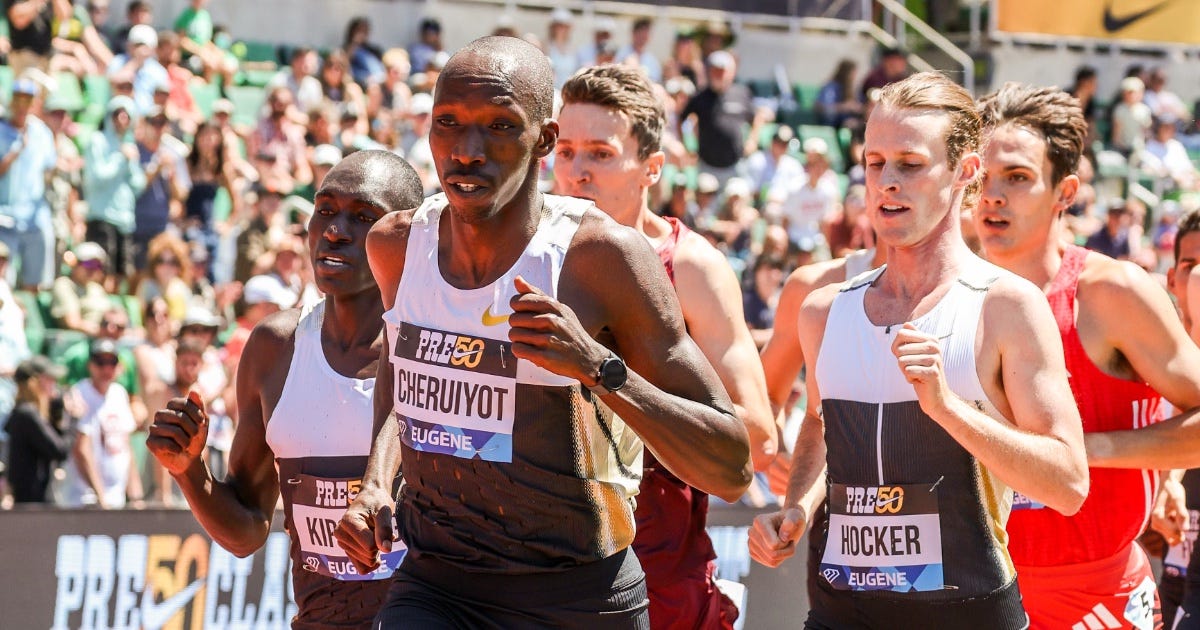
Timothy Cheruiyot: When you’re 30, you (hopefully) don’t feel that old, but when you’re the former World Champion, entering your 12th year on the circuit, then it feels like you’ve been around a lifetime. The 1500m specialist previously tested the deeper waters of a 3000m in 2023 when he ran 7:36 to finish 5th at the Doha Diamond League. But a few years later, his return to the distance has given reason to believe he might have a fair shot at a second act in his career. In what was the deepest 3000m ever (14 guys under 7:30), Cheruiyot finished fourth in a significant PB of 7:27.24.
Tsige Duguma: The 2024 Olympic silver medalist over 800m was technically around in 2025, but she wasn’t always around the front. Well, in 2026, it appears she’s returning to form. After testing the 1500m waters with a 4:03 debut during the indoor season, the Ethiopian standout returned to the event on the DL circuit and knocked her second swing out of the park. It’s not so much that her time of 3:55.71 is exceptional, it’s that the athletes she finished ahead of are: the reigning World Championship silver and bronze medalists, among others.
Devynne Charlton: In the immortal words of Adam Sandler, “Happy learned to putt… uh-oh!” That’s the sentiment we’re feeling after seeing the 3x World Indoor Champion and world record holder over the 60m hurdles break through with a personal best of 12.38 (+0.4) in her first 100m hurdles race of the season. The Bahamian star had a previous best of 12.44 and has finished 6th at the last two Olympics, so it’s not like she hasn’t been competitive. But if those last few hurdles come together like they did in China then she could be joining training partner Masai Russell (the race’s winner) on the medal stand soon.
Kena Tufa: If your first reaction was “who?” You’re probably not alone. That’s because Tufa, the 20-year-old Ethiopian steeplechaser who took fourth in Shanghai, just improved her personal best by a whopping 32 seconds to become the 17th woman in history under 9 minutes. Tufa had shown signs of potential for those paying very close attention, finishing second at the Kip Keino Classic last year and winning the Ethiopian Championships in March, but to the wider world outside hardcore African distance fans, she’s a complete unknown. Not for long, if her current trajectory holds.
Trent McFarland: It feels like McFarland has been hovering on the cusp of a breakout all year. He took third in the mile at NCAA indoors, ran 3:33.17 and 3:52.73, and anchored Michigan to a 9:14.80 DMR (#2 all-time). Simeon Birnbaum got the better of McFarland at Big Tens by about half a second in a kicker’s race, but McFarland had to do a LOT of work on the final lap to get up on Birnbaum’s shoulder with 200m to go. If McFarland starts that lap in the right spot and then unleashes his kick, it’ll be a much closer race and the positions could easily end up flipped. He is a winner here not for his performance, but for the lesson learned.
The most memorable quote from the forgotten pre-West Wing Aaron Sorkin show Sports Night is “if you’re good enough to come in second place, then you’re good enough to be disappointed in it.” It sure feels like the lessons these athletes picked up from their races have the potential to lead to a lot of winning in the weeks, months, and years to come.
Every Lane Of The Shanghai 200m Had A Story 📖
The very first meeting of the 2026 Diamond League season kicked off last Saturday in near-ish Shanghai, China, and at the end of the morning (assuming you were watching in the U.S.) there was plenty to talk about.
Masai Russell continued her red-hot start to the season, posting a world-leading 12.25 in the 100m hurdles. When you’re that fit, it doesn’t matter whether you’re hurdling in your own backyard of Lexington, Kentucky, or halfway around! The distance closes were all decided by tiny margins: Faith Kipyegon won the 5000m by 0.07 seconds, Mark English took the 800m by 0.04 seconds, and Peruth Chemutai persevered over World champ Faith Cherotich in the steeple by a mere 0.01 seconds. Chemutai’s win was no kicker’s race, either: she and Cherotich clocked the two fastest times ever recorded in May at 8:51.47 and 8:51.48. South Africa’s Gift Leotlela took down a strong field in the men’s 100m with a 9.97 win over the likes of Kenny Bednarek and Trayvon Bromell. And Mondo Duplantis (of course) recorded his 40th straight victory in the pole vault.
But the most interesting event from top to bottom was, undoubtedly, the women’s 200m.
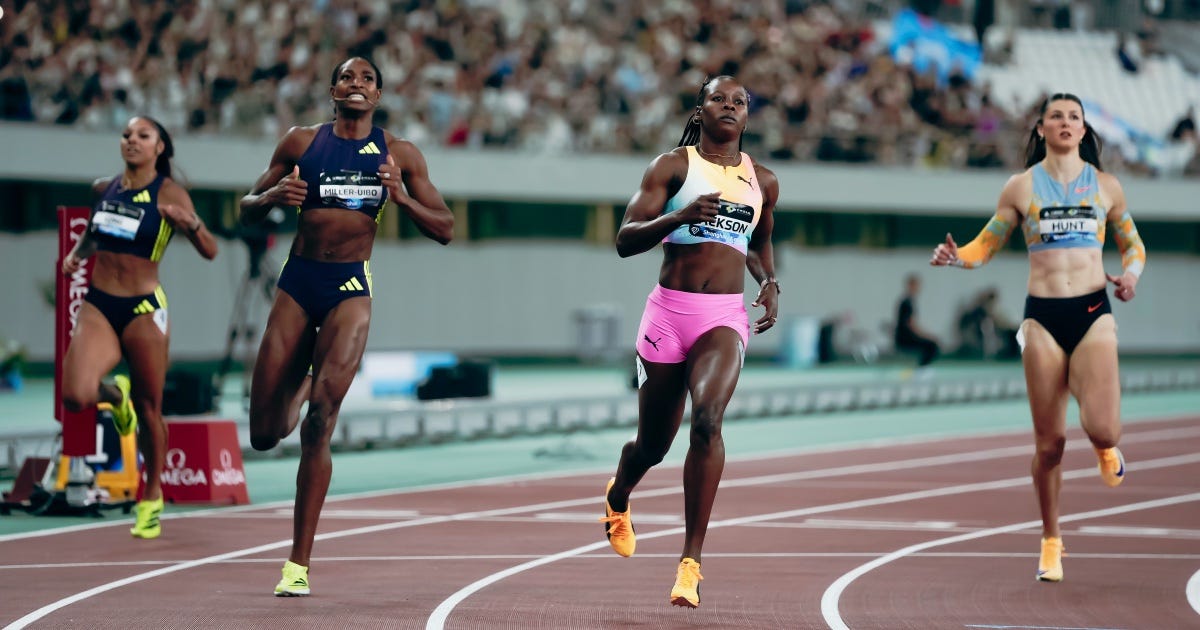
Shericka Jackson took the victory in her first 200-meter race of the season in 22.07, her fastest opener since 2023. That’s a great early-season time, but it’s only the fourth-fastest run in 2026 so far, and only one of the nine total finishers set a personal best. Sounds pretty boring, right? Wrong! There’s something interesting to unpack about every single result in this race, so let’s go through it all, finisher-by-finisher.
1. Shericka Jackson, 22.07: Jacko is back-o, baby! After a strong run in the 4x100m at World Relays and a couple rust-busting 400ms, the sense was that the 31-year-old Jackson was starting the season fully healthy for the first time in a while and ready to rock. After taking bronze at Worlds last year, Jackson showed that her injury woes at the Paris Olympics wouldn’t define the next stage of her career, and it’s also clear she isn’t ceding the top step to Gabby Thomas, Julien Alfred, or anyone else for that matter. Compared with last year’s DL opener, where she was well-beaten by Anavia Battle in Xiamen, this is a much better starting point, and though she ran hard all the way through the line, she looked comfortable the entire way.
2. Shaunae Miller-Uibo, 22.26: Speaking of “back, baby,” the now-mom-of-two taking second in this stacked field was probably the biggest surprise. Miller-Uibo ran her fastest 200m since 2021, knocking nearly two-tenths off her season’s best and beat the second- and fourth-placers from last year’s World final in the process. At 32, Miller-Uibo has plenty of good years of running ahead of her, but it would be understandable if the three-time global champ over 400m focused solely on the longer event during her comeback. Flashing this kind of speed this early in the season sent a clear message that the Bahamian isn’t settling for less than her best stuff.
3. Anavia Battle, 22.40: This time last year, no one was thinking of Battle as a major international contender… until she won the first four Diamond Leagues in a row. She then beat Gabby Thomas and Brittany Brown at USAs, made the team, and took fourth at Worlds in Tokyo. She may not have started this outdoor season with yet another DL win, but she actually ran a hair faster than she did in Xiamen. If there was even a shred of doubt left, let it fade away: Anavia Battle belongs in the conversation.
4. Sha’Carri Richardson, 22.42: Sha’Carri haters will probably look at the three names before her and decide this race was a failure to launch, but in comparison to her past openers, this race was a qualified success. It was her fastest opening 200m since 2022, and in 2024, she ran 22.99 and 23.11 in China before dropping her time to 21.99 in her next 200m. 22.42 won’t set the world on fire or put any real fear into her rivals in this particular event, but it’s a good sign that the 100-meter specialist will be well-prepared for her debut over the shorter distance. Her race execution was far from perfect, getting a sub-par start but then running a strong bend and easing up a little just before the line. Plenty of room for improvement, which at this point in the year is probably a good sign.
5. Amy Hunt, 22.48: British athletics fans were likely hoping for a slightly more impressive run from Hunt, who beat Jackson to take silver at last year’s World Championship. Hunt clearly times her peak well, as her first and last 200ms of 2025 were 23.08 and 22.94 but her best time of the season (22.08) came in the World final. There’s no reason to panic after Hunt ran 22.63 and 22.48 in her first 200m efforts of the season, but there also isn’t exactly much evidence that Hunt has decisively leveled up.
6. Jenna Prandini, 22.68: Death, taxes, and Jenna Prandini. 11 years after her Diamond League debut, the 33-year-old vet, now sponsored by On, is still mixing it up. She began her outdoor season Stateside, going 3 for 4 with 100m/200m wins, and didn’t quite match her 22.36 season’s best here, but Prandini is the kind of relentless that is honestly inspiring for those of us who were in college at the same time as her.
7. Yujie Chen, 22.84: On the other end of the experience spectrum, 17-year-old Yujie Chen made the most of her second-ever Diamond League in front of the roaring home crowd, snagging a new PB of 22.84 in eighth. It’s only her third-career sub-23, and after making her World Championships and World Relays debut last year, she’s got a bright future ahead of her as she racks up more experience.
8. McKenzie Long, 22.85: Long had a pretty tough lane draw, running blind in lane 9 before Miller-Uibo used her strength to fly past her on the home stretch. This is probably a race to forget for the 25-year-old, but the pro life is an unforgiving one. Let’s not forget that Long ended up fifth at USAs but then made both the Diamond League and World finals over 200m—it’s purely a testament to the talent at the top of the event that occasionally she finds herself overmatched.
9. Torrie Lewis, 23.25: The only athlete with a worse lane draw than Long was Lewis, who drew the short straw (almost literally) and had to brave the tight turns of lane 1. Given the proximity of time zones, it wasn’t a surprise to see Australians show up in almost every event in Shanghai, and Lewis, like many of her compatriots, was making her way back from World Relays in Botswana as well. After a long indoor season featuring five meets in Europe, this may be a sign that it’s time for a little rest and reset. Lewis is probably not used to not being the youngest athlete in fields like this, as she’s only 21. Like Chen, there’s probably still a bit of a learning curve as a working pro on the road.
The women’s 200m in Shanghai was unique for its sheer number of storylines, but in a way, it’s also a microcosm for this point in the season. For some athletes, it’s an opportunity to bust the rust and tighten the screws; for others, it’s an addendum to an indoor campaign that began in January. The old heads are taking on the newest crop of young guns, and either way, that can feel a bit like you’re fighting just to prove you deserve a lane at the highest level of competition. Most of all, meets at this time of year leave you wanting more, and fortunately for us, every finisher in this 200m is running it back in the same event next weekend in Xiamen.
An Elegant Solution To The Women’s Shot Put Record Board Issue 💪
What are we to do about the all-time list in the women’s shot put?
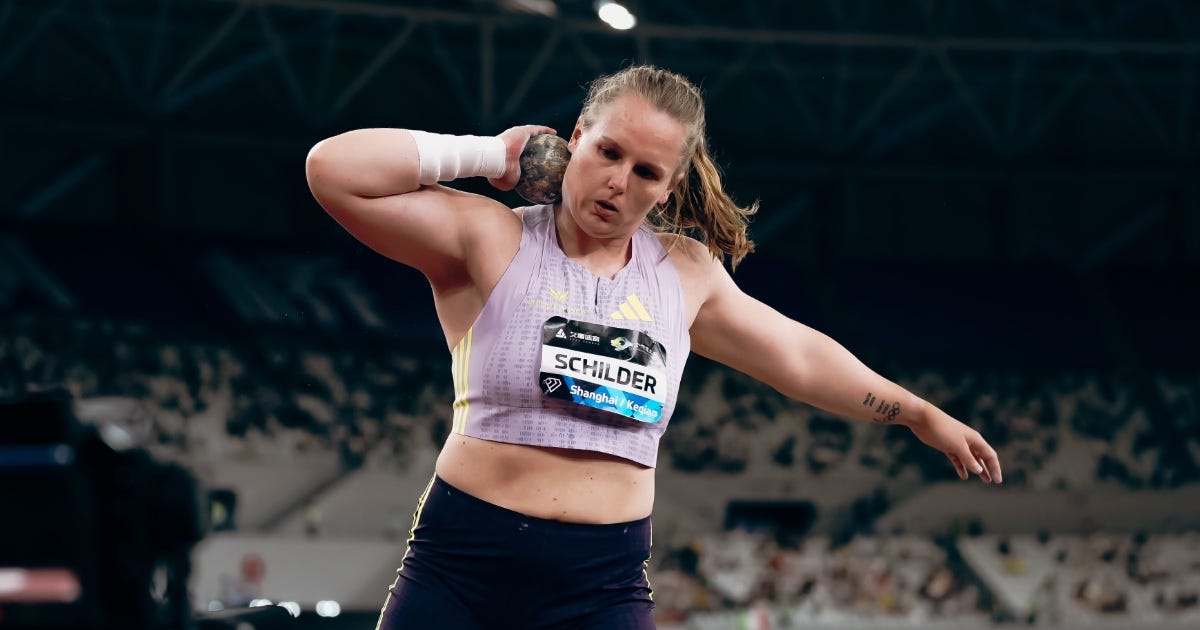
It’s a dilemma that has long troubled throws enthusiasts, and a 27-year-old Dutchwoman by the name of Jessica Schilder once again brought the issue to the forefront over the weekend. On her fifth attempt at the Shanghai Diamond League, Schilder—the reigning outdoor World champ—uncorked a mammoth 21.09m toss that ended one of the discipline’s most significant droughts. For the first time since July 17, 2012, a woman threw past the 21m mark in the shot put.
With her historic effort, one that hadn’t been matched for well over a decade, Schilder landed herself all the way up to… tied for 29th on the all-time list?
That doesn’t seem right. Surely a performance of this stature, a drought-breaker like this one, would slot in substantially higher in the record books? A 14-year fallow period would end if we see a man go 9.6X in the 100m this season—and he would be tied for second fastest ever, at worst! Usually when we see long stretches of time without a particular mark populating the results sheets, it’s because it was just as hard to do in the past as it is today.
And then, there’s the women’s shot put. 35 women in world history have hit the 21m barrier (a shade under 69 feet for imperial measurement fans). 31 of those women did so between 1972 and 1999, with 28 hailing from Eastern European nations and the remaining three from China. That leaves Schilder and three other women that have hit that mark this century:
Russia’s Larisa Peleshenko, who threw 21.46m in 2000 at age 36 and served a four-year doping ban in the late 90s which wiped her 1995 World Indoor title off the board.
Belarus’s Nadzeya Ostapchuk threw 21.09m in 2005 and was once one of the most decorated women’s throwers ever before the final 7.5 seasons of her career were Thanos-snapped away due to a string of positive tests. (That 21.09m throw is actually the last mark on her World Athletics page that is still recognized.)
Finally, New Zealand’s Valerie Adams threw 21m on four occasions between 2009 and 2012. Very notably, in this context, the 10-time global champion never incurred a failed drug test or other anti-doping violation in her career that spanned over two decades. In fact, two of Adams’s 10 titles were originally won by Ostapchuk and then reallocated following her suspension.
Adams’s excellence really highlights the flaws in the record books, as her PB of 21.24m comes in at No. 23 in world history. In order to believe, without doping suspicions, the historical dominance of the all-time lists by athletes from decades ago, you need to believe that the event has simply taken a massive step back, bucking the trend of progress experienced across nearly every other discipline. Many reasonable observers do not blindly accept that.
Women’s discus faces many of the same issues, but ever-windy Ramona has served as something of an equalizing factor in that respect. Shot put can’t be helped out with favorable weather patterns in the same way, unfortunately, so the common solution presented is resetting the record books.
That’s a lot harder to do in practice than in theory. For starters, how do you land on “X” date as the new start of shot put history? That unfairly impacts athletes that were clean in your somewhat arbitrary purge window and ignores the dopers that were active after that era concluded. You can be suspicious all you want, but in the absence of actual positive tests from the Soviets and East Germans and Bulgarians and whatnot, World Athletics’s figurative hands are tied in what they can do in terms of eliminating or resetting marks.
That leaves us with one other option: change the implement! Javelin has done it a few times before, with the men’s model changing in 1986 as a result of people throwing far enough to regularly endanger officials and crowds. It created an entirely new record book while still maintaining the sanctity of the former list, as World Athletics still recognizes distinct current and old model lists and records.
A shot put is a simpler, more spherical implement that can’t be tweaked by moving the center of gravity forward, so what about tinkering with the weight? Two years ago there was a widely-lambasted report that Seb Co and Co. were thinking about making the women’s shot put lighter to make it more exciting.
It’s this newsletter’s opinion that that’s a silly proposal. The excitement of the event is very much there. Just look at round six from Tokyo…. It was awesome! And every Diamond League brings the opportunity for a different winner. So our forthcoming (very realistic, extremely serious) solution doesn’t hinge on needlessly cooking the distance of throws to somehow make the event more interesting or exciting. It doesn’t need that! We’re just trying to allow the current generation of athletes to get the historic recognition they deserve.
Instead, let’s up the weight… by 0.01 kilogram! It’s not a meaningful difference and shouldn’t change the event in any meaningful way. It would still allow for valid comparisons between clean throwers of different eras, while also making excitement about world and continental records a possibility. Who knows what contract incentives and bonuses the 4.01kg shot might open up? It also makes marketing to outside fans easier if you can bill clashes between a handful of the 10 best women in world history instead of a kneejerk reaction that this current group of athletes is lightyears behind the 80s and 90s.
Again, we must reiterate that this is not a perfect solution. In fact, it’s not even a realistic solution! But it’s a conversation worth having, because Natalya Lisovskaya’s 22.63m world record is one that likely will stand the test of time until someone builds a throwing facility inside a hurricane’s eyewall.
Until that day comes, though, we implore you not overlook how impressive a performance like the one Schilder just had is simply because it’s over 1.5m back of the world record.
More News From The Track And Field World 📰
– Tokyo’s Golden Grand Prix featured a mix of locally-sourced, pseudo-national championship-style competition, plus a handful of small but elite international fields. In addition to the aforementioned Noah Lyles return to the 100m, where he took the win in 9.95, Rai Benjamin (44.69) secured a tidy 400m victory over Paris bronze medalist Muzala Samukonga.
– At the African Athletics Championships there was a major upset in the men’s 4x400m relay, with Zimbabwe breaking the tape in 3:01.11 ahead of Kenya and Morocco… pre-race favorites Botswana came in fourth; 2016 Olympic silver medalist and Kenyan javelin institution Yulius Yego won his sixth AAC gold medal; in the women’s steeple, Kenyan youngsters Diana Chepkemoi and Mercy Chepngeno employed some classic team tactics to secure gold and silver.
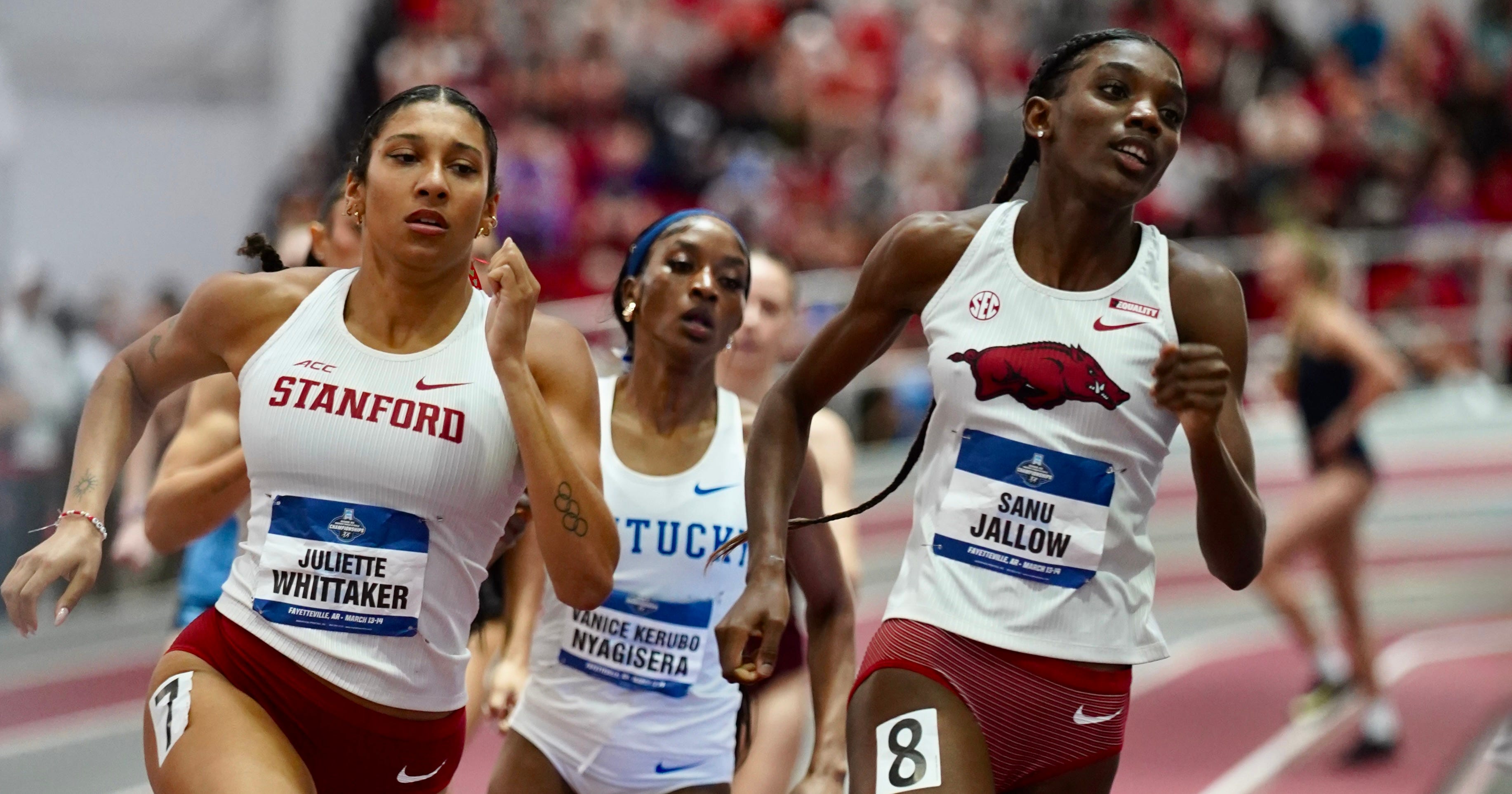
– The SEC Championship’s annual bid to be informally recognized as the premier sprinting meet in the world was an impressive one. On the women’s side Georgia’s Adaejah Hodge claimed the 200m title in 21.92 and her teammate Dejanea Oakley won the 400m in 48.92; in the 800m, Arkansas’s Sanu Jallow won in 1:58.82; Emmi Scales of Kentucky won the 100m hurdles in 12.64, and Akela Garrett (South Carolina) won the 400m hurdles in 54.02. Each of those event winners are now also the NCAA leader, and all finals were run with legal wind readings. For the men of the SEC, Jelani Watkins of Arkansas snagged wins in the 100m and 200m (9.95 and 19.87, both wind legal); Alabama’s Samuel Ogazi won the 400m in a world-leading 43.95; and Auburn’s Ja’Kobe Tharpe won the 110m hurdles in 13.05 into a 1m/s headwind. The Florida women and Arkansas men took the team titles.
– The Oregon men and women completed their triple crown of team conference titles with their dominant wins at the Big Ten Championships. Washington’s Hana Moll broke the collegiate outdoor record in the pole vault with a 4.83m clearance; Oregon newcomer Sharifa Davronova only recorded one attempt in the triple jump, but at 14.11m, it was NCAA-leading and more than enough to win; and Simeon Birnbaum won a stacked men’s 1500m in 4:00.98, perhaps a signal that we are returning to an era of tactical conference men’s mid-D events… nature is healing. The sprint times were aided by Wizard-of-Oz-tornado-level winds, with Eddie Nketia of USC taking the 100m in 9.73 (+5.6) and, not to be outdone, his teammate Madison Whyte got the wind reader up to +6.0 for her 21.78 200m win.
– Big 12s also saw a humorously slow men’s 1500m final, with reigning NCAA indoor champ Carter Cutting (3:58.63) striking gold; Tafadzwa Chikomba of Kansas State won the men’s long jump in 8.27m and Texas Tech’s Jonathan Seremes won the triple in 17.09m, both NCAA leads; Emmaculate Jemutai of Kansas took home the win in both the 800m (2:05.90) and 1,500m (4:09.66). Texas Tech won the men’s and women’s team titles.
– ACCs were held in Louisville (“LOO-uh-vul”) so feel free to read the rest of this paragraph while dropping unwanted syllables at your discretion: Neo Mosebi of Florida State won the 100m in 9.98; Virginia Tech’s Nicholas Plant impressively closed the back half of the men’s 1500m to edge out Gary Martin and Rocky Hansen; Juliette Whittaker of Stanford outleaned Sadie Englehardt in the women’s 1500m; Whittaker’s teammate Alyssa Jones won the long jump at 6.92m; and UNC’s Makayla Paige went 2:00.68 to win a loaded 800m. The Clemson women and Virginia men were the team champs.
– Matthew Gray of Appalachian State won the Sun Belt pole vault title in the third best outdoor clearance in the world so far this season, 5.84m; and Molly Caudery—the World Indoor champ—opened up her outdoor season at 4.61m at the Loughborough International meet.
– The all-time high school boys’ 200m all-conditions leaderboard is lousy with wind-aided results, but nobody has run a faster wind-aided time than Blake Hamilton. The senior from Katy’s Tompkins High School ran 19.86 with a +4.6m/s wind reading to win the Texas 6A State Championship. His fastest wind-legal time is 20.27, which came in the prelims. He hasn’t lost a race all season.
– U.K. 800m wunderkind Phoebe Gill stepped up to the 1500m at the inaccurately named British Milers Club Grand Prix and broke the meet record in a PB of 4:05.53; that’s her first result since an indoor 400m 2025.
– Jakob Ingebrigtsen, Olympic champion, husband, musician, brother, father, and achilles tendon injury sufferer, has shared that his focus is getting back to peak health and fitness rather than rushing into racing by a set date. “I’m trying to train as much as I can and that’s the main focus right now… I am a competitor and of course, I’m going to compete once I’m ready for it. However, it’s not my main goal right now,” he told Johanna Gretschel of Runner’s World.
– ATHLOS NYC is returning to Icahn Stadium for the third straight year, with the 2026 edition of the meet slated for October 2nd. And! There will be a second meet that takes place before the NYC one!
– On is launching a sprint-focused pro group, based in Los Angeles, and coached by John Bolton. Stay tuned for updates and content from CITIUS MAG, who will be embedded with the group the next few days.
Interested in reaching 20,000+ dedicated runners and track and field fans? Advertise with us here.
Why don't you post High jump wins, and info??