

Hurdling The Hurdles' Hurdles ⏱️
Lap 272: Sponsored by New Balance
Sponsored by New Balance
New Balance’s latest daily trainer is the Ellipse. Very much looks like a lifestyle shoe but reliable for easy days and recovery miles.
It fits clean right out of the box. The Fresh Foam X cushioning keeps the miles soft and the legs fresh. Engineered mesh keeps things breathable. The engineered mesh breathes. The gusseted tongue stays put. Get lost in it.
$145. Style on lock, performance on lock. Check out the Ellipse. Available now at newbalance.com/running.
Compiled by David Melly, Paul Snyder, & Kyle Merber
The Collegiate 1500m Has Never Been Better 😎
We’re living in a golden age of unpredictability.
At the same time as we lament the flattening of professional marathoning into a series of technology-aided time trials, elsewhere in the track and field world, outcomes have never been more uncertain.
We’re talking, of course, about the NCAA men’s 1500m. Generally speaking, middle-distance races on the collegiate level tend to separate the tactical wizards and generational talents from the also-rans, filtering out the chaos of championship racing over time to fairly predictable results. Over the last several years of the 800m/1500m at NCAAs, there have been a good number of repeat champions:
Maia Ramsden (2023 and 2024 outdoor 1500m, 2024 indoor mile)
Cole Hocker (2021 indoor 1500m, 2021 outdoor 1500m)
Roisin Willis (2023 indoor 800m, 2025 outdoor 800m)
Juliette Whittaker (2024 indoor 800m, 2024 outdoor 800m)
Luke Houser (2023 and 2025 indoor mile)
Joe Waskom (2022 and 2024 outdoor 1500m)
Nathan Green (2023 and 2025 outdoor 1500m)
Wilma Nielsen (2025 and 2026 indoor mile)
Come outdoor NCAAs this year, there will be two women with an opportunity to pick up their third titles—Whittaker and Nielsen. But at the 2026 indoor meet, three of the four middle-distance champions (with the exception of Nielsen) were adorned with the crown for the first time, and none was more unexpected than mile champ Carter Cutting of BYU. You’d think that the reigning indoor mile champ would be the odds-on favorite to win outdoors, and yet that feels just as unlikely as Cutting’s first trip to the top of the podium.
Cutting’s won his first three 1500m outings of the season, but two of those races were in Utah, and at the Stanford Invitational, he wasn’t in the fastest section and won his race by six seconds in 3:41.32. Until his conference meet at least, he’s kinda in the same boat as indoors: good at winning races, but no super splashy PBs to his name. Then again, that can often be the kind of runner who thrives in championship settings, so maybe we shouldn’t put too much stock in his spot on the descending order list…
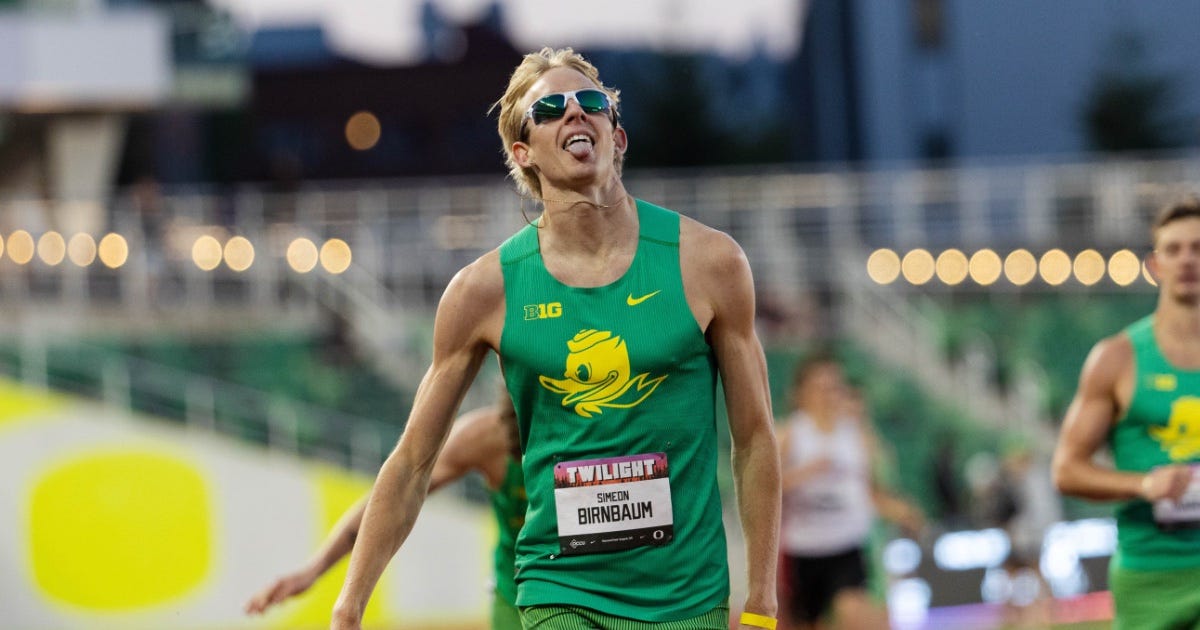
It’s hard not to, however, in the current environment. That’s because the eight fastest college 1500ms of all time have all been run in the last two seasons, including four of the top five in the last three weeks. The newly-minted collegiate record holder is Oregon’s Simeon Birnbaum, who only finished seventh in last year’s 1500m final but took third second in the 3000m indoors and became the first collegian ever to run 3:31 in-season with a stunning eight-second victory at the Oregon Team Challenge in April.
So is Birnbaum the favorite? Surprisingly, that’s a pretty hard case to make. He has three Big Ten titles to his name, but all in longer distances, and had he not just run a huge 1:44.67 800m this past weekend, one could argue he would be better suited focusing on the 5000m and hoping for a tactical race. But now the be-(sun)-spectacled junior has opened his outdoor campaign by running 1:44, 3:31, and 13:19 so it’s hard to call him anything but a contender in any or all distance events.
Besides Birnbaum, there are at least four or five guys with nearly as strong a claim to co-favorite status.
Unless his fate changes this time around, Villanova’s Marco Langon may very well graduate with the dubious honor of being the fastest guy to never win an NCAA title, as he sits at #2 on the 1500m list (3:32.79), #3 on the 3000m list (7:34.00), and #5 on the 5000m list (13:05.21). Could his last season be the one where he finally gets to the line first?
Gary Martin and Colin Sahlman are two guys that’ve already won NCAA titles in other events, but never the 1500m. There’s a good chance one or both of them opt to focus on other distances, but it’s fairly likely that at least Martin will give the 1500m one more go in his senior season. Sahlman has been ripping 800ms all year but skipped the event entirely indoors; perhaps the lack of a distance relay outdoors will entice him to the shorter event. But if he does choose the 1500m, he’s gotta be considered a threat.
The two guys that finished between Cutting and Martin at NCAAs indoors are Trent McFarland of Michigan and George Couttie of Virginia Tech, two runners who’ve been in the mix but never on top on the NCAA scene for a little while now. They don’t have the pedigree of some of the others, but at the same time, it wouldn’t be a shock to see either of them break out.
Last but not least (how’s that for a lede for a section about a guy who is fourth on the all time list?) is Brian Masai of Arkansas. The SEC 3000m champ PRed by five seconds at the Arkansas Twilight meet last weekend, running 3:33.17 for second behind OK State alum Fouad Messaoudi. Masai’s historically been more of a distance guy, but he did anchor the Razorbacks to a runner-up finish in the DMR indoors.
So that’s eight guys who’ve never won a 1500m title but have a legitimate chance to. If they all make the final in Eugene in June (far from a guarantee), it’ll be anyone’s guess who comes out on top. No matter what, the results will be nothing less than epic. If you ascribe to the belief that predictability is anathema to excitement, the collegiate 1500m has never been better. And if you’re the kind of fan that wants to see a record in every race… well, all the fastest guys are running fast right now. There will only be one victor, but everybody wins.
Shanghai Hopes 🇨🇳
Following a week without much in the way of across-the-board high-level track and field action, we’re back, folks. We’re back in a huge way. The Diamond League—once again the king of the pro circuit by default, since the husk of Grand Slam seems unlikely to lure top-tier athletes away—season begins on Saturday.
Though still called the Shanghai Diamond League, the event will actually take place 140 miles away in Keqiao. And while the first few non-European meets on the calendar don’t always attract the same buzz as your Londons or Zurichs or Brusselses, we’re truly excited for what Shanghai/Keqiao will reveal about the state of the sport at this early stage of the season.
Every single event—regardless of weird, nebulous “Diamond+” status—has the potential to be awesome, or at the very least, interesting. Because every event is also essentially kicking off the full season of competition, we’ve boiled down every single contested event this weekend into a bumper-sticker log line for your viewing pleasure:
Men’s Long Jump: The full podium from Tokyo ‘25 is set to compete, which very notably includes China’s own Shi Yuhao, the bronze medalist from Worlds. In an event with as much parity as the men’s long jump, look for the roar of the roughly 40,000 hometown fans to factor in as he attempts to flip the script on Italian gold medalist Mattia Furlani, Jamaican silver medalist Tajay Gayle, and the rest of the talented field.
Men’s Pole Vault: Our shortest preview segment ever: this one has Mondo.
Women’s Shot Put: Going off of current world rankings, the six best throwers in the world will all enter the ring in Keqiao. Of the four women who have thrown past 20m in 2026, only this year’s Indoor World champion Chase Jackson has done so outdoors. Will that small bit of momentum be enough to once again carry her past her many worthy adversaries?
Women’s 5000m: Compared to last year’s highly-publicized sub-four attempt/brand activation, things have been relatively quiet on the Faith Kipyegon front. Last year’s 1500m World champ has raced once in 2026, an under-the-radar but still very impressive 29:47 road 10k debut in Monaco. She won the race outright, but it was really more of a paced hard effort from the looks of it. All that said, anytime the GOAT steps on the track it’s worth tuning in, because there’s a chance she does something wild, like knocking out her first career sub-14 5000m in her track opener. Hilariously, this is not an official DL event.
Women’s 400m: No non-NCAA woman has run under 50 seconds so far this year. Look for Salwa Eid Naser to become the first as she begins her redemption tour following last year’s bronze-medal performance at Worlds. She opened up her 2025 HOT, posting a pair of 48.X quarters before May, so she’s no stranger to early season statements.
Men’s 110m Hurdles: Whether or not we are living in an era of post-Grant Holloway dominance has a lot to do with whether somebody else comes in to assume the mantle. Right now, Cordell Tinch has as much a claim to that throne as anyone, given that in 2025 he was the World champion and world leader in the event. We’ll get our first look at him in meaningful competition here, but last year’s runner-up, Orlando Bennett of Jamaica, Spain’s Enrique Llopis, and Japan’s Rachid Muratake all probably think they’re next up, too.
Women’s Long Jump: Tara Davis-Woodhall will not be here, which means somebody else has to win! Colombia’s Natalia Linares is the only 2025 World Champs medalist we’ll see on the runway, but she’ll have her hands full with three other top-10 world ranked jumpers (including Italy’s Larissa Iapichino, who had the third farthest jump in the world last year), plus American Lex Brown, who has already posted a mark in 2026 that would have tied for the second best in all of 2025.
Women’s Steeplechase: The steeple won’t be contested at the World Ultimate Champs (boo!). And given how close Winfred Yavi came to taking down the world record these past two years, you’ve gotta assume putting Beatrice Chepkoech eight-year-old WR (8:44.32) to rest is just about the only to-do on this list this year. With no Yavi in this one, that means Faith Cherotich of Kenya and Uganda’s Peruth Chemutai will get first dibs at a fast time in what will likely be a strung-out, rabbited affair from the jump.
Men’s 800m: Without any of the Tier-One stars of the event slated to compete, this should be an incredibly fun battle of the wildcards. Australia’s Peter Bol likely comes in as the favorite, but really, you could run this race a dozen times and get a dozen different outcomes thanks to potential spoilers like Ireland’s Mark English, Botswana’s Kethobogile Haingura, Great Britain’s Ben Pattinson, and America’s Brandon Miller.
Men’s Discus Throw: For the most part, dudes just don’t throw over 70m outside of Ramona. That’s not meant to discredit what’s still a very competitive discus cohort currently competing, but it is the narrative. Every time out, then, keep an eye on whether or not somebody like Sweden’s Daniel Ståhl or Slovenia’s Kristjan Čeh can put that notion to bed—for what it’s worth they’ll both be in Keqiao and are the only two non-injured men in the world who went over 70m not in Oklahoma last year.
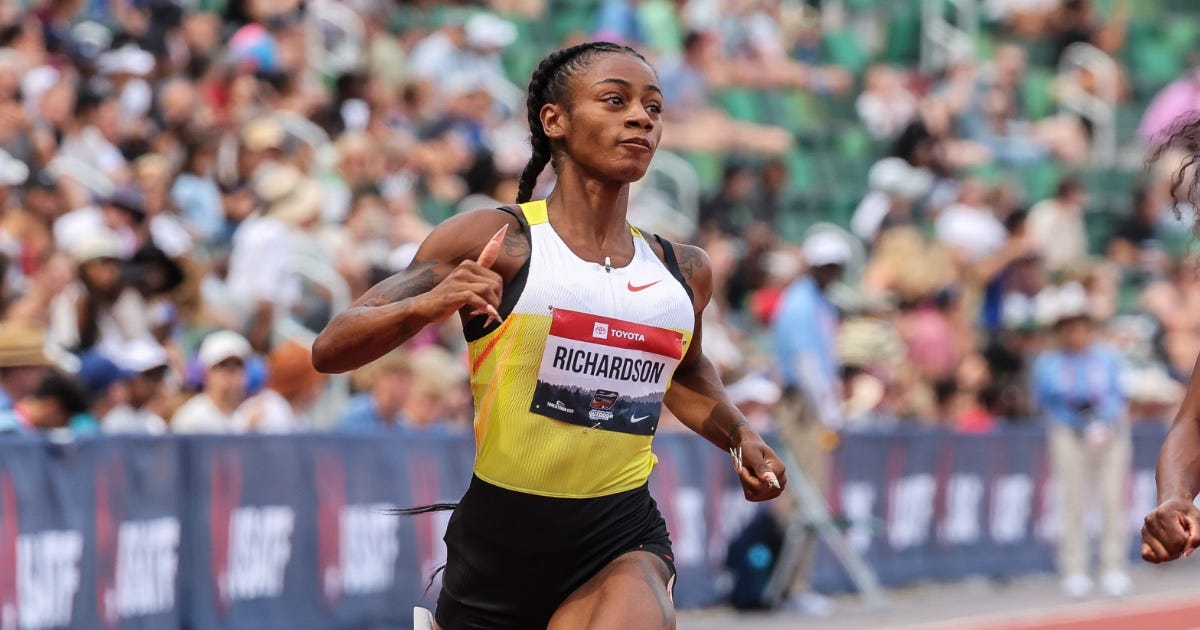
Women’s 200m: This could be the most fun event on the program. We’ve got a nice mix of DL circuit mainstays, up-and-comers, returning world medalists, and established stars looking to prove that they’ve got more in the tank. For America, you have Anavina Battle, McKenzie Long, Jenna Prandini, and Sha’Carri Richardson. Amy Hunt of Great Britain took silver in Tokyo, and just behind her in third was Shericka Jackson—they’ll both line up. Shaunae Miller-Uibo struck Olympic gold back in 2016, when Yujie Chen—just 17 now and the U18 Asian area record holder in the 200m—was a literal child. No matter what happens here, it feels like we’ll be spinning an entire 1,000-word essay out of it next week on the implications.
Men’s 3000m: No shade to the 3000m—or wait, actually, yes shade to the 3000m—but it feels almost like a waste to put a field like this in an event that isn’t really a thing. Oh well. We won’t turn our noses up at the chance to watch Andreas Almgren (who won a DL 5000m, which is A REAL DISTANCE, last year in Stockholm) duke it out with Cheruiyots Ronald and Timothy, Eduardo Herrera, and a slew of other guys who on the right day can make a splash, or at least make things interesting.
Men’s 100m: Even though plenty of guys in this field have already gotten under 10-seconds this outdoor season (Lachlan Kennedy, Ferdinand Omanyala, Akani Simbine), we’ll be more interested in seeing what the season debutants—Kenny Bednarek and Letsile Tebogo—look like here. Simbine tends to burn his hottest at this point in the season, but will the medal merchants show up a little fitter than normal during this atypical year?
Women’s 1500m: With Kipyegon reporting for duty over 12.5 laps, maybe half of the 16 very accomplished milers in this field have a realistic shot at a Diamond League win to kickstart their spring campaign. Jess Hull and hard-closing Claudia Hollingsworth represent Australia’s best shot at a win here; Ethiopia’s got established threats in Birke Haylom and Worknesh Mesele, plus 2024 800m Olympic silver medalist Tsige Duguma will be making her outdoor debut at the distance. Kenya’s Dorcus Ewoi always comes to play, and American Emily Mackay has been on something of a heater since February.
Men’s 300m Hurdles: Another weird distance, another great field. We’ll get our first look at Karsten Warholm following his surprise fifth-place showing at Worlds last summer. Even if he’s in great form, he’ll have to contend with the likes of Alison Dos Santos. If either of these two perennial global medalists are a step slow, it’s anybody’s race.
Women’s 100m Hurdles: If the parity in men’s longer hurdling comes from the absence of Rai Benjamin and a reshuffling around him, things are far more exciting in the women’s high hurdles. Five of the finalists from Worlds last year are in this field, and the worst world ranking of anyone competing—aside from the obligatory host country entry—is 11th. This is an impossible event to build much momentum in right now because of just how deep and good everyone is. Masai Russell has the world lead at the moment, but you’ve gotta assume that even if she retains it after Saturday, it’ll be a quicker time than the 12.40 she posted in Kentucky earlier this month.
There’s something for everyone, particularly if you’ve been starved for some good ol’ fashioned pros racing pros. In America, that will require a Flotrack subscription, an alarm clock, and a coffee maker, as the paywalled meet is set to start at 7am E.T. on Saturday. But start it will, and with it, an unusual pro season full of intrigue.
The Inherent Problem With The 400m Hurdles For American Dudes 🙇♂️
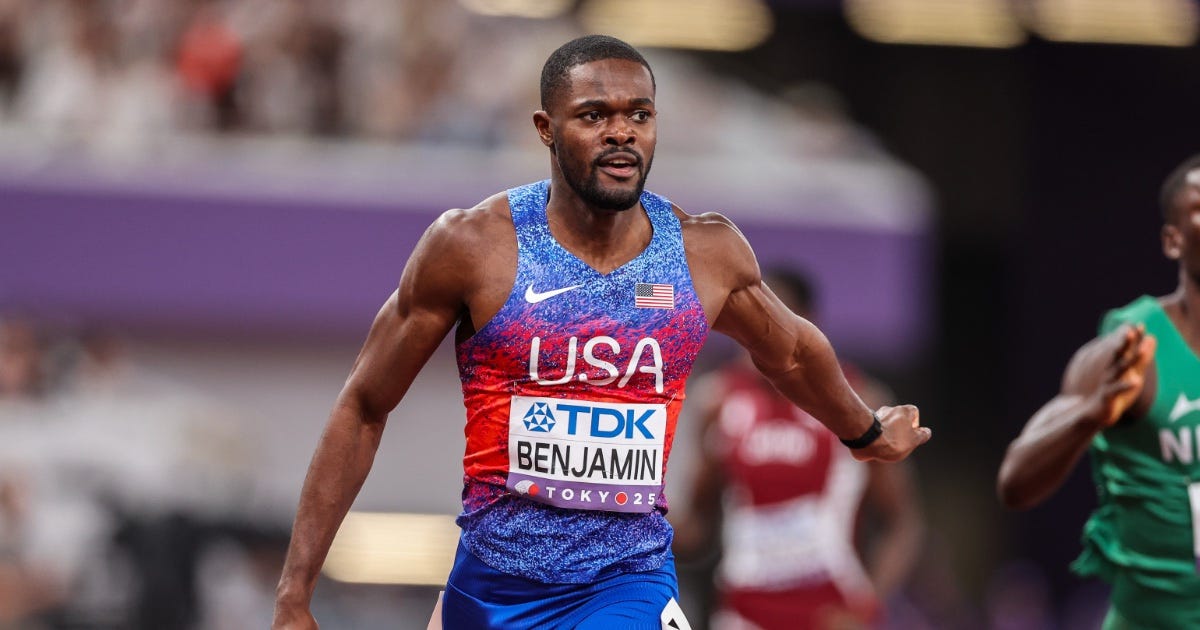
Don’t point fingers at Rai Benjamin… It’s not his fault… but the U.S. men have a 400m hurdles problem.
Okay, maybe it is Rai’s fault, just a little bit. Let’s get into why.
The United States has a storied tradition in the 400m hurdles, dating way back to the Paris Olympics… not that one, the one held 126 years ago. The event was first introduced at the 1900 Olympics, and its inaugural champion was Walter Tewksbury who ran 57.6 seconds over what then became the standardized 10 hurdles. (He also medaled in the 200m, 60m, 100m, and 200m hurdles, which arguably makes it less impressive because it seems like those fields were comprised of chainsmokers suffering from whichever vitamin deficiencies were fashionable at the onset of the previous century.)
A whole lifetime later, the event came to be dominated by American Edwin Moses, who in addition to winning two Olympic gold medals, a bronze, and two World Championships, went on an incredible streak of 122 consecutive wins. Eventually his world record was broken by California’s Kevin Young, whose Barcelona Olympics-winning 46.78 would stand for almost 29 years. In 2008, the American trio of Angelo Taylor, Kerron Clement, and Bershawn Jackson swept the Olympic podium and only deepened the legacy of great 400m hurdlers.
An American man has won 50% of all possible Olympic medals in the event.
But is the world catching up? Like most events in track and field, times are quickly getting faster. For the 400m hurdles, the 30th fastest time in 2025 was 48.45, compared to 49.03 in 2016.
Although depth has improved, it has been an event dominated by a few names for quite a few seasons. Aptly named “The Big Three” there is no question who has run the tables the past seven seasons. Since 2019, there have only been six men to win a medal at a global championship:
Rai Benjamin (6)
Karsten Warholm (5)
Alison dos Santos (4)
Kyron McMaster (1)
Abderrahman Samba (1)
Trevor Bassitt (1)
In addition to winning medals, the trio has established the three fastest times in history and Kevin Young’s once seemingly unbreakable record is now a paltry 26th on the descending order.
This is not to say the event is boring—it’s anything but! These are three wildly entertaining personalities and with an American, European, and South American trading blows year after year, there are global rooting interests.
The concern for Americans, however, is outside of our dominant leader (who at any point is liable to abandon hurdling for road cycling) that the depth—and crucially, investment in the event—is fading. At the 2025 US Championships there were 25 qualified individuals, yet only six of those individuals had a shoe contract. During the 2024 U.S. Olympic Trials, only three of the 27 qualifiers had a shoe sponsor. Are shoe deals the best proxy for the quality of an event at a given time? Hardly… ask just about any thrower. But we’ll come back to the significance of these figures.
Is it the chicken or the egg? On the international stage, the American advantage is deteriorating quickly. While in 2008, eight of the top 12 times in the world were owned by an American, that dwindled to just four of the top 15 in 2025.
The flip happened around 2019 when the 10th fastest American matched up with the 30th fastest man in the world. In 2025, the 10th fastest American was 58th in the world. This is a great sign if you’re Seb Coe as World Athletics continues to invest in popularizing and expanding the sport in all corners of the globe. In contrast, an American hurdles fan may not be feeling quite as idealistic about such stats.
So what’s happening?
Well, at least in the U.S., the 400m hurdles is often introduced to versatile athletes as a way for coaches to score points to win meets. This past weekend, for instance, the best prep quarter miler in American history, Quincy Wilson, ran the 300m hurdles in 38.77 for the first-time ever to help his high school team win their conference meet.
The NCAA has long been the entry point for many 400-meter runners to add some jumping in the middle, but the collegiate system—formerly the U.S.’s developmental secret weapon—is no longer a secret to international talent. In 2016, only six men broke the 50-second barrier and all but one were American. In comparison, there were seven non-Americans who dipped below 50 seconds in 2025.
Now let’s get back to talkin’ turkey, and by turkey, we mean an entry-level shoe deal that might amount to essentially a meager stipend plus gear and some travel. Imagine you are an American quarter-miler considering what event to focus on as a post-collegiate athlete chasing the dream.
In the 400m hurdles there is relatively little interest from shoe companies, and as long as Rai Benjamin lives and breathes and can still get over the hurdles at a respectable clip, there are only two spots up for grabs. Plus, it’s a gamble. What if you invest a year of your prime to hurdle-specific training, only to discover you are godawful at it?
Now look at the open 400m, which has three spots that seem to be doled out via random number generator—15 different men have qualified since 2019. Then consider that there is a 4x400m squad AND, since 2019, a mixed-gender relay. Just making the U.S. final is essentially a lock to earn a World or Olympic medal! Plus, it’s comfortable: it’s the event you’ve specialized in since you were a 10-year-old on the AAU circuit.
Which event are you choosing?
The United States being slightly less deep and dominant at the 400m hurdles is not a huge problem in the grand scheme of things. Having a diversity of countries being competitive on the international stage is ultimately a good thing for the sport. And this “issue” is one without any real blame to assign. Like all of us, athletes chase after opportunities where they can win and get paid.
Ironically, Rai Benjamin himself has never really needed to explore his other options. But this season, in what is one of the most intriguing storylines of 2026, he is opting to. The defending World/Olympic champ is dipping his toes into the 200m in an effort to produce the fastest flat 400m times of his career. The rest of the world may no longer have an American 400m hurdler problem, but the quarter milers are about to find out if they have a Rai Benjamin problem.
More News From The Track And Field World 📰
– At the U.S. 25K Championships in Grand Rapids, Andrew Colley (1:14:00) and Emma Grace Hurley (1:22:51) took top honors. That’s two U.S. road titles for Hurley this season, and a perfect four-for-four podium finishes. Just in case nobody has made this awful, awful joke before, here goes: “maybe Emma Grace should call herself ‘HURLEY-DAVIDSON’ because she sure does excel on the roads!”
– Jimmy Gressier, last summer’s surprise 10,000m World champion did the expected and dominated the French 10k Road Champs. He clocked in at 27:47, which was about a minute ahead of second place.
– Rachel Entrekin won the Cocodona 250—the 250 mile sufferfest from Black Canyon City to Flagstaff in which runners scramble up roughly 40,000 feet of accumulated vert—outright. It was her third time winning the women’s race, and the first time in race history that a woman was the overall winner.
– Yes, yes, at the Franson Last Chance meet in Azusa, Marco Langon went 3:32.79—the second fastest NCAA mark ever. But we also want to note that in second was Jake Heyward, who went 3:34.18 and shaved over three seconds off last week’s season opener… which was his first race since 2022!
– 60m hurdles GOAT Grant Holloway revealed on Instagram that he tore his hamstring in March, which kept him from competing all indoor season and, thus far, has kept him out of the mix outdoors as well.
– In happier hurdler news, four-time World/Olympic medalist Jasmine Camacho-Quinn announced she’s pregnant and will presumably miss the 2026 season. Congrats!
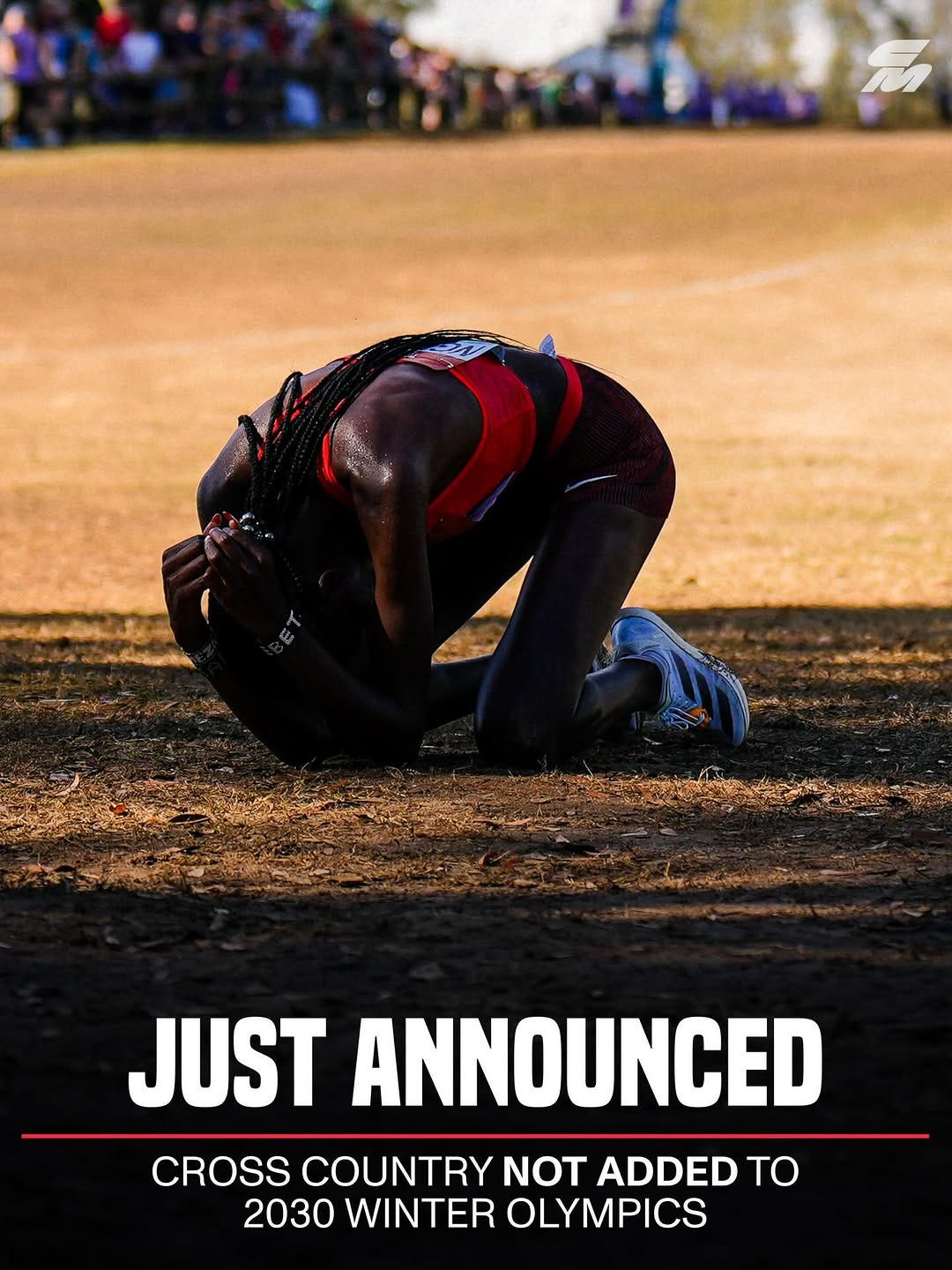
– Go ahead and return your one-of-one “CROSS COUNTRY IS A WINTER OLYMPIC SHIRT” to the bottom of the drawer. There will be no cross country at the Winter Olympics in 2030.
– Gout Gout was featured on 60 Minutes, and regardless of where you stand on his controversially blustery 200m performance from last month, you can’t deny the kid has charisma! (Watch the full interview here.)
– And lastly, a GoFundMe has been started for Fast Women’s Alison Wade, to help provide a bit of financial stability for her family following the sudden and tragic death of her husband, Parker Morse.
Interested in reaching 20,000+ dedicated runners and track and field fans? Advertise with us here.
Can you have place where you tell us how to watch all the great races that are coming up please.